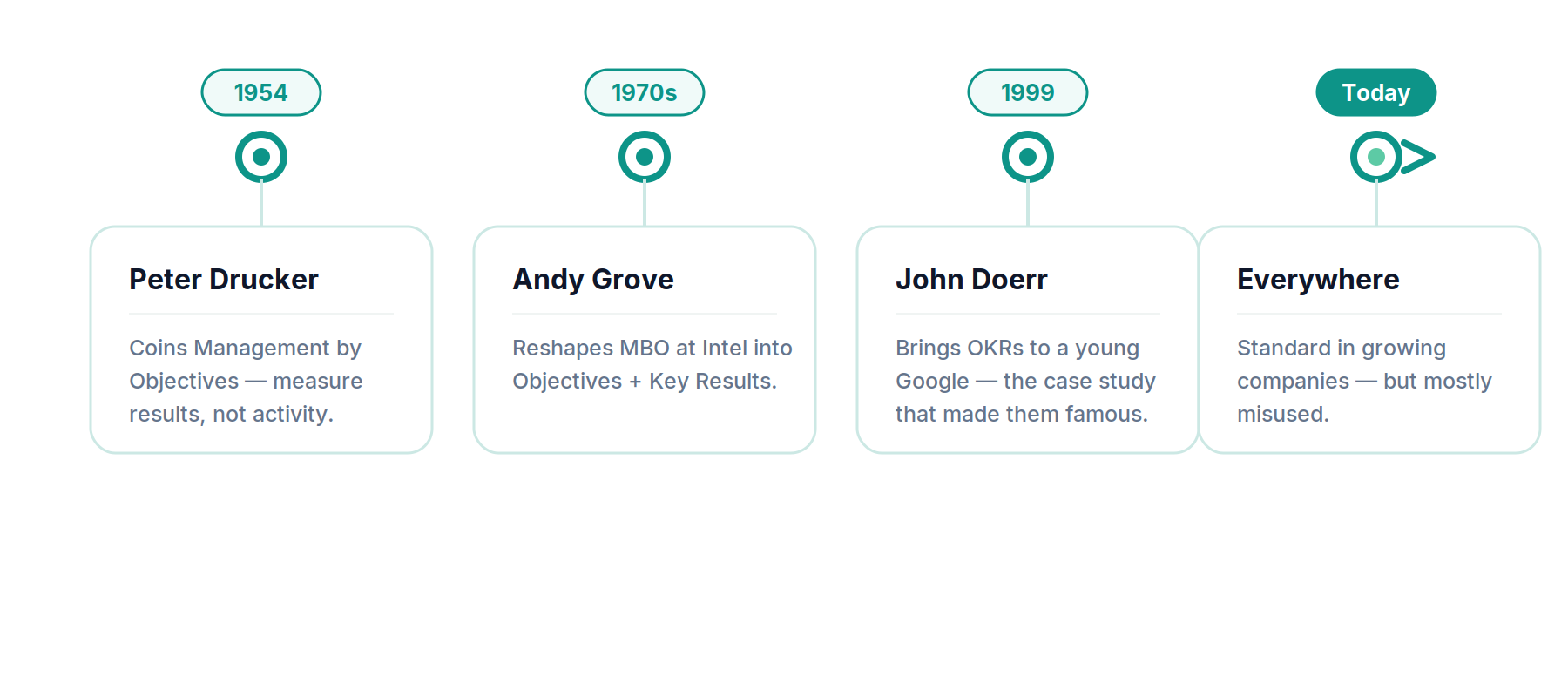
If you look at global Google search data for “OKRs” from 2004 through today, the pattern is unmistakable.
Interest sits close to zero until around 2013, climbs steadily through the mid-2010s as the methodology spreads beyond early adopters like Google and Intel, and then jumps sharply around 2022 before stabilizing at a much higher level.
As of 2026, interest reaches its highest point yet.

By any reasonable measure, OKRs have never been more widely adopted. More companies are experimenting with them, more teams have received training, and an entire ecosystem of software has emerged to support the methodology.
At the same time, a quiet countertrend is happening inside many of those same companies. The same quarter that introduces OKRs to a new team often produces another group of leaders who conclude that the system simply does not work for them. ‘
They tried it, ran a cycle or two, and eventually moved on.
That combination - rapid adoption paired with persistent failure - is the real story behind OKRs right now. Understanding why it happens matters far more than debating whether OKRs are a good idea in theory.
Why Interest in OKRs Spiked After 2022
The surge in OKR interest around 2022 did not happen randomly. It closely tracks a structural change in how knowledge work operates after the pandemic.
Before 2020, many growth-stage companies relied heavily on informal coordination. Teams shared offices, overheard conversations, and developed a kind of ambient awareness about what the organization was doing. Alignment often existed less as a formal system and more as a byproduct of proximity.
Once remote and hybrid work became widespread, that informal layer disappeared. Leaders suddenly realized how much of their perceived alignment had been supported by physical presence rather than explicit structure.
Without those informal signals, it became much harder to answer simple questions about execution. Which teams were actually moving toward the company’s priorities? Where were initiatives stalled? Which objectives were drifting off course?
OKRs gained attention in that environment because they offered something companies were suddenly missing: a structured way to make priorities visible.
The surge in interest was not a passing management trend. It was a response to a real operational problem that became impossible to ignore once distributed work removed the informal coordination layer that had quietly supported execution.
The Adoption–Execution Gap
Although adoption has increased dramatically, the way most organizations implement OKRs tells a very different story. Our research across growth-stage companies reveals a few patterns that appear again and again.
- 67% of organizations still use spreadsheets as their primary OKR tracking system. Despite the availability of OKR software, most teams rely on Excel or Google Sheets. These tools provide flexibility but offer little support for ownership, accountability, or real-time visibility.
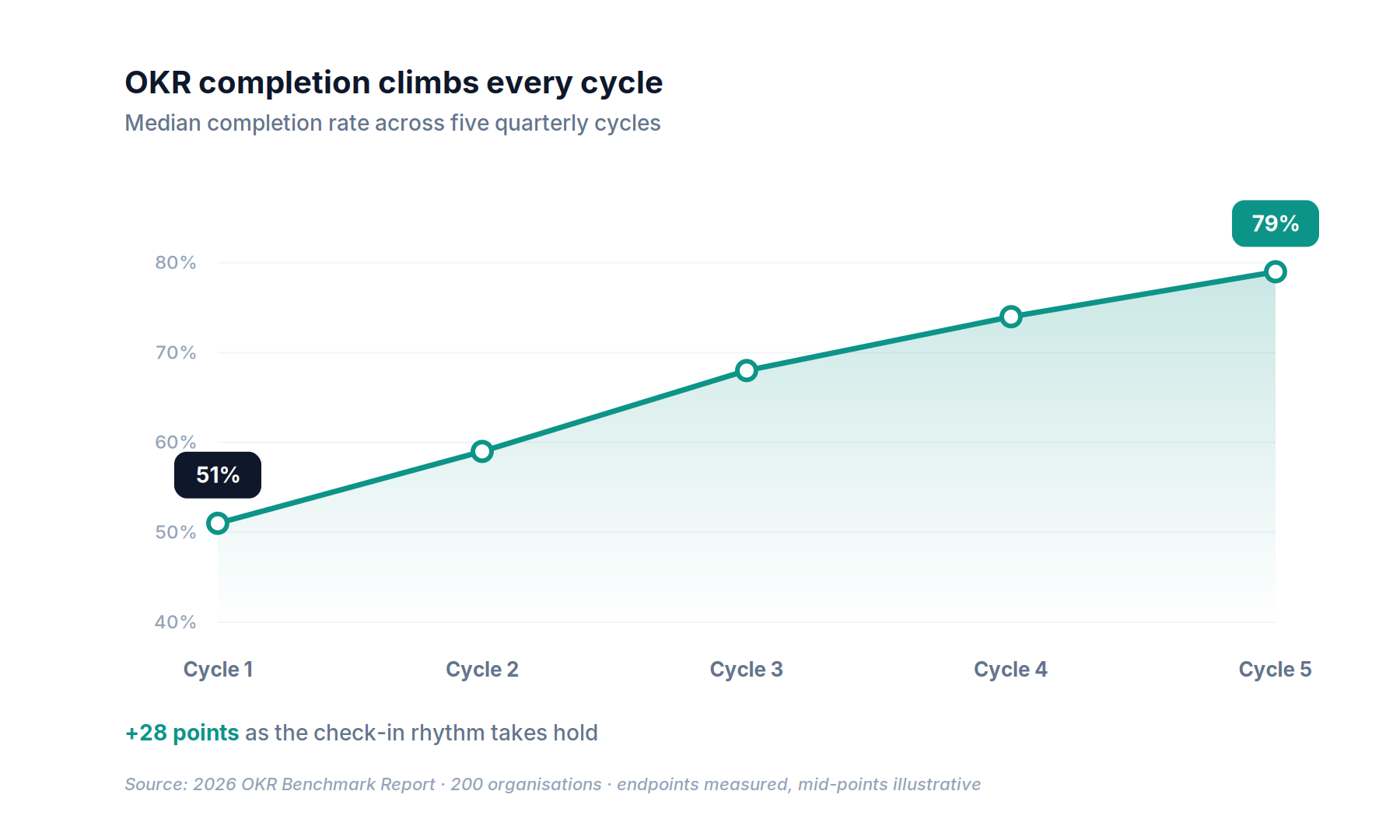
- Weekly check-ins dramatically improve outcomes. Organizations that review OKRs every week are 43% more likely to achieve their goals compared with teams that review progress bi-weekly or monthly.
- Most companies do not maintain a weekly cadence. The typical pattern involves bi-weekly updates at best. Many teams update their goals monthly, while others only revisit them at the beginning and end of the quarter.
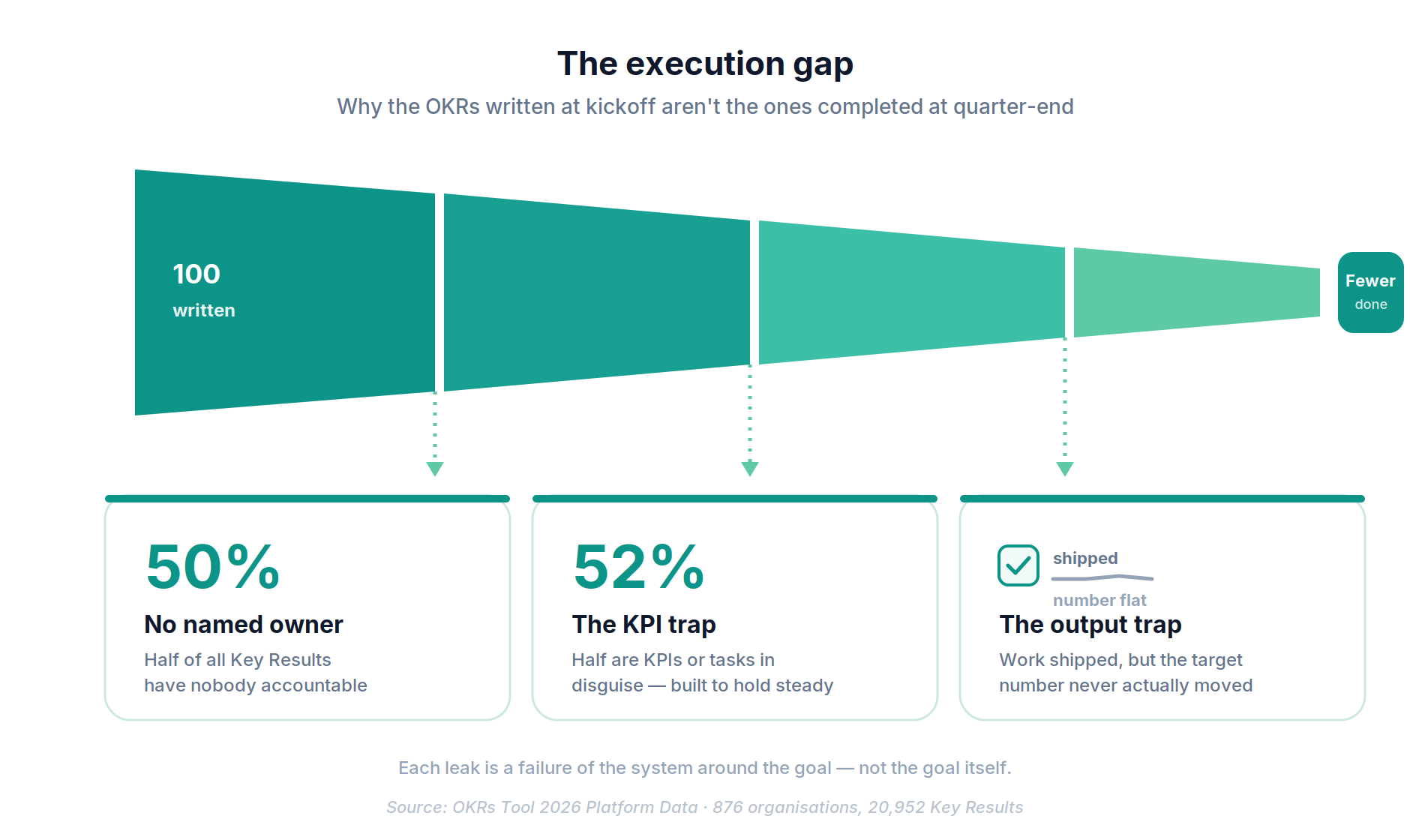
Taken together, these numbers highlight the gap between adoption and execution. Many organizations have adopted the language of OKRs without building the infrastructure required to sustain them.
They are attempting to run a system that depends on consistent weekly engagement using tools that make that engagement expensive. When the process becomes difficult to maintain, the cadence collapses and the system gradually loses credibility.
When OKRs “Fail,” What Actually Failed
This distinction becomes important when companies conclude that OKRs do not work.
In many organizations the process unfolds in a familiar pattern. Teams invest time in a quarterly planning session, define ambitious objectives, and document their key results in a spreadsheet or internal document.
After the planning session ends, daily execution quickly takes priority and the goals receive little attention until late in the quarter.
By the time teams review progress again, many objectives are either stalled or already out of reach. The retrospective conversation often includes a familiar commitment to improve the process next quarter.
From the outside, the conclusion seems obvious: the OKR system failed.
In reality, the methodology was never fully implemented. What failed was a particular version of the system - usually one with no ownership enforcement, no structured update cadence, and limited visibility into progress during execution.
The principles behind OKRs remain sound. Clear objectives, measurable outcomes, and shared visibility into progress are all practices that improve execution when applied consistently. The challenge lies in sustaining those practices week after week.
What “Running OKRs” Usually Looks Like
One reason the debate around OKRs can feel confusing is that the phrase “running OKRs” describes wildly different realities inside different organizations.
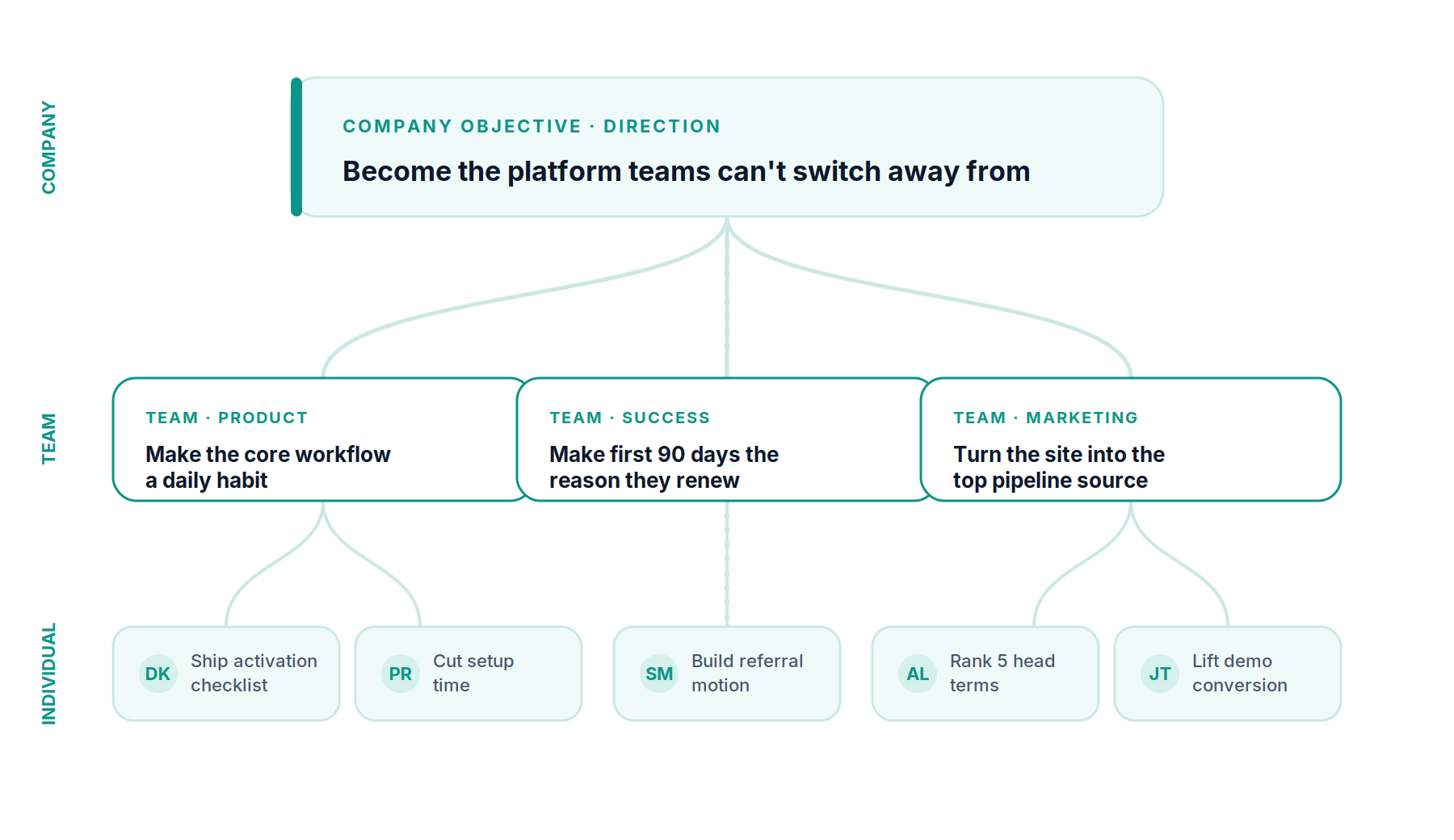
Some companies treat OKRs primarily as a planning exercise. Leadership defines objectives during quarterly planning, teams align their own goals, and the results are presented briefly in an all-hands meeting before disappearing into a shared document.
Other organizations operate very differently. Objectives remain visible throughout the quarter, key results are updated regularly, and progress informs real decisions about priorities and resources.
Most growth-stage companies sit somewhere between these two extremes, although many lean closer to the planning-only model.
What often surprises leaders is that the quality of the initial goals matters less than how consistently the system is used afterward. A modest set of objectives that receives weekly attention will outperform a beautifully written plan that no one revisits until the end of the quarter.
Execution cadence ultimately determines whether OKRs become an operational tool or a planning artifact.
Why Many OKR Tools Miss the Mark
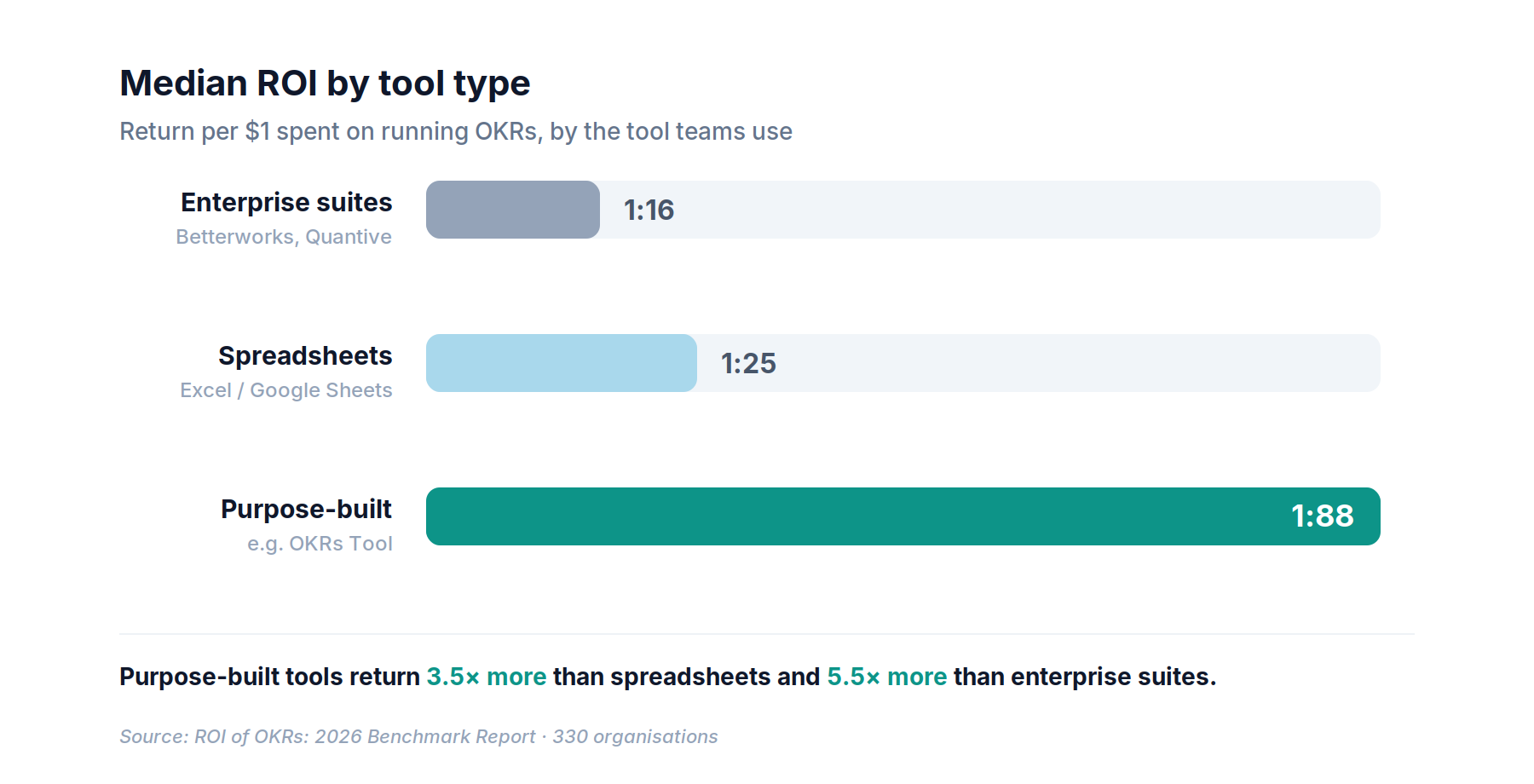
The rapid increase in OKR adoption also created a surge of new software platforms. Many of the early tools were designed for large enterprises that needed extensive governance and reporting capabilities.
When those same platforms were adopted by smaller growth-stage companies, the experience often felt heavier than expected.
Features such as complex onboarding processes, mandatory reporting fields, approval workflows, and dashboards designed for executive review introduced more overhead than many teams were prepared to manage.

The result was predictable. Teams started the quarter with enthusiasm, gradually disengaged as the administrative burden became clear, and eventually abandoned the system altogether.
The continued reliance on spreadsheets is not simply a sign that companies are unaware of OKR software. In many cases it reflects the opposite: teams tried a platform and found it required more effort to maintain than the spreadsheet it replaced.
The Opportunity Hidden in the Adoption Surge
Despite the challenges, the surge in OKR adoption represents a meaningful opportunity.
The underlying forces driving interest in the methodology are unlikely to reverse. Distributed work, cross-functional execution, and the complexity of scaling beyond fifty employees all increase the need for clear, visible priorities.
The real opportunity lies in the gap between interest and execution.
Many companies experimenting with OKRs today are struggling not because the framework lacks value, but because their implementation stops short of the operational practices that make the system effective.
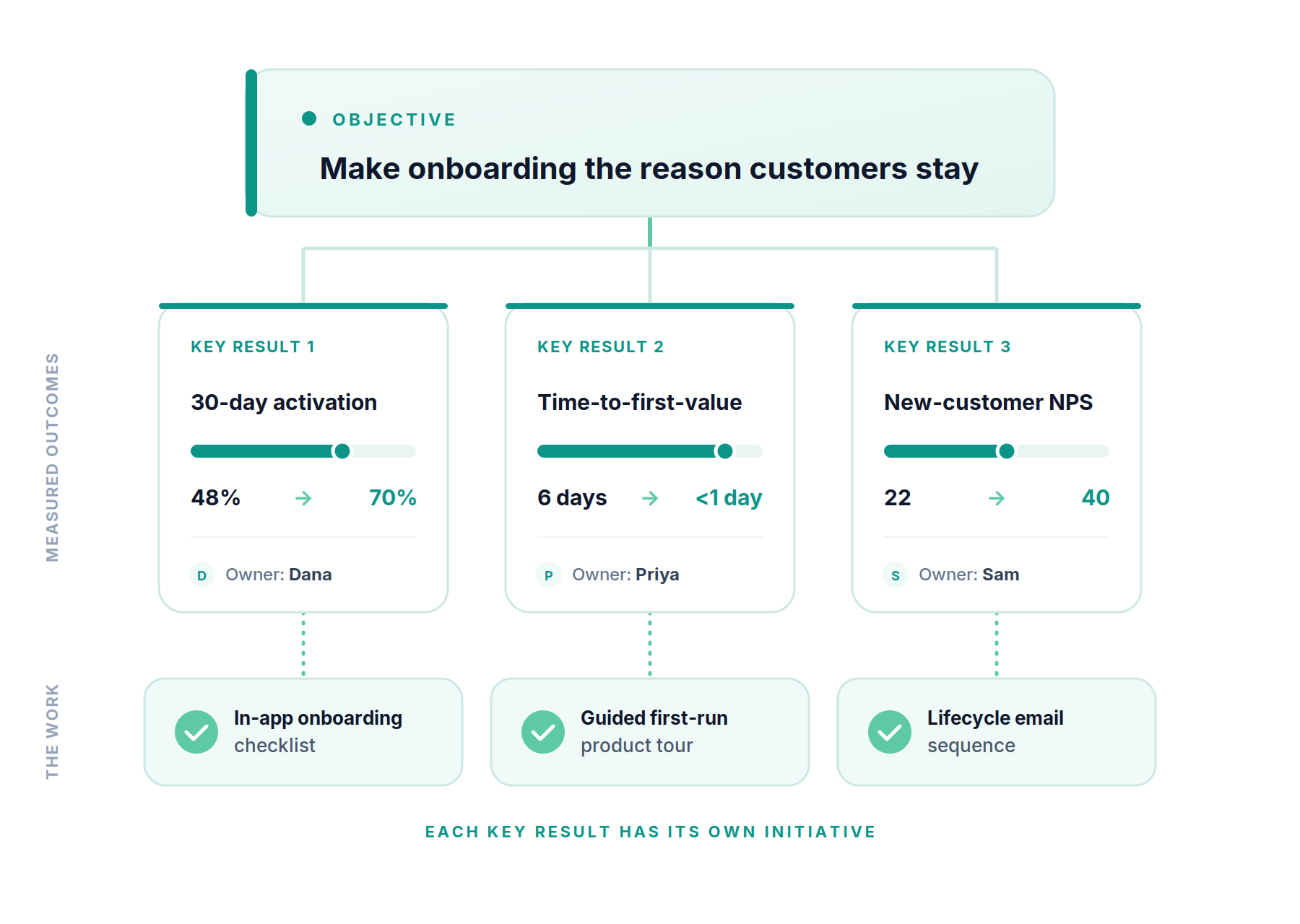
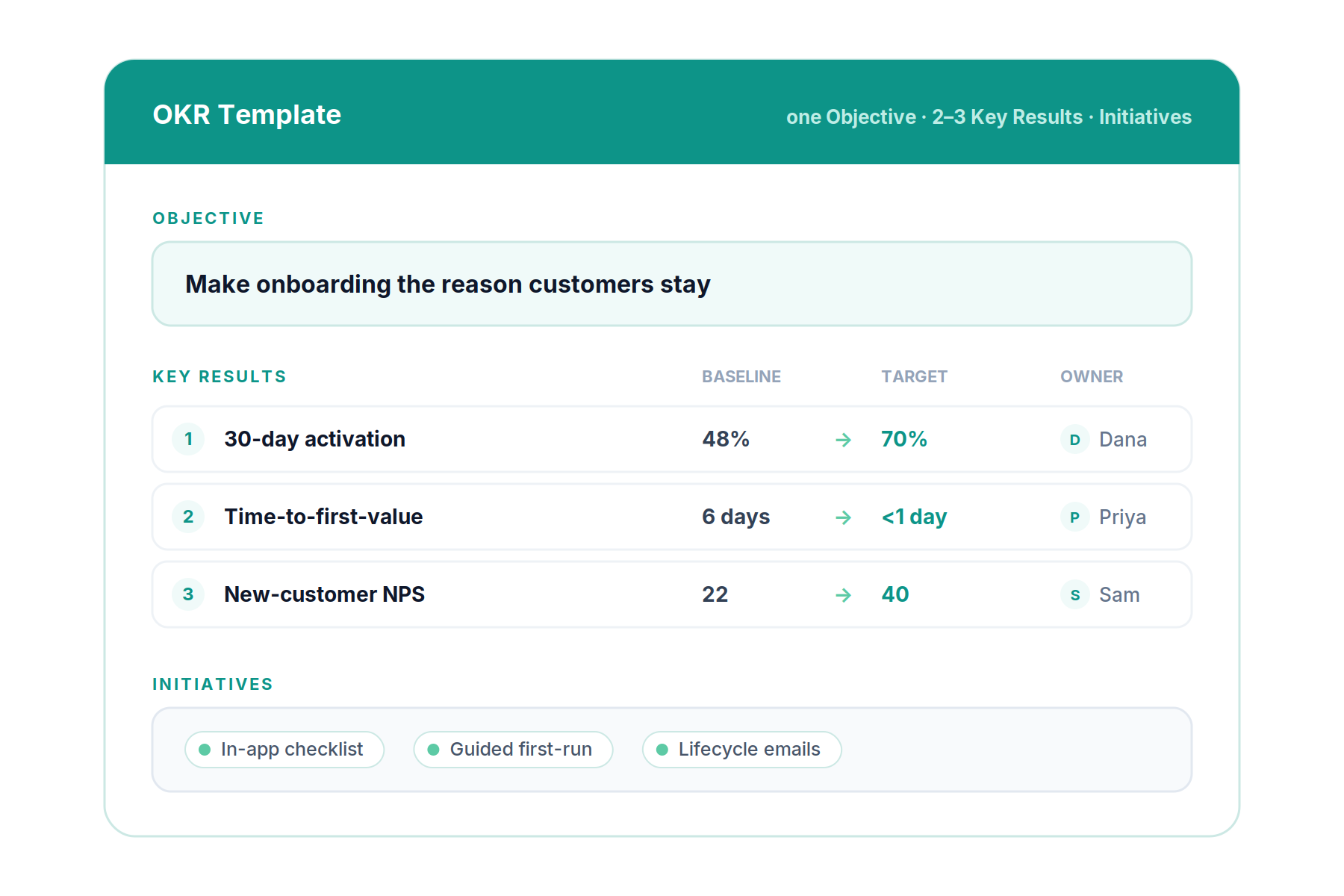
In practice, the fundamentals that distinguish successful OKR systems are relatively straightforward:
- weekly progress updates
- clear ownership for each key result
- shared visibility across teams
- minimal reporting overhead
When these elements are in place, OKRs shift from being a planning exercise to becoming a real execution system.
The organizations that benefit most from the current wave of adoption will not necessarily be the ones with the most sophisticated planning processes. They will be the ones that build a system simple enough for teams to use consistently.
Weekly visibility into progress changes how companies execute. Problems surface earlier, adjustments happen faster, and leaders gain a clearer view of where the organization is actually heading.
That consistency - not the elegance of the initial plan - is what ultimately determines whether OKRs deliver on their promise.