
27% of technology companies of 50–200 people are considering OKRs right now, and 22% have already looked and decided against them. Adoption is decided early: organizations whose first key result stays at zero stop adding goals after a median of four days, and 78% of OKR stalls happen in the first three cycles, so a rollout needs a plan for both windows.
Ask a room of operations leaders about OKRs and the answers split four ways. In the Goal-Setting Benchmark, 21% of 280 companies already used them, 27% were considering them, 22% had looked and decided against them, and 30% hadn't looked or weren't sure. For the largest group, the ones considering OKRs now, the open question is how to make them stick once they start.
Our data says the answer is decided in two windows. The first is the opening days of the first cycle, when a first goal either gets moving or gets left, and the second is cycles two and three, when the launch energy runs out.
Where Companies Stand on OKRs
Interest in OKRs is high among growing companies, and so is the share that has already tried and passed.
Only 4% of companies in the Goal-Setting Benchmark named OKRs as their primary framework, so most of the 21% using them run OKRs alongside something else. The 22% who looked and passed matter most for anyone planning a rollout, because they show how often a first look at OKRs ends in a no, and why the first attempt needs to work.

Adoption Is Decided Early
Two pieces of our research point to the same conclusion: OKR programs are won or lost near the start.
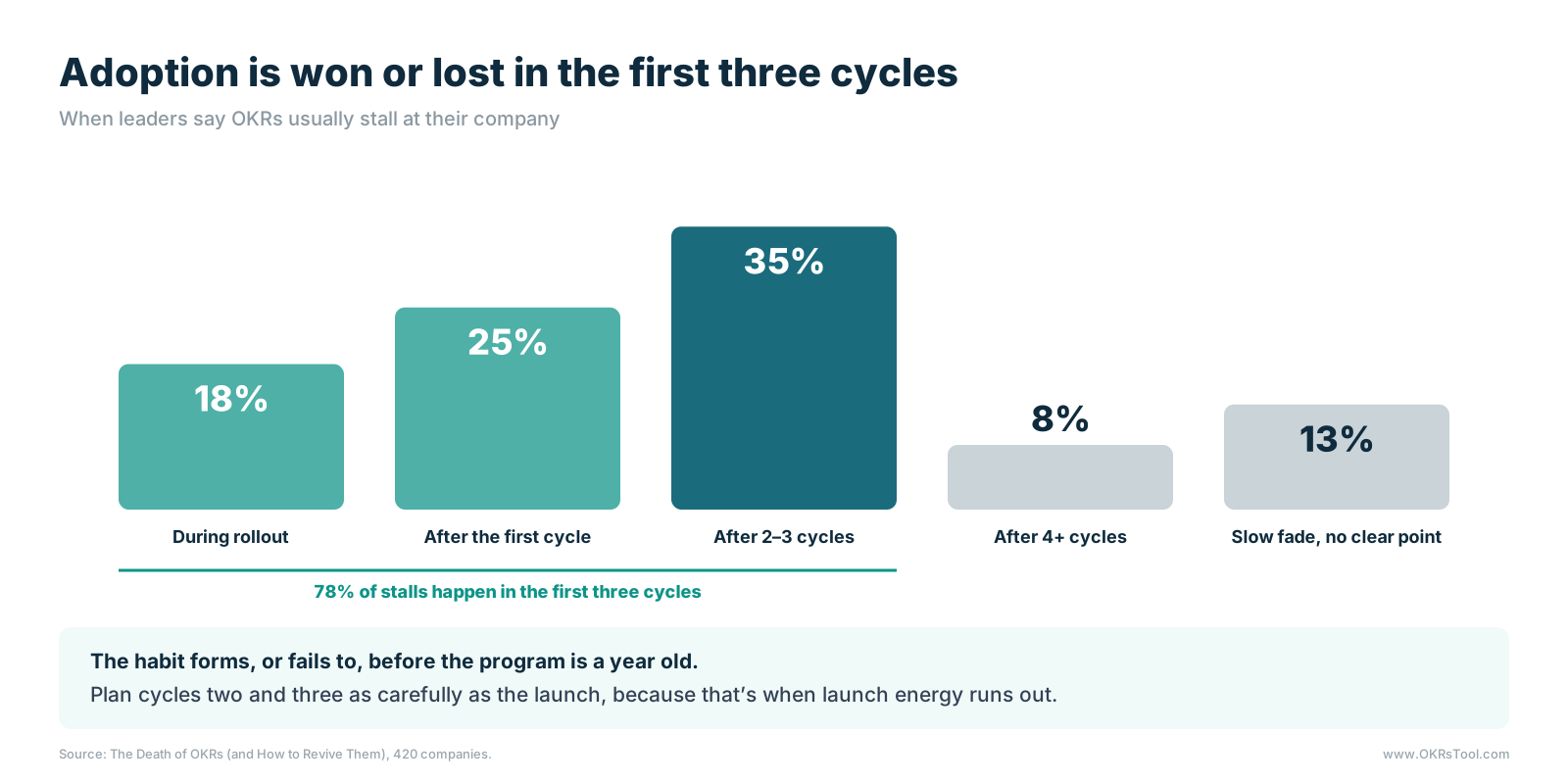
In The Death of OKRs, a survey of 420 operations and strategy leaders, 78% of stalls happened in the first three cycles, peaking after the second or third once the launch energy had gone. Our platform data shows an even earlier danger point.
Across 29,987 key results, organizations whose first-ever key result stayed at zero stopped adding new goals after a median of four days, against 32 days for organizations whose first key result hit, and 58% of the goals they set afterwards also died at zero. That first goal is the strongest single predictor of why OKRs fail in our data.
The plan below is built around those two windows: the first 30 days, and cycles two and three.
The First 30 Days
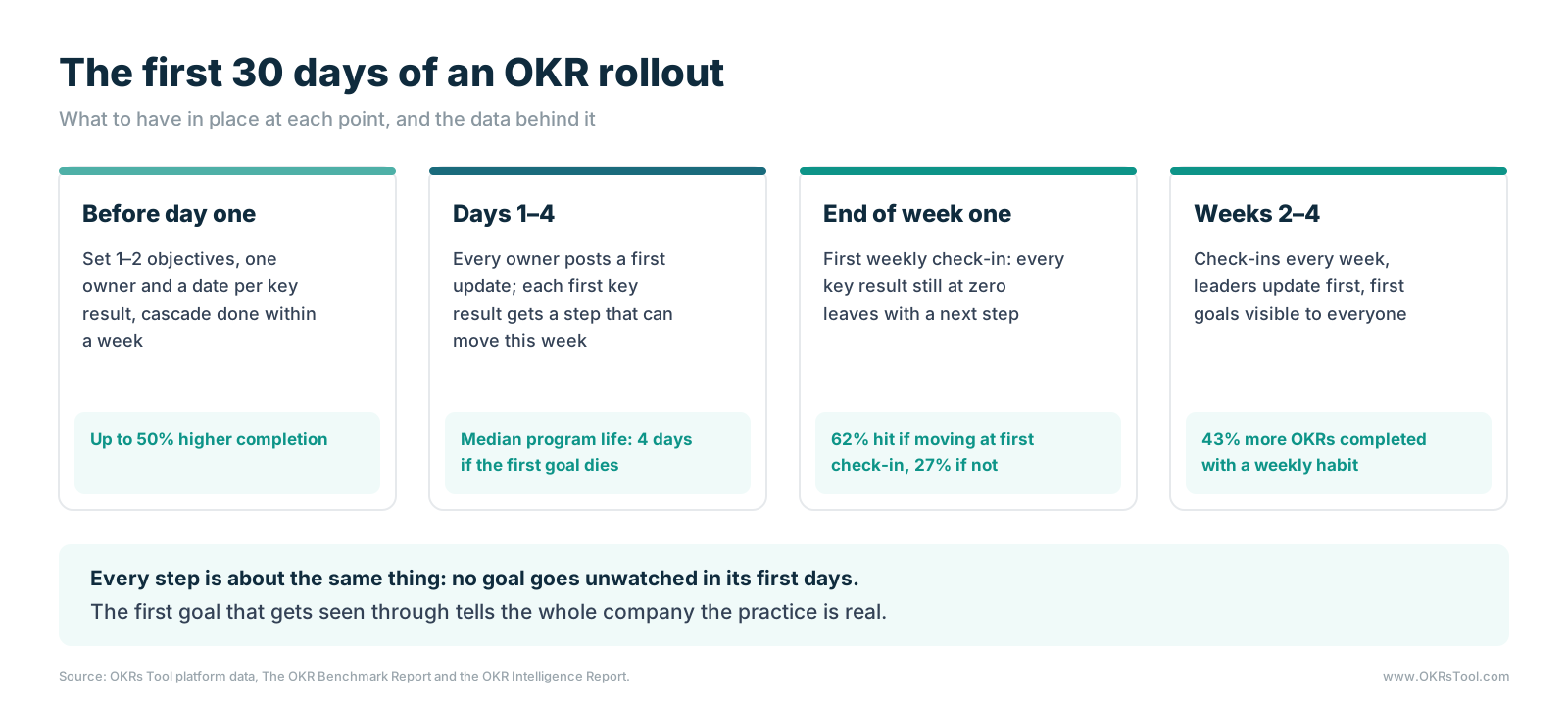
Each step in the first month has one aim, which is making sure no goal goes unwatched in its first days.
Before Day One: Set Up for a First Win
Start with one or two objectives. Teams running one or two objectives per quarter are twice as likely to achieve them as teams running three or more, according to The OKR Benchmark Report, and a first cycle is the worst time to spread attention thin. Setting the right number of OKRs matters most when the team is still learning the rhythm.
Let leaders set the first goals. The first goals a company sets are usually the leadership team's and the most visible in the business. On the platform, organizations whose first key result was seen through went on to hit 53% of their later key results, against 24% when it fell short, so the first goals deserve the leadership team's full attention.
Teams then draft their own key results under those objectives, because companies that set strategy collaboratively stopped OKRs on a team 40% of the time, against 53% where the exec team set it alone, which is the case for mixing top-down and bottom-up OKRs.
Give every key result one owner and a date. Teams with every OKR owned hit their goals very consistently 65% of the time, against 17% without, and key results with an explicit timeframe hit their target 67% of the time on the platform, against 51% without one. Both belong in the key result before it goes live, alongside a baseline and a target, as set out in how to write OKRs.
Finish the cascade within a week. The OKR Intelligence Report found that teams launching within one week of the quarter start see up to 50% higher completion, and only 16% of organizations complete the cascade that fast. One half-day session for company objectives, with teams drafting key results in parallel over the next two or three days, keeps it inside the week.
Days One to Four: Get Every Goal Moving
The platform data puts the first danger point inside the first week, so the first four days carry the most weight of the quarter. Ask every owner to post a first update, even a short one, and make sure each first key result has a step that can show progress before the first check-in. Leaders go first here too, because a leadership goal updated on day two tells every team the practice is real, which is where leadership accountability for OKRs starts.
End of Week One: The First Check-In
Run the first weekly check-in and start with one list: every key result still at zero. Key results already moving at their first check-in hit their target 62% of the time on the platform, against 27% for those still at zero, so each one on the list leaves the meeting with an owner, a next step and a date for the next update.
Weeks Two to Four: Build the Habit
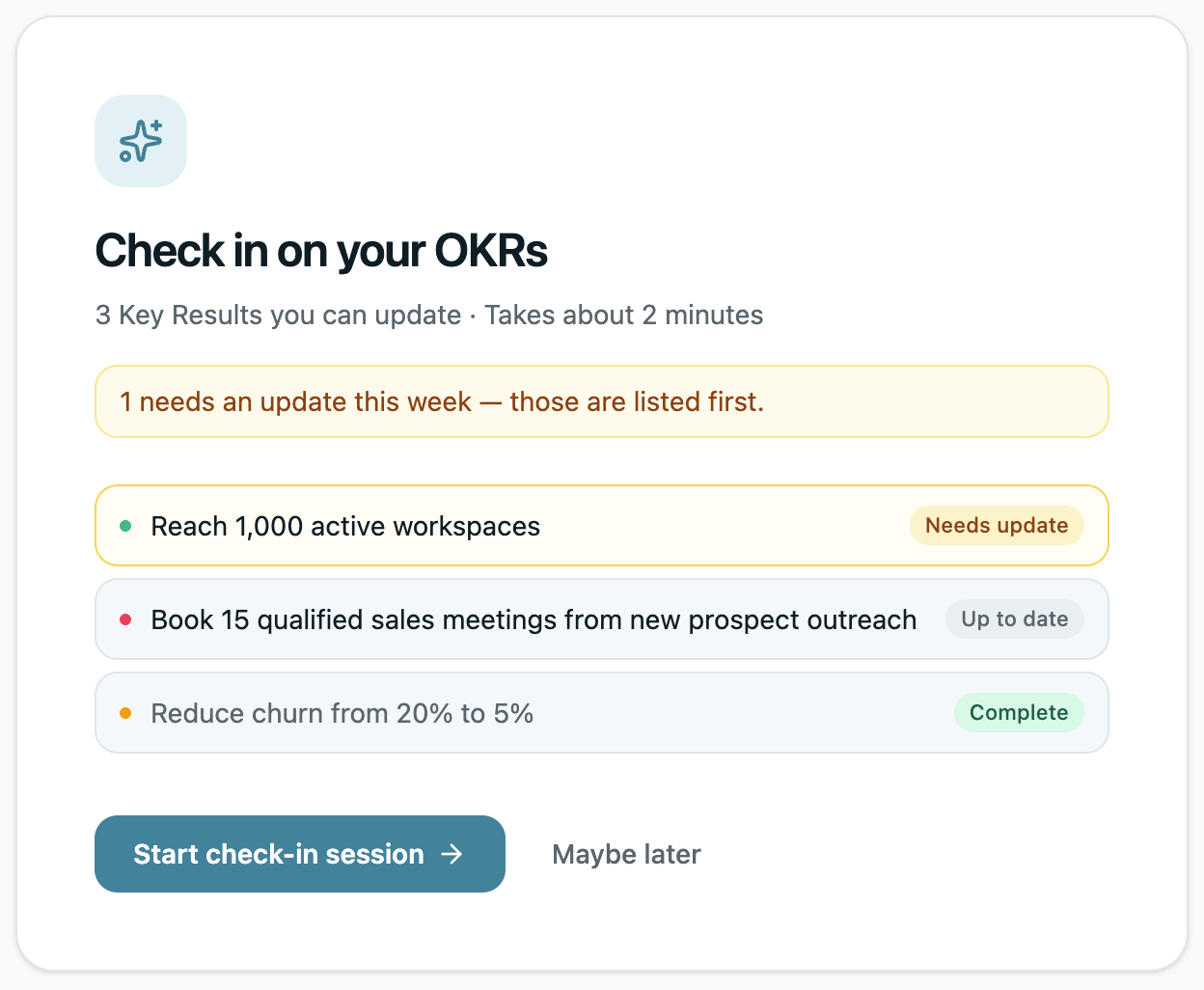
Teams with a weekly check-in habit complete 43% more OKRs, according to The OKR Benchmark Report, and the habit forms in these weeks or not at all. Keep the check-in short and at the same time every week, send reminders automatically so nobody has to schedule it, and put the first goals on an OKR dashboard the whole company can see.
The OKR Pacing Benchmark found that key results that hit their target were typically at 50% by week four, so the end of the first month is a fair point to check which goals are on pace.
When the first key result lands, say so in front of the company. Celebrating early OKR wins turns one result into evidence that OKRs work here, and that evidence carries into everything set afterwards.
Cycles Two and Three: The Second Danger Zone
A program that survives its first month still faces the most common stalling point. In The Death of OKRs, 35% of leaders said OKRs usually stall after two or three cycles, and among companies three to eight cycles in, 56% had stopped OKRs on at least one team. Past nine cycles, that falls to 22%.
The causes shift as a program ages. Early stalls come down to confusion, with lack of clarity and low engagement leading the list. Later stalls come down to overload, as the share naming too many goals rises from 37% to 56% and goals pile up cycle after cycle unless someone removes them. Three habits carry a program through this stretch:
- Close every cycle with a decision. Half of all OKR endings in The Death of OKRs happened with nobody deciding. A retrospective that gives each OKR a continue, change or stop verdict cuts silent endings from 64% to 41%, and teams running structured retros complete 30–45% more goals the following quarter.
- Prune before adding. Review the goal count at every planning session and retire what didn't work before writing anything new.
- Move off spreadsheets before the habit depends on one person. Companies tracking OKRs only in spreadsheets stopped OKRs on a team 56% of the time, against 37% on dedicated software, because a spreadsheet has no reminders and someone has to chase every update, which is the core weakness of OKR tracking spreadsheets once more than a couple of teams rely on them.
Programs that get through this stretch tend to keep going. Average completion climbs from 51% in a team's first two cycles to 79% by cycle five along the OKR maturity curve, and the staircase of four core habits (weekly check-ins, live progress, an owner on every OKR and a retro every cycle) takes teams from hitting their goals very consistently 10% of the time with none of them to 80% with all four.
Signs Adoption Is Working
By the end of the first month, a healthy rollout shows a few clear signals:
- Every key result has one named owner, and every owner has posted at least one update.
- No first key result is still at zero after the first check-in without a next step and a date.
- The weekly check-in has run every week, with leaders updating their own goals first.
- At least one goal has visibly moved, and the company has heard about it.
By the end of the third cycle, the signals shift to the program as a whole: each cycle ends with a retro and a decision on every OKR, the goal count is the same or smaller than it was at launch, and progress updates arrive without anyone chasing them. An end-of-cycle reflection is the natural place to check each one.
Make the First Goal the Proof
OKR adoption is decided in two places: the first days of the first cycle, when a first goal either moves or gets left, and cycles two and three, when the launch energy runs out and the habits have to carry the program. A company that sees its first goals through, with leaders going first and every owner updating weekly, gives every team after it a reason to believe OKRs work here.
That work is mostly routine, which is why it's easy to drop when the quarter gets busy. A platform that requires an owner on every key result, sends the weekly reminders from day one and flags anything still at zero after the first check-in keeps the routine running, so adoption doesn't depend on one person remembering to chase it.
Data: OKRs Tool platform data, The Goal-Setting Benchmark, The Death of OKRs (and How to Revive Them), The OKR Benchmark Report and the OKR Intelligence Report.