Weekdone helps small teams track goals and stay aligned — but teams consistently hit the same limits: a UI that hasn't kept pace, per-user pricing that compounds quickly, and a check-in format that generates reporting overhead without driving action. These 7 alternatives fix each of those problems differently.
Weekdone has been a go-to for OKRs and weekly check-ins for a long time. While it works for small teams tracking goals and staying aligned, teams consistently hit the same limits as they grow: a rigid structure, a UI that hasn't kept pace with modern platforms, and per-user pricing that scales poorly.
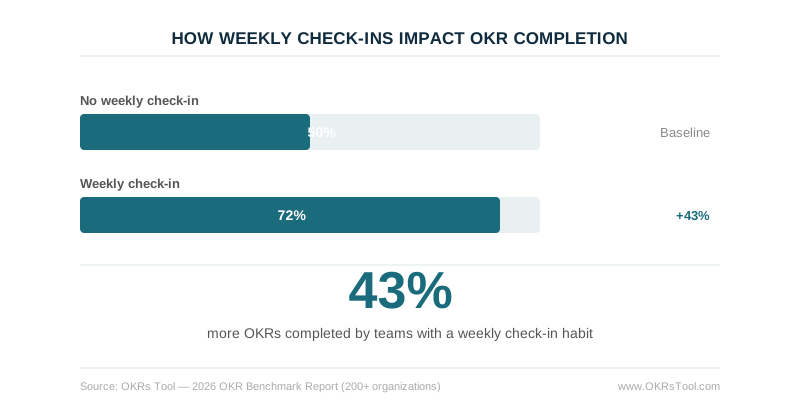
The 2026 OKR Benchmark Report across 330 organizations identifies what actually drives OKR results: automated weekly check-ins (43% more completions), required ownership per Key Result (26% higher completion), and fast launch cycles (50% higher completion for teams live in under a week). These are the criteria this guide uses to rank the alternatives — not feature lists.
Why Teams Look for Weekdone Alternatives
Most teams don't leave Weekdone because the framework is wrong. They leave because specific structural limitations start costing time.
The check-in format generates reporting overhead — weekly updates feel repetitive even when nothing has changed, and the output rarely drives a decision. The per-user pricing at $10/user/month compounds quickly: a 30-person team pays $300/month, more than six times what OKRs Tool charges for the same team on flat pricing. The UI, while functional, hasn't kept pace with newer OKR platforms — and for distributed teams running async workflows, the synchronous-first design creates friction.
The tools below each solve these limitations differently. The right alternative depends on which limitation is costing your team the most.
The 7 Best Weekdone Alternatives (2026)
1. OKRs Tool
Best for: Growing teams (50–200 people) that need the full OKR cycle without enterprise overhead
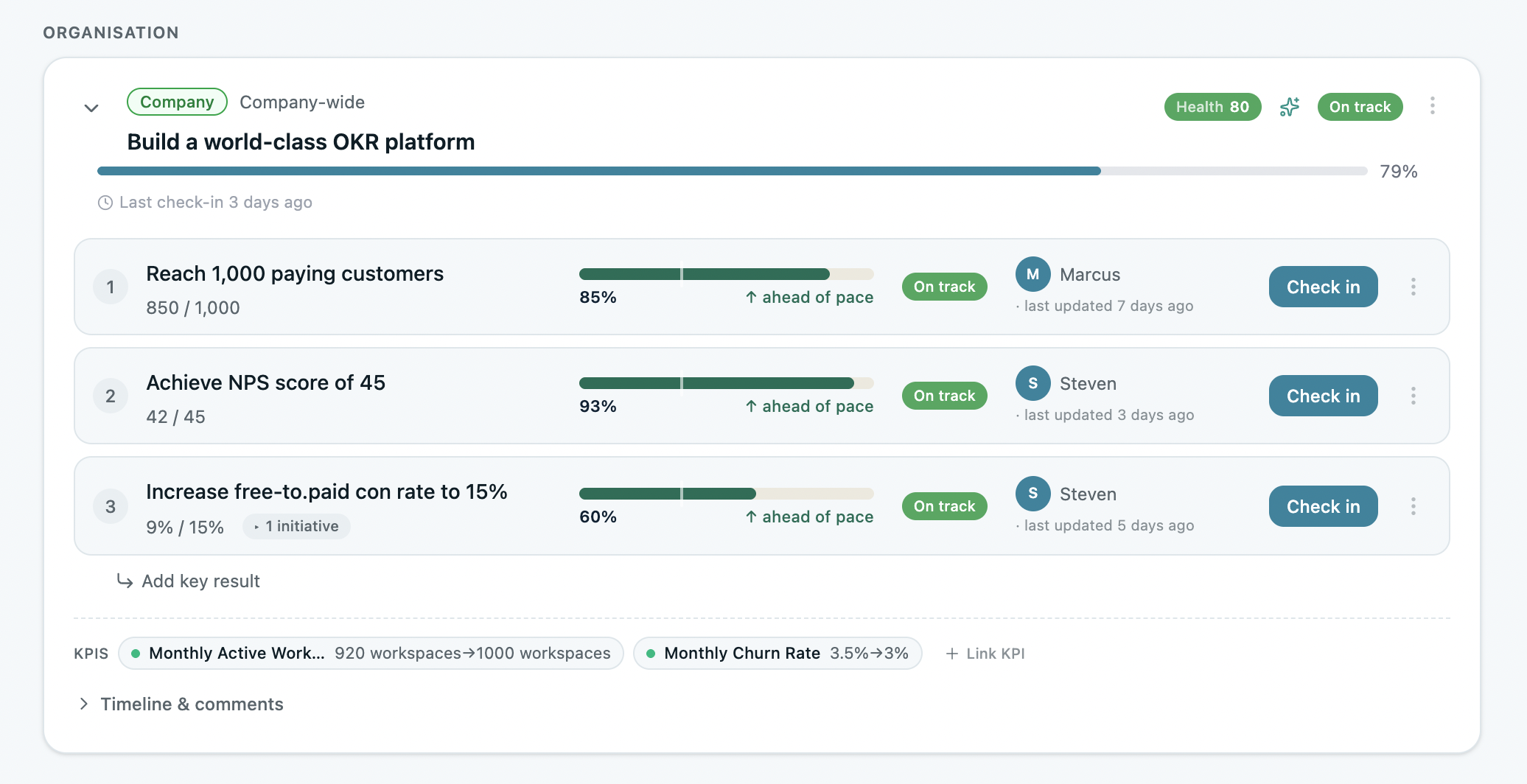
OKRs Tool is a lightweight, AI-powered OKR platform built for teams that need to launch quickly and stay focused. Where Weekdone leans into reporting and weekly structure, OKRs Tool is built around the execution habits the benchmark data identifies as highest-return: required ownership per Key Result, automated weekly nudges, and a live alignment map that shows every team's goals connected to company priorities.
The flat pricing is the most significant structural difference from Weekdone. At $49/month for the entire organization — not per user — a 30-person team pays 85% less than the equivalent Weekdone plan. That gap widens with every hire.
Setup is under 15 minutes. Slack integration keeps check-ins async. AI-generated OKRs reduce the blank-page problem in the first cycle.
Why it's a better Weekdone alternative: Automated check-ins rather than manual scheduling, required ownership rather than optional assignment, flat pricing rather than per-user scaling, and a live alignment view rather than status reports.
Pricing: Free for up to 5 users. $49/month flat for 6–50 users. $129/month for 51+.
2. Tability
Best for: Distributed teams that want to replace meetings with structured async check-ins

Tability is a beautifully designed OKR and check-in platform that helps teams build consistent goal habits through weekly nudges and async visibility. The UX is more modern than Weekdone, the check-in flow is lighter, and Slack integration is tighter.
Where Weekdone can feel like it generates status reports, Tability is built to generate decisions — prompting team members to reflect and flag blockers rather than just log progress.
Why it's a better Weekdone alternative: Cleaner UI, more intuitive check-in flow, better async support, and a more modern approach to habit-forming goal tracking.
Pricing: From $6/user/month. 14-day free trial.
3. Perdoo
Best for: Mid-sized organizations that want to tie OKRs to strategy and long-term direction

Perdoo is a strategic OKR platform that connects company goals, team objectives, and Key Results into one visual framework — with initiative tracking and strategy mapping alongside the OKR layer.
Where Weekdone stops at weekly reporting, Perdoo adds strategic depth: the ability to link initiatives to Key Results and visualize how teams contribute to company-wide priorities. For organizations growing past basic weekly reporting into company-wide alignment, it's a meaningful upgrade.
Why it's a better Weekdone alternative: Strategic planning layer, stronger cascade visibility, and initiative tracking alongside Key Results.
Pricing: Free for up to 5 users. From €8/user/month (10-seat minimum).
4. Workboard
Best for: Enterprise teams that need OKR and strategy execution at scale

Note: Workboard acquired Quantive (formerly Gtmhub) in May 2025. The combined platform is now one of the strongest enterprise-grade options in the category — with OKRs, strategy execution, and live data integrations from the Quantive acquisition.
For organizations that need OKRs tightly connected to live business data — automatically tracked from CRMs, databases, and BI tools — Workboard now carries Quantive's 160+ integration capability alongside its own executive accountability and strategy mapping features.
Why it's a better Weekdone alternative: Live data integrations reduce manual check-in overhead entirely. Executive dashboards give leadership visibility without status meetings.
Pricing: Custom quote. Enterprise-focused — best suited for 200+ person organizations.
5. Profit.co
Best for: HR-led organizations that want OKRs connected to performance reviews and 1:1s

Profit.co is an all-in-one OKR and performance management platform that combines goal tracking with 1:1s, reviews, and employee development features. Where Weekdone is check-in focused, Profit.co treats OKRs as the foundation of ongoing performance conversations.
The platform is more structured and process-heavy than Weekdone — but for organizations connecting OKR delivery to performance decisions (75% of organizations now do this, per the OKR Intelligence Report 2026), that structure is the point.
Why it's a better Weekdone alternative: Full performance review layer, OKR-linked 1:1s, and stronger accountability infrastructure for HR-led teams.
Pricing: Custom quote.
6. Synergita
Best for: Growing teams building OKRs and performance culture simultaneously

Synergita combines OKR goal tracking with continuous feedback, recognition programmes, and structured reviews — in a lighter package than full enterprise performance suites. For growing teams building their first People Ops stack alongside OKRs, it provides a more thoughtful alternative to Weekdone's narrower check-in focus.
The interface is clean and straightforward. Onboarding is fast — important for teams without a dedicated operations lead.
Why it's a better Weekdone alternative: People development layer built in, continuous feedback alongside goal tracking, without the cost or complexity of full enterprise HR software.
Pricing: Free for 1 company OKR. Paid plans on request.
7. ClickUp Goals
Best for: Teams already using ClickUp for task management

ClickUp is a productivity and project management platform with a Goals feature that allows teams to track OKRs inside their existing task workflows. If your team already lives in ClickUp, Goals means no additional tool, no new login, and no migration — OKR tracking sits inside the platform where work already happens.
It doesn't follow OKR methodology as strictly as purpose-built platforms, but it's flexible enough to make it work for teams that prioritize fewer apps over OKR depth.
Why it's a better Weekdone alternative: No extra tool required for ClickUp teams, real-time task-to-goal connection, and strong adoption because everyone's already there.
Pricing: Free plan available. Paid from $7/user/month.
How to Choose the Right Alternative
The right Weekdone alternative depends on which limitation is costing your team the most.
For teams that want a lightweight, fast-setup OKR tool with flat pricing and automated check-ins, OKRs Tool or Tability are the strongest options. Both replace Weekdone's manual reporting format with automated nudges and async-friendly workflows.
For organizations that need OKRs tied to strategy, data, and execution at scale, Perdoo or Workboard add the strategic depth that Weekdone doesn't offer.
For teams connecting OKRs to performance reviews and people development, Profit.co and Synergita extend beyond goal tracking into the full performance conversation.
For teams already inside ClickUp, ClickUp Goals removes the tool-switching friction entirely.
At a Glance: Weekdone vs the 7 Alternatives
Final Thoughts
Weekdone works for a specific type of team at a specific stage. When the reporting overhead outweighs the clarity it provides, or when per-user pricing starts compounding, the alternatives above are each worth evaluating.
The benchmark data is clear on what matters most in the decision: automated check-in infrastructure, required ownership per Key Result, and fast enough setup to launch in under a week. Any tool that delivers all three will outperform Weekdone for a growing team — the question is which one fits the rest of your stack.
Data: The ROI of OKRs: 2026 Benchmark Report (330 respondents), The 2026 OKR Benchmark Report (200+ organizations).