OKRs return $25 for every $1 spent running them, 98% of organizations report measurable revenue growth, and 95% report less wasted work. These are operational returns the benchmark data measures directly — here is each of the eleven, and the mechanism behind it.
The case for OKRs is usually made in the abstract: focus, alignment, accountability. The ROI of OKRs: 2026 Benchmark Report makes it concrete instead. Across 330 organizations, OKRs return 1:25 on investment, 98% report measurable revenue growth, and 86% report faster decisions — returns that show up before most teams have even mastered the framework.
The eleven benefits below are drawn from that report and the 2026 OKR Benchmark Report of 200 organizations. Each is a benefit of the OKR framework itself — what it does, and why — not of any particular tool used to run it.
1. Measurable Revenue Impact
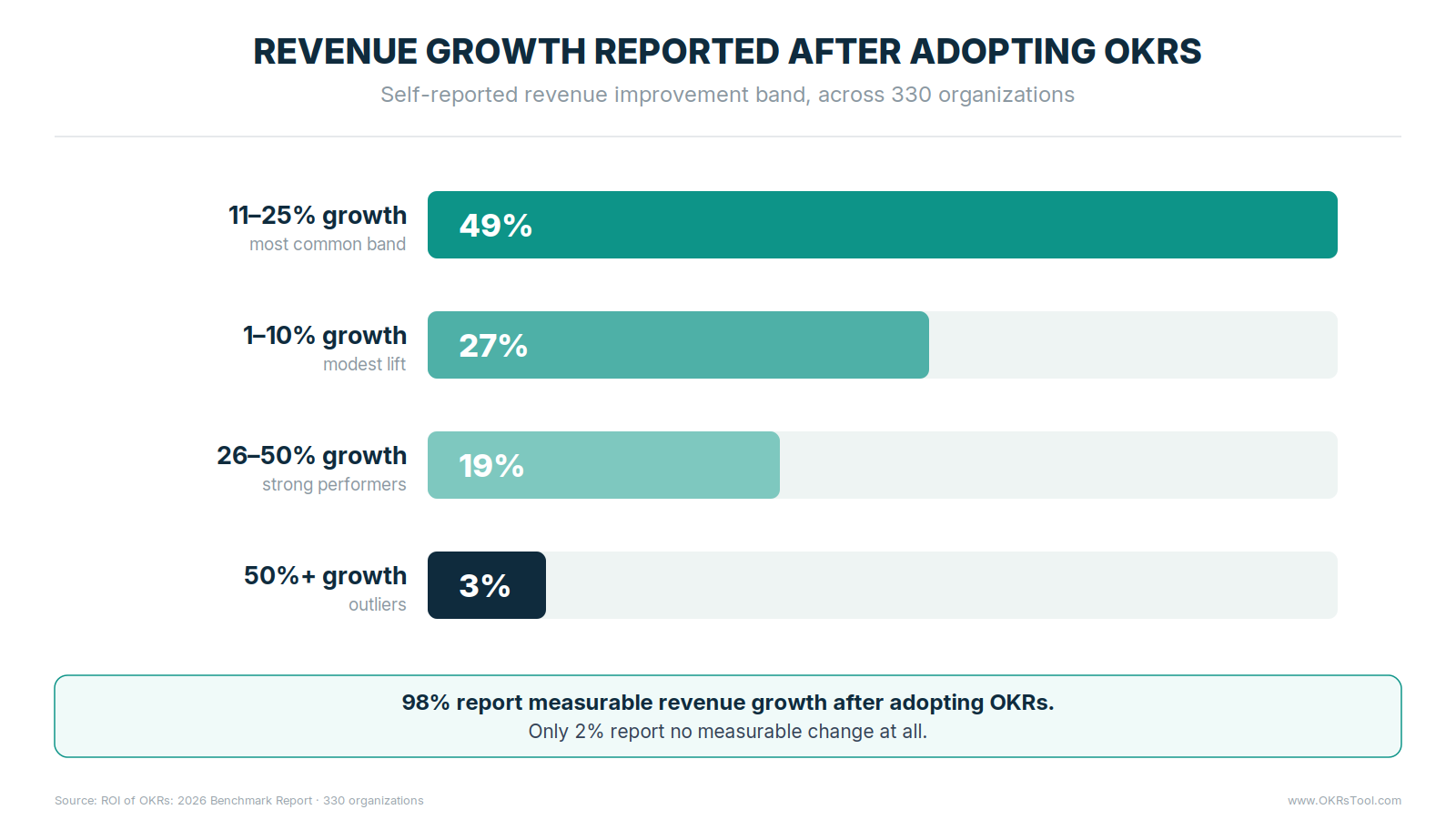
The benefit teams least expect to be this concrete is the financial one. Across 330 organizations, OKRs return 1:25 — for every $1 spent running them as a framework, organizations report $25 back in revenue impact. 98% report measurable revenue growth after adopting OKRs, and only 2% report no measurable change.
The most common improvement band is 11–25%, cited by 49% of respondents, with a further 19% reporting 26–50% growth. And 62% see the return inside a single quarter, which makes OKRs one of the faster-paying operational changes a growing company can make.
2. Alignment That's Visible, Not Assumed
At a growing company, teams drift into silos, each with its own priorities. The benchmark data sizes the problem plainly: 65% of teams admit their goals aren't linked to company strategy. Work gets done that no one at the top asked for, while stated priorities go unstaffed.
OKRs close that gap by breaking company objectives into measurable key results each team can connect to. Done through a proper cascade, every team goal traces back to a company priority, and everyone can see how their work ladders up. Alignment stops being something leadership hopes is happening and becomes something anyone can trace on demand.
3. Focus on the Few Things That Matter
Growing teams juggle shifting priorities against limited resources, and without a forcing function they chase too much at once. OKRs impose a ceiling: a small number of high-impact goals, ideally one or two objectives per team per quarter, as the best-practice guidance holds. Teams running one or two OKRs are roughly twice as likely to hit them as teams running three or more.
When leaders were asked which benefit of OKRs mattered most, the answers clustered around exactly this kind of operational clarity.
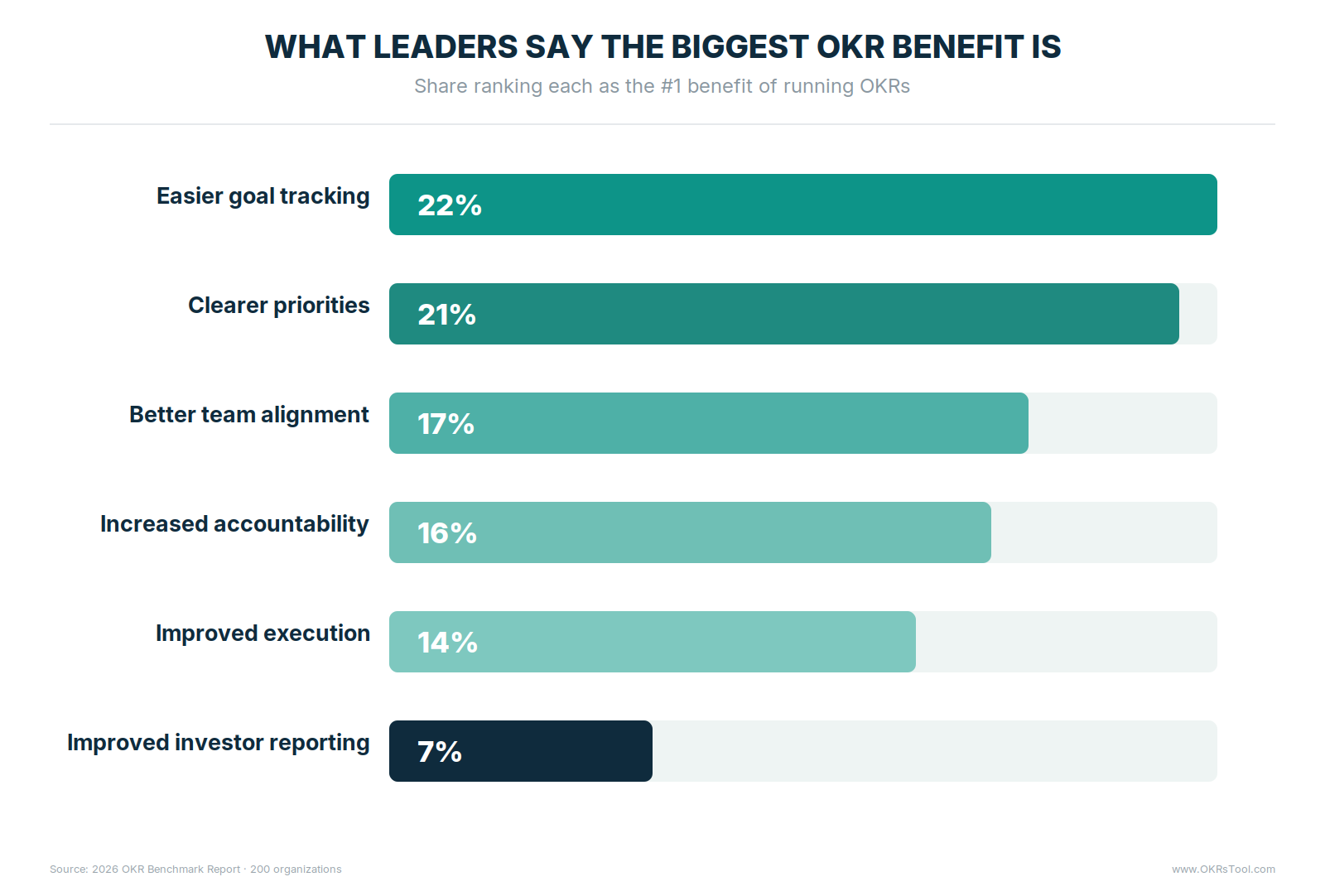
Focus becomes a structural property of how the quarter is set up, rather than something that depends on each person's discipline in the moment.
4. Less Wasted Work
One of the most financially significant benefits is also the least discussed. Asked whether OKRs had reduced wasted or misaligned work, 95% of respondents said yes — 42% significantly and 53% somewhat, with only 4% reporting no change.
For any organization carrying the hidden cost of busy-but-misaligned teams — effort that looked productive without advancing the right outcome — that reclaimed capacity is among the largest returns in the whole benchmark. When work that doesn't map to an OKR becomes visible, it becomes a candidate to stop, and that freed capacity moves to work that counts.
5. A Structure That Scales With Headcount
Goal-setting that works at 15 people falls apart at 50. Spreadsheets lose their thread, ownership blurs, and no one can see the whole picture at once. OKRs are built for that transition: the same cascade from company to team to individual holds whether there are three teams or thirty.
As the organization grows, the framework absorbs the added complexity instead of breaking under it — multiple objectives tracked across many teams while the line back to company strategy stays intact. Growing teams don't have to swap methods at every stage; the OKR framework is the connective tissue that grows with them.
6. Accountability Through Single Ownership
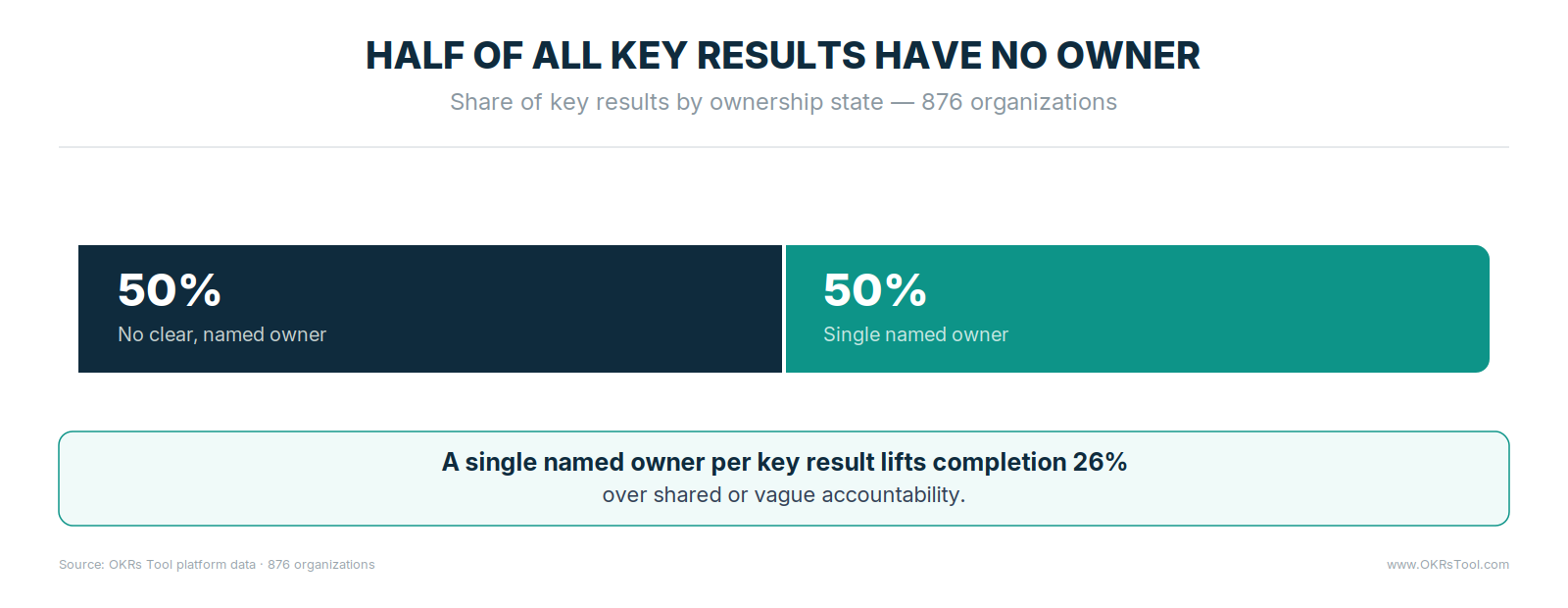
Accountability rarely happens by default, and it almost never happens under shared ownership. The platform data is stark: 50% of all key results have no clear, named owner. A goal everyone owns is a goal no one owns.
OKRs done well force the opposite — one named owner per key result, visible to the whole team. Teams that assign single ownership to every key result see 26% higher completion than teams with shared or vague accountability.
7. Psychological Safety to Set Ambitious Goals
A benefit that rarely makes these lists, but that the data strongly supports, is what OKRs do to goal-setting behavior once scoring is handled well. When goals feed directly into performance ratings, people protect themselves: 96% admit to sandbagging — setting targets they've already mostly hit — when the goal affects their review, versus 81% when it doesn't. Fear of the number produces cautious goals, and cautious goals produce cautious results.
The OKR framework separates the two on purpose. Scoring a key result is meant to read what happened as fact rather than judge the person, which lets teams set genuinely ambitious targets and score a 0.6 as useful information rather than a failure. That separation is what makes stretch goals safe to write — and stretch goals are where the outsized results come from.
8. Transparency That Replaces Status Meetings
As teams grow and go remote, communication breaks down along the seams. OKRs counter that by making goals, progress, and results visible to everyone rather than only the people in a given meeting. The state of every objective is a thing you can look up, not a thing you have to ask about.
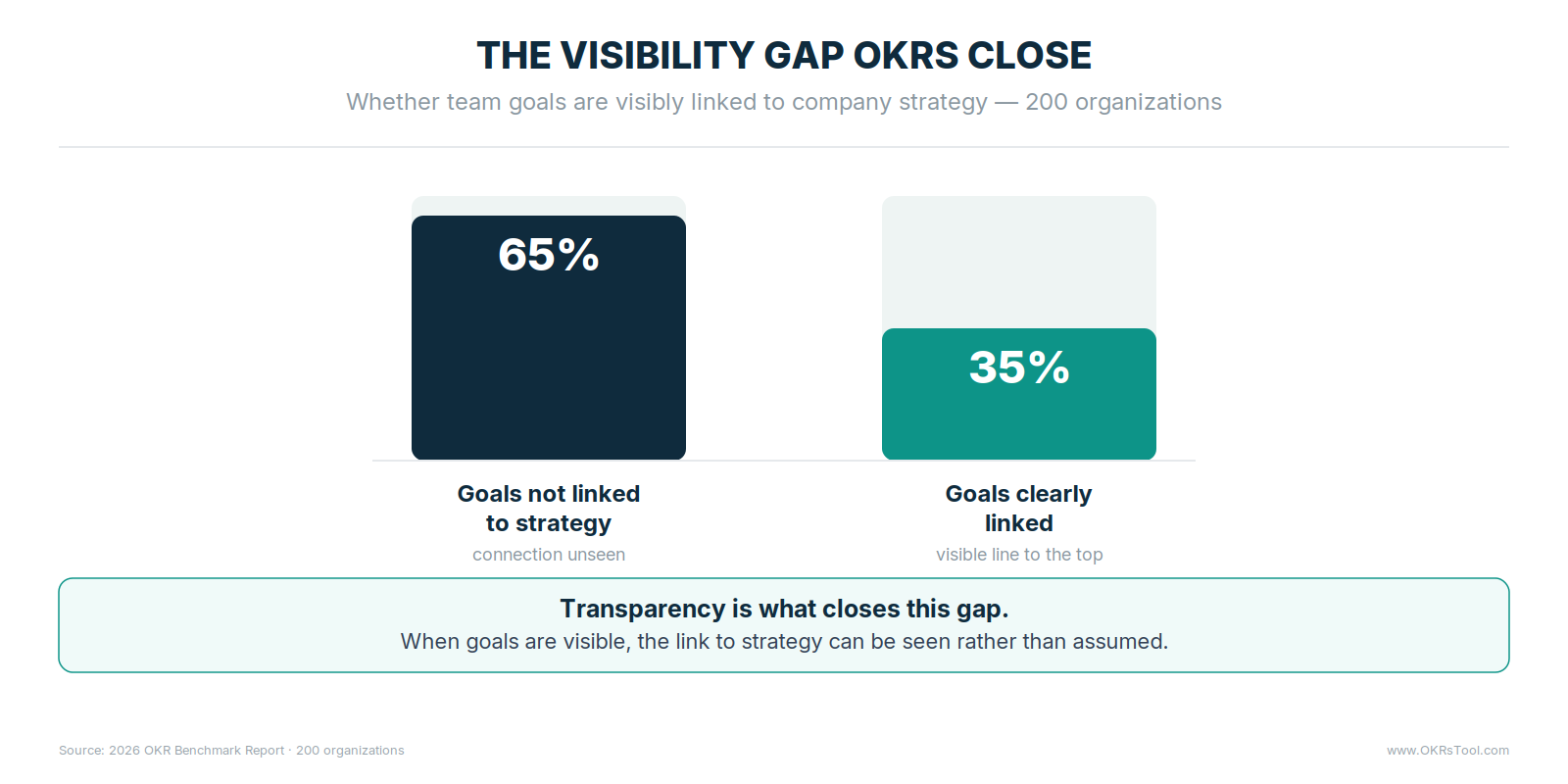
That visibility does real work: it surfaces cross-team dependencies early through better tracking, cuts the need for status updates, and keeps a distributed team pointed the same way. Regular check-ins against shared, visible goals replace a layer of meetings whose only purpose was to tell everyone where things stood.
9. Faster Decisions at Every Level
86% of organizations report that OKRs shortened their decision cycles — 42% significantly and 44% somewhat. The mechanism is straightforward: when priorities are explicit, shared, and visible, decisions that used to need escalation or a consensus meeting can be made on the spot.
The quarter's OKRs become the reference that answers "should we be working on this?" without a meeting to decide. A request that doesn't serve a current company objective has a clear, principled answer, and that answer can come from anywhere in the organization rather than only from the top.
10. Honest Prioritization Under Pressure
Asked what would break first if OKRs vanished tomorrow, 30% of respondents named prioritization — the single most common answer, ahead of accountability and alignment. It's the benefit teams miss most once it's gone.
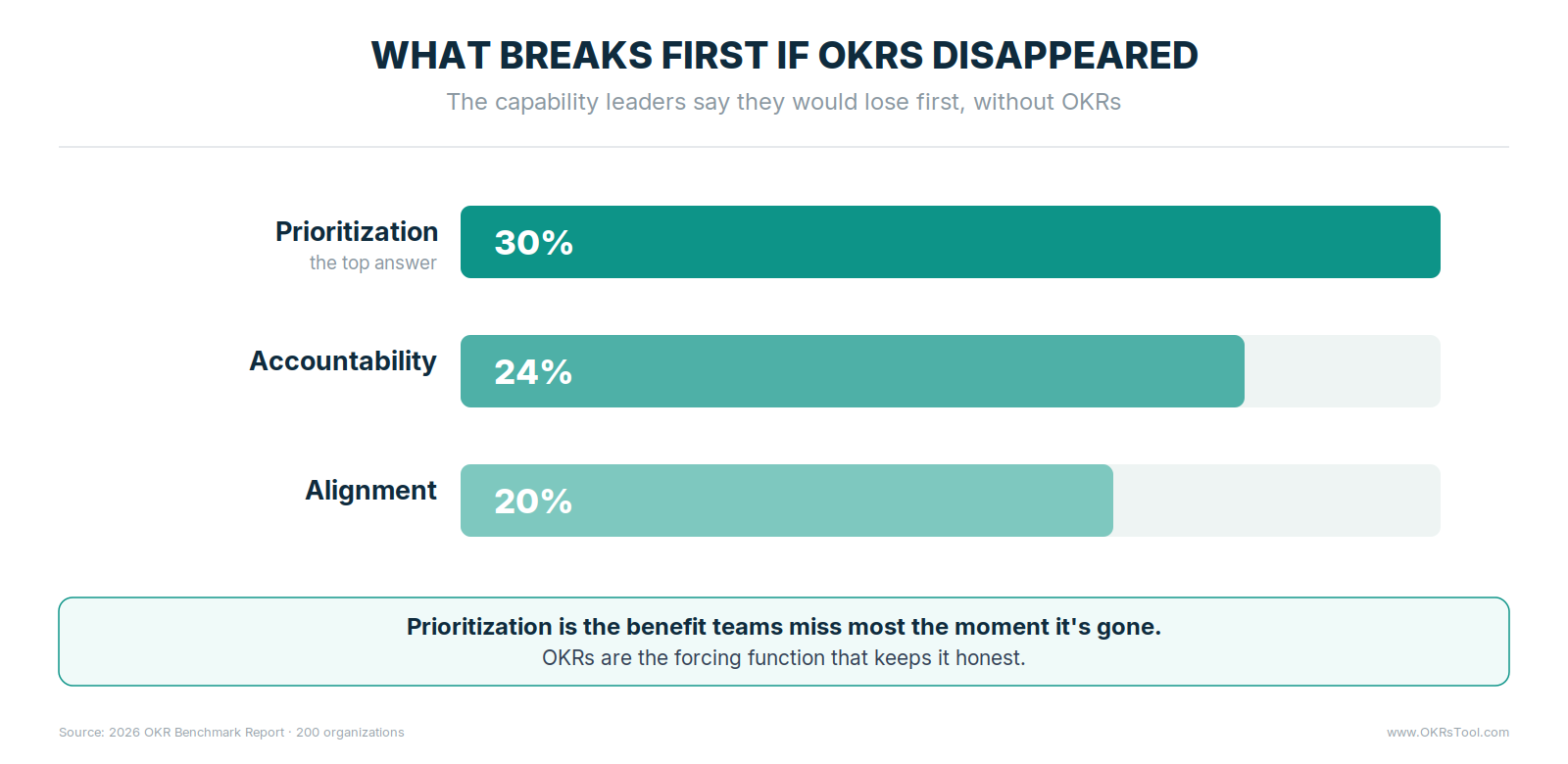
OKRs force honest prioritization by capping commitment: one or two objectives a quarter turns "everything is important" into an explicit ranking. That discipline matters most under pressure, when new requests arrive and the team needs a principled basis to say no. A shared set of priorities survives leadership changes and market shifts better than priorities that live only in a founder's head.
11. Compounding Improvement Cycle Over Cycle
OKRs function as a learning system on top of a planning one. Regular reviews and end-of-cycle retrospectives let teams adjust in real time and carry lessons forward — and the effect compounds. Teams that run retrospectives see 30–45% higher completion the following quarter.
The curve is measurable over the longer run: teams in their first two cycles finish around 51% of goals, while teams at cycle five and beyond finish 79%. The payoff extends past this quarter's execution to something larger: an organization that gets measurably better at execution every quarter it keeps the cadence, which is what turns the 1:25 return into a floor rather than a ceiling.
The Return Is Real, and It Compounds
The eleven benefits above are documented across 330 organizations, visible inside a single quarter, and larger the longer OKRs run consistently: clearer priorities, faster decisions, tighter accountability, less wasted work, and a team that shares a definition of what winning looks like. None of it depends on a particular tool — it comes from the framework's core demand that goals be few, measurable, owned, and reviewed.
The 1:25 return is the median, and it rises with the practices that make OKRs work and keep a program from dying young: honest retrospectives, weekly check-ins that catch a problem while it's still small, and key results written as outcomes instead of tasks. Teams in their first cycle average 51% completion; by cycle five they average 79%. The ceiling moves with the discipline behind the framework, which is why the benefits grow rather than fade the longer a team runs OKRs.
Data: the ROI of OKRs: 2026 Benchmark Report (330 respondents) and the 2026 OKR Benchmark Report (200 organizations).