
Most teams that adopt OKRs for the first time don't fail because the framework is wrong. They fail because the structure around the goals isn't built to sustain the weekly habit. This guide covers what the benchmark data shows about first-cycle success, the five structural decisions that determine whether OKRs take hold, and what to do in the first 90 days.
Every organization that runs OKRs today ran them for the first time once. The ones that made it stick didn't have better goals than the ones that abandoned the framework by week six. They had a better structure — and they knew, before the cycle started, which problems to solve first.
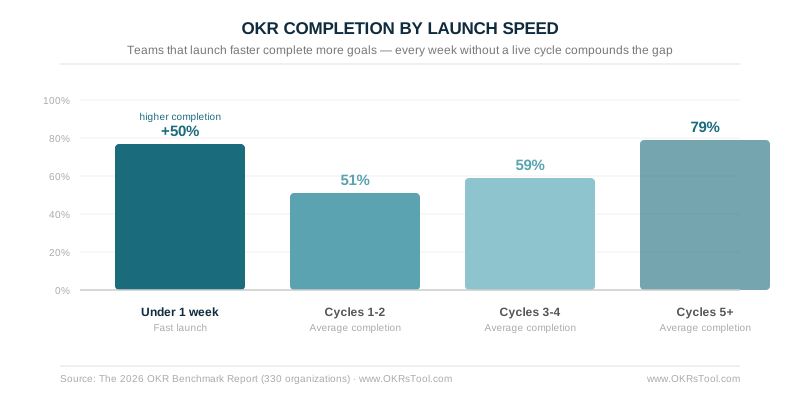
The 2026 OKR Benchmark Report across 330 organizations puts a number on the first-cycle challenge: teams in cycles 1–2 average 51% completion. That's not failure — it's the baseline. By cycle 5+, the same organizations average 79%. The improvement isn't from writing better goals. It's from the accumulated discipline of structural habits that compound cycle over cycle.
The fastest way to reach 79% is to get the first cycle right.
What the Data Shows About First-Time OKR Adoption
The OKR Intelligence Report 2026 surveyed 222 organizations at the 51–200 employee stage — the exact profile of most teams adopting OKRs for the first time. The findings are specific and actionable.
Only 16% complete the full cascade within the same week. The cascade — company OKRs finalized, department OKRs set, team Key Results written — should happen before the cycle starts. For 84% of organizations, it doesn't. Teams spend the first two to three weeks of the quarter catching up instead of executing. Teams that complete the cascade in under a week see up to 50% higher completion rates.
52% of Key Results are tasks or KPIs in disguise. From our analysis of 7,857 Key Results written by real teams. "Launch the new onboarding flow" is a task. "Increase Day 7 activation from 34% to 52%" is a Key Result. The distinction matters because tasks can be completed without moving the business — and first-time OKR adopters almost always write tasks.
50% of all Key Results have no named owner. Without a named person accountable for each Key Result, accountability is diffuse and updates stop. Teams with required single ownership per Key Result see 26% higher completion rates.
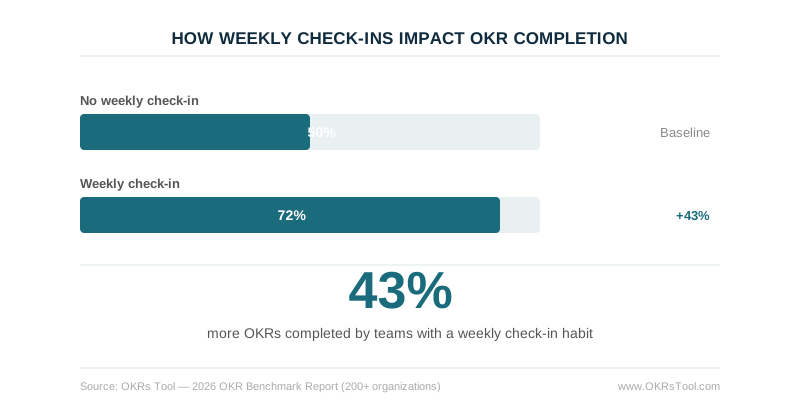
3x abandonment without weekly check-ins. Teams that skip the weekly check-in rhythm are three times more likely to abandon OKRs altogether in the first cycle. The check-in isn't overhead — it's the mechanism that keeps goals alive between planning sessions.
Before You Start: Three Decisions to Make
Decision 1: Top-down, bottom-up, or both?
65% of organizations use top-down goal-setting — leadership sets company OKRs, teams cascade from them. This is the right approach for a first cycle. It establishes the strategic direction before asking teams to contribute, which reduces confusion and prevents misaligned goals.
Bottom-up goal-setting — where teams set their own OKRs and leadership aligns upward — works better in mature cycles where teams have a strong sense of strategic context. In cycle one, the risk is teams optimizing for their own priorities rather than company priorities.
The practical recommendation: run top-down in cycle one. Introduce collaborative refinement from cycle two once the framework is understood.
Decision 2: How many OKRs?
Teams running 1–2 company Objectives per quarter are twice as likely to achieve them as those running three or more. For a first cycle, start with one company Objective and 2–3 Key Results. Add depth in subsequent cycles once the habit is established.
The instinct to be comprehensive in cycle one — setting goals for every department, every team, every function — is the instinct that kills adoption. Focus beats coverage every time.
Decision 3: What tool will you use?
67% of organizations start with spreadsheets. That's fine for a 10-person team in cycle one. It breaks down past 20–30 people — no automated reminders, no ownership enforcement, no alignment visibility, no at-risk flagging.
If your organization is already past 20 people, skip the spreadsheet stage. The OKR software that makes the weekly habit structurally unavoidable — automated nudges, required ownership, live alignment map — generates a 1:88 return on investment against the same revenue baseline as spreadsheet-based programmes at 1:25. The right tool from day one compounds faster than the right tool from cycle three.
The First 90 Days: Week by Week
Weeks 1–2: Set Up the Structure
Week 1: Leadership sets 1–2 company Objectives and 2–3 Key Results. Each Key Result gets a named owner — one person, not a team. The Objective should be qualitative and inspiring. The Key Results should each have a baseline, a target, and be scoreable on a 0.0–1.0 scale at cycle end.
Week 2: Department heads and team leads set their own OKRs, cascading from the company level. The question each team asks: "What is our specific contribution to the company priority above us?" Complete the full cascade before day 14. Every Key Result has a named owner before it goes live.
Run a 30-minute cascade check at the end of week two: can every team's Key Results be connected to a company priority in one sentence? If not, revise before the cycle officially begins.
Weeks 3–10: Run the Weekly Rhythm
The weekly check-in is the highest-return habit in the entire OKR framework. Teams with it complete 43% more OKRs than those without. It takes 20 minutes. Four questions:
- What moved since last week?
- What's at risk?
- What are the 1–3 priorities this week?
- Where is help needed?
The check-in should run at the same time every week. If it requires someone to schedule it manually, it will eventually stop being scheduled. Automated nudges — via Slack or MS Teams — remove the dependency on discipline.
At week six: run a mid-cycle review. Score every Key Result on a 0.0–1.0 scale. Any KR below 0.5 needs an explicit decision — revise the target, escalate the blocker, or formally close it. The OKR Intelligence Report 2026 found 7% of off-track Key Results are simply abandoned — quietly dropped with no revision or consequence. The mid-cycle review closes this structurally.
Week 12: End-of-Cycle Review
The end-of-cycle review is where cycle one becomes the foundation for cycle two. Score every Key Result. Run the retrospective. Four questions:
- What did we achieve?
- What drove progress?
- What slowed us down?
- What do we do differently next cycle?
Teams that run structured end-of-cycle retrospectives complete 30–45% more OKRs the following quarter. The review isn't about judging performance. It's about producing three specific changes to the next cycle's setup that prevent the same structural problems from repeating.
The Most Common First-Cycle Mistakes
Writing tasks as Key Results. "Launch the onboarding redesign" is a project milestone. "Increase Day 7 activation from 34% to 52%" is a Key Result. If you can complete it without improving a business metric, it's a task. The how to write OKRs guide covers the baseline-to-target formula in detail.
Setting too many OKRs. Three company Objectives and fifteen Key Results in cycle one is not ambition — it's a guarantee that nothing gets focused attention. One Objective, two or three Key Results. Add more in cycle two if the framework holds.
Skipping the cascade. Teams that write their OKRs without referencing the company level aren't cascading — they're operating independently. The structural test: every team Key Result should connect to a company Key Result in one sentence. If it takes a paragraph to explain the connection, it's not connected.
Treating the first cycle as a trial run. The most common first-cycle error is treating OKRs as a pilot — low-stakes, reversible, easy to abandon. The benchmark data is clear: cycle one teams that commit to the full structure (cascade, ownership, weekly check-ins, end-of-cycle review) reach cycle five performance significantly faster than those that treat the framework as optional.

What Good Looks Like at Cycle End
A first cycle that hit 51% of its Key Results, ran weekly check-ins for 10 of 12 weeks, completed the end-of-cycle review, and produced three specific changes for cycle two is a successful first cycle — not a failed one.
The OKR maturity curve is the most important benchmark to internalize before you start: 51% is the average, not the floor. The organizations that reach 79% by cycle five didn't skip to sophistication — they built it week by week from a first cycle that looked exactly like yours will.
The goal of adopting OKRs for the first time isn't perfect execution. It's a functioning structure: goals that are specific and measurable, an alignment cascade that connects everyone's work to a company priority, named owners who check in weekly, and a retrospective that makes cycle two better than cycle one.
That's it. Everything else compounds from there.
Data: The ROI of OKRs: 2026 Benchmark Report (330 respondents), The 2026 OKR Benchmark Report (200+ organizations), OKR Intelligence Report 2026 (222 organizations, 51–200 employees, technology sector), OKRs Tool platform data (7,857 Key Results analyzed).