
A North Star Metric without OKRs becomes a number everyone agrees is important and nobody is specifically accountable for moving. OKRs without a North Star become well-executed quarterly work that doesn't compound toward anything transformational. The two frameworks are most powerful when one defines the destination and the other executes the journey.
The North Star Metric concept emerged from product-led growth thinking in the early 2010s, popularized by companies like Airbnb ("nights booked"), Spotify ("time spent listening"), and Slack ("messages sent within an organization"). The premise is simple: for any business, there is one metric that, if it grows consistently, indicates the company is delivering genuine value to customers — and that predicts long-term sustainable growth better than any financial metric alone.
Finding that metric requires honest thinking about what the product fundamentally does for people. Not what generates revenue, but what value is actually being exchanged. Revenue is a consequence; the North Star captures the cause.
What the North Star Metric Actually Does
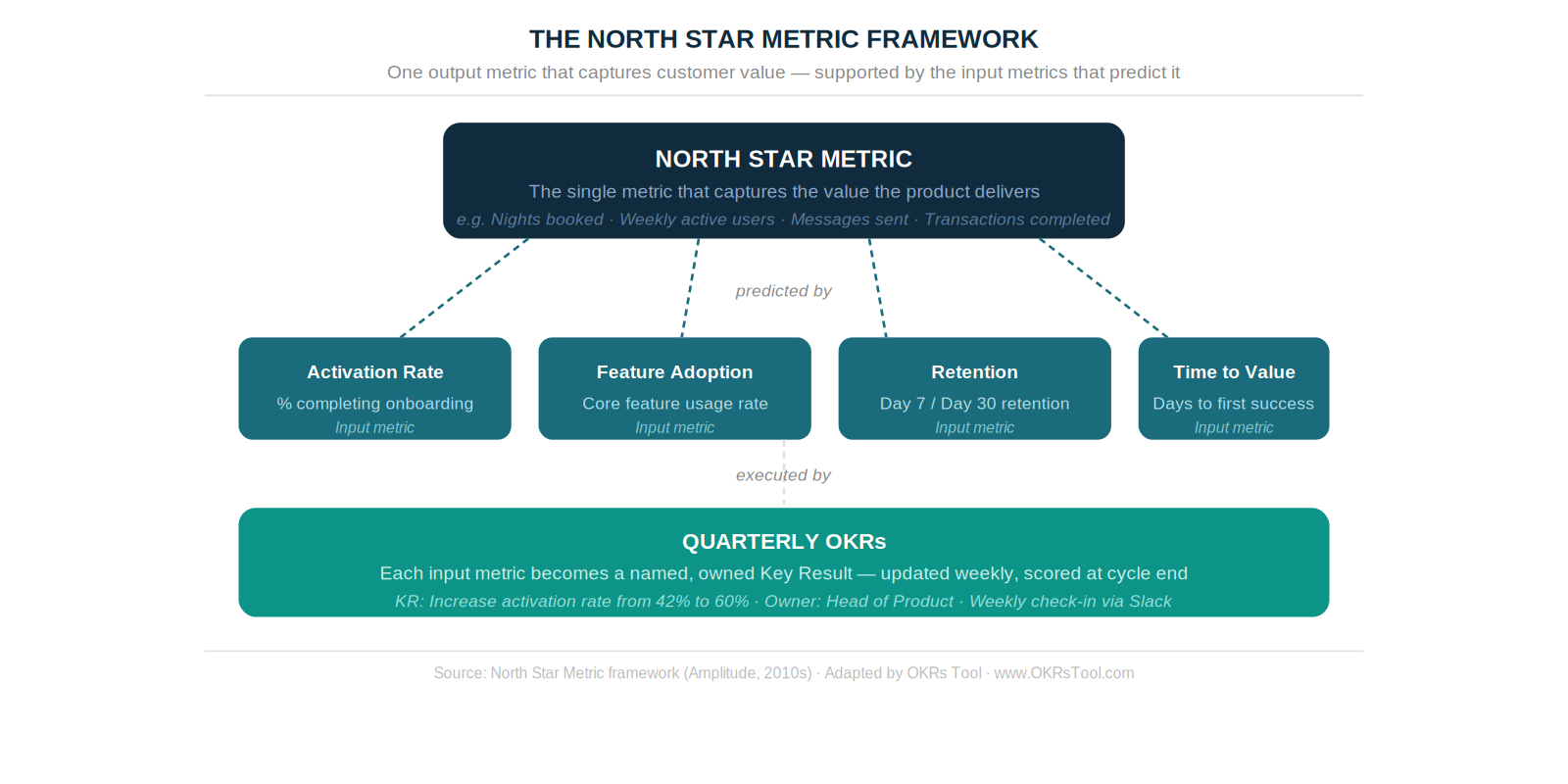
The North Star Metric is a focusing tool. It asks an organization to identify — and commit to — the single metric that best captures the value it delivers to customers. Supporting input metrics measure the levers that predict the North Star. Teams align their work around moving those inputs.
The framework has three components that work together. The North Star itself is the output metric: nights booked, weekly active users, messages sent, successful transactions completed. Input metrics are the leading indicators that predict the North Star — activation rate, feature adoption, time to first value, retention at key milestones. The organizational commitment is the choice to evaluate every project and experiment through the lens of whether it moves the North Star or its inputs, rather than through internal proxies like revenue targets or project completion.
What the North Star Metric framework does not provide: a quarterly planning cycle, named ownership per metric, a weekly accountability mechanism, or a cascade from company level to team level. It identifies what matters. It does not create the execution infrastructure for moving it.
What the Critical Failure Mode Looks Like
A product team agrees on a North Star Metric — daily active users, or activation within seven days of signup, or some equivalent measure of genuine engagement. The metric is published. The leadership team aligns on it. The quarterly business review references it.
By Q3, every team is working hard. The North Star is referenced in planning documents. But when it comes to the weekly work — which sprint items to prioritize, which experiments to run, which customer segments to focus on — the connection between the North Star and the day-to-day decision is abstract rather than structural.
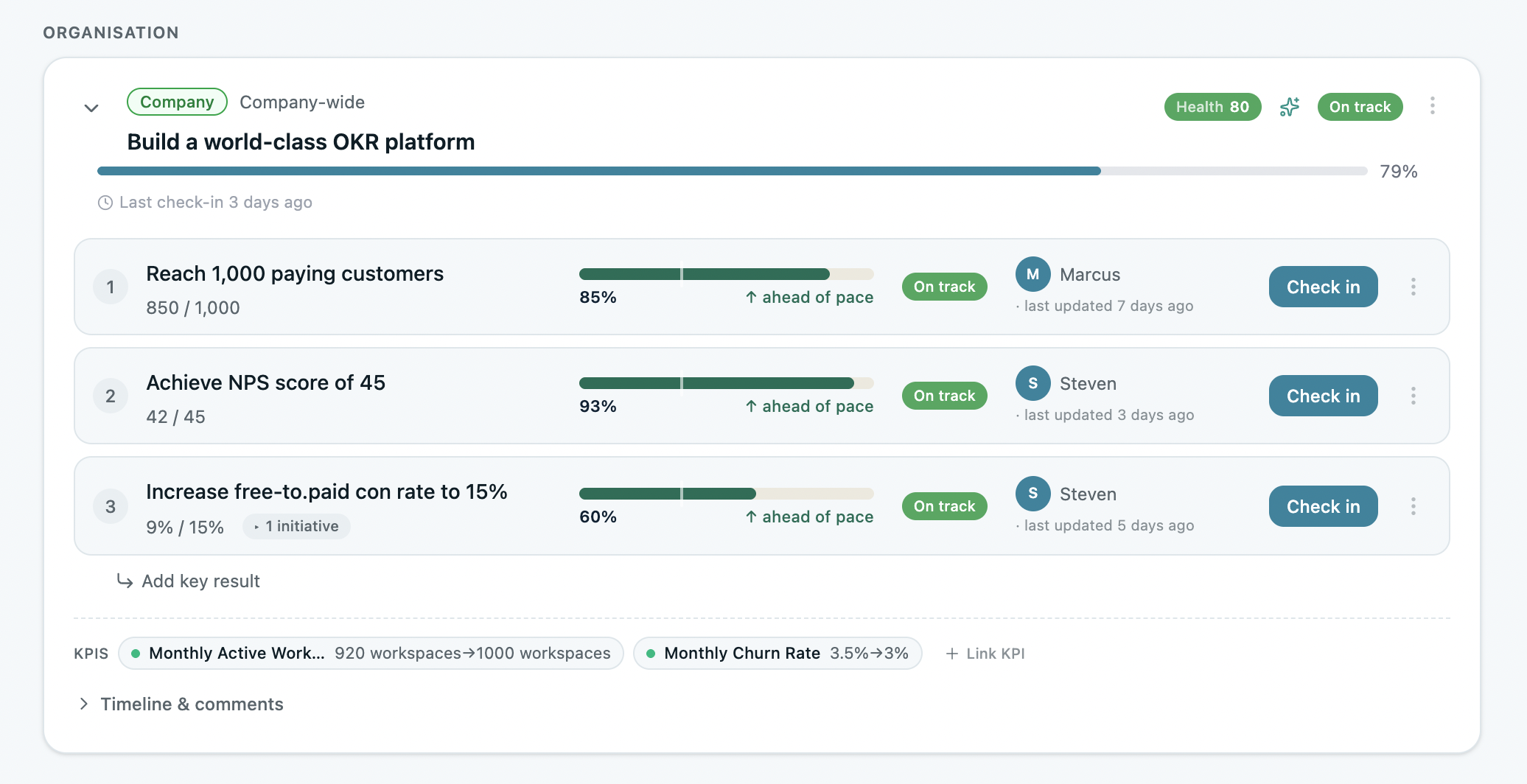
Nobody has a named Key Result that moves a specific input metric by a specific amount this quarter. Nobody receives a weekly check-in nudge on the metric they own. Nobody's quarterly review includes a score for how much they moved their specific input.
The North Star is visible. But it's not load-bearing.
The 2026 OKR Benchmark Report found 65% of teams admit their goals aren't clearly linked to company strategy. For companies running a North Star framework, the number likely reflects the gap between metric alignment and execution accountability: everyone agrees on what matters, but the work isn't structurally pointed at it every week.
How They Compare
The Right Architecture: North Star + OKRs
The North Star Metric and OKRs are not alternatives — they connect directly. The North Star defines the long-term output metric the company is committed to growing. OKRs define which specific input metrics each team will move this quarter, by how much, and who is accountable for each.
In OKRs Tool, you can add your North Star Metric directly in the Strategy section — keeping it visible alongside your quarterly OKRs so the connection between the long-term destination and this quarter's execution is always explicit, not assumed.
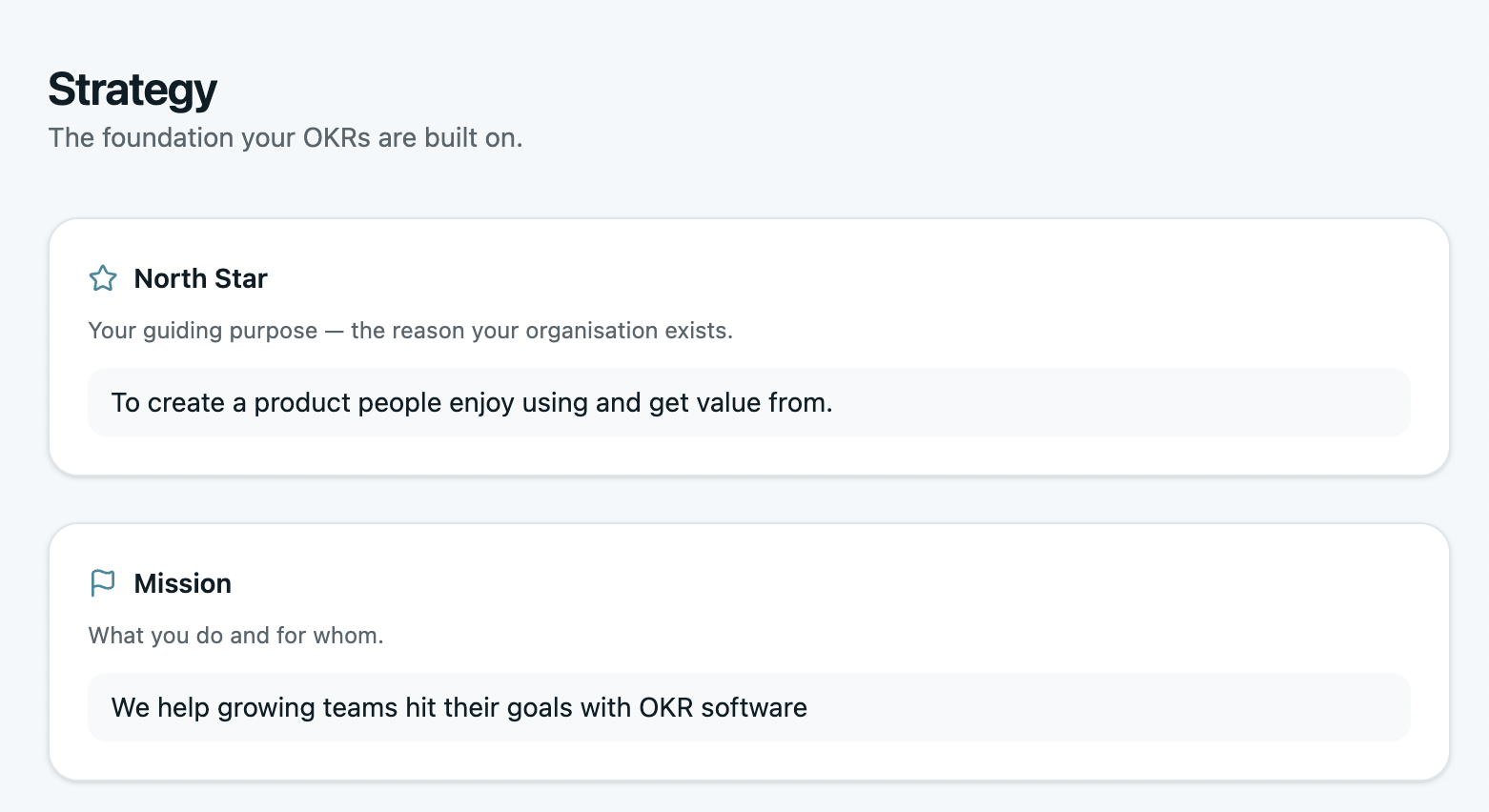
The connection in practice: the company's North Star becomes the context for each quarter's OKR planning session. Which input metrics are lagging this quarter? Which teams are positioned to move them? The quarterly Objectives are set from the answer. The Key Results are the specific, named, owned commitments to move those input metrics by the end of the OKR cycle.
The North Star without OKRs produces strategic clarity without execution accountability. OKRs without a North Star can produce well-executed quarterly work that doesn't compound toward anything. The quarterly retrospective closes the loop: did this quarter's Key Results actually move the North Star? If not, which input metrics should we focus on next quarter?
Teams with automated weekly check-ins complete 43% more OKRs than those without. Teams with required single ownership per Key Result see 26% higher completion rates. Those numbers hold regardless of whether the Key Results point at a North Star or any other strategic direction — but the direction makes the execution compound. See how OKRs Tool implements the full execution cycle as the accountability layer underneath any North Star framework.
Data: The 2026 OKR Benchmark Report (200+ organizations).