Measure What Matters is the best case ever made for OKRs. It's also written about Google and Intel. At the 50-to-80-person stage, the gap between the book's examples and your Tuesday morning is real — but smaller than it looks. Here's how to close it.
Measure What Matters lands differently depending on where you are when you read it.
For some leaders, it's a confirmation of something they already believed — that focus is the real competitive advantage, and that most companies scatter their energy across too many priorities to build real momentum. For others, it's a revelation: a framework that finally makes strategy feel executable, not just aspirational.
Either way, the instinct after finishing Measure What Matters is the same. Get the team together. Set some objectives. Start the quarter differently.
What happens next is where most implementations run into trouble.
The Gap Between The Book And The Business
John Doerr's examples are instructive and intimidating in equal measure. Google in its early years. Intel under Andy Grove. Bono running a global advocacy campaign. The OKRs in the book are sharp, consequential, and executed by people who had either invented the framework or been trained by those who had.
Your team has a different context. The management layer is two years old. Half the team leads have never written an OKR before. The quarterly planning process is currently a two-hour all-hands and a shared doc that nobody updates after week one.
The principles in the book apply. The implementation needs to be calibrated for where you actually are — not where Google was in 1999.
The principles are the same. The pace of adoption needs to match where your team actually is.
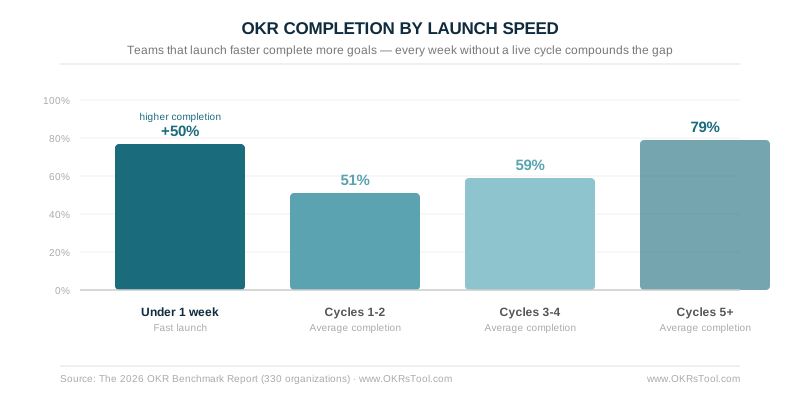
The 2026 OKR Benchmark Report across 330 organizations puts a number on what that pace produces: teams in cycles 1–2 average 51% completion. By cycle 5+, the same organizations average 79%. The improvement isn't from writing better goals — it's from the accumulated discipline of structural habits that compound cycle over cycle. Teams that launch in under a week see up to 50% higher completion rates. Teams with automated weekly check-ins complete 43% more OKRs than those reviewing monthly.
The book is the inspiration. The structure is what makes it work.
What The Book Gets Right That Most Implementations Miss
Before getting to the how, it's worth being precise about what Doerr is actually arguing — because the most common implementation mistakes come from misreading the book's central claims.
The first is that OKRs are not a performance management tool. Doerr is explicit about this. Objectives should be aspirational enough that hitting 70% is considered strong progress.
When OKRs get tied to bonuses or reviews, the ambition disappears — people set targets they know they can hit, which defeats the entire purpose. At the 50-to-80-person stage, this is the mistake that kills the first cycle and poisons the second.
The second is that alignment doesn't mean top-down cascade. The book describes a bidirectional process — company objectives set the direction, but team and individual objectives are developed with genuine input from the people doing the work.
An OKR that gets handed down is a target.
An OKR that gets co-created is a commitment.
The third is that the check-in cadence is not optional.
Doerr describes weekly check-ins not as a reporting mechanism but as a thinking discipline — a regular moment to ask whether the work being done is still pointed at the right outcome. Without that cadence, OKRs become a planning exercise rather than a management system.
"Our management team all read Measure What Matters. We're a team of 75 people — we needed a simple way to communicate expectations without it being too cumbersome." — OKRs Tool customer
Where To Start — And What To Resist
The most common mistake after reading the book is trying to implement everything at once. Company OKRs, team OKRs, individual OKRs, CFRs, stretch goals, and a scoring system — all in the first quarter.
The ambition is understandable. The result is a team that spends more time on the OKR process than on the work it's supposed to be directing.
Start with one level. Set three to four company objectives for the quarter — written by leadership, with input from team leads. Write two to three key results per objective, each with a named owner.
Your first 90-day OKR cycle — week by week
Week –1: Before the quarter — Run the OKR workshopSend the pre-read 48 hours before. Draft objectives with team leads. Assign one owner per key result. Lock in the first check-in before anyone leaves the room.
Week 01: Quarter opens — Publish and share objectivesObjectives, key results, and owners published within 24 hours of the workshop. Shared at the all-hands. Every team member can see what the quarter is for.
Week 03: Early signal — First progress check-in15 minutes per team. Each key result owner shares where things stand and flags early blockers. Not a review — a pulse check.
Week 06: Mid-quarter — Mid-cycle reviewHonest assessment of progress. What's on track, what's behind, and what needs to change in the next six weeks. Decisions made in the room — not deferred.
Weeks 7–11: Execution — Weekly check-in rhythmOwner updates every week. Progress tracked in real time, not reconstructed at the end. Blockers surface early enough to do something about them.
Week 13: Quarter closes — End-of-cycle retrospectiveScore the key results honestly. Review what worked in the process itself — not just the outcomes. Carry the lessons into cycle two.
Cycle one doesn't need to be perfect. It needs to be finished — with a retrospective that makes cycle two stronger.
Share them clearly before the quarter starts and schedule a check-in in week three.
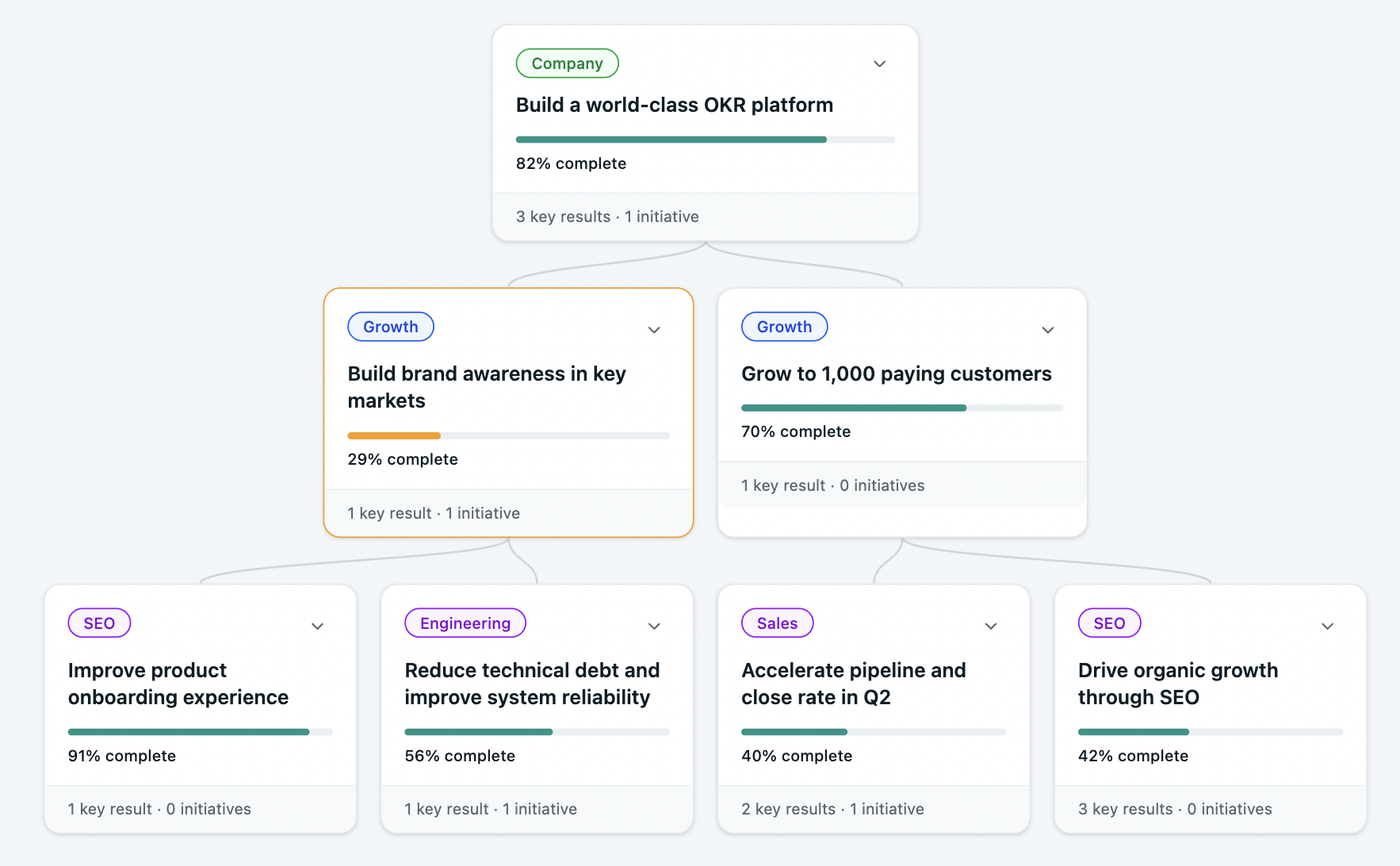
Show ImageCompany objectives with named Key Result owners and live progress scores — what a first cycle looks like in OKRs Tool.
That's it for cycle one. The goal isn't a perfect OKR programme. It's a quarter where the objectives are visible, the progress is tracked, and the team experiences what it feels like when a goal is actually managed rather than set and forgotten.
Everything Doerr describes about individual OKRs, CFRs, and organisational alignment is real and worth building toward. But it gets built in cycles, not installed in a weekend.
Should You Use OKR Software — And Why?
Doerr is notably pragmatic about tooling. The book doesn't prescribe a platform — it prescribes a discipline. OKRs have been run on spreadsheets, on whiteboards, and in a dedicated OKR software tool, and the quality of the outcomes depends far more on the quality of the thinking than the sophistication of the system.
That said, at 75 people, a spreadsheet creates the problems described throughout this article — manual updates, version confusion, low adoption, and a progress picture that's always stale.
The right tool isn't the most feature-rich one. It's the one that makes the check-in cadence frictionless enough that it actually happens. The ROI data is clear on what the right infrastructure produces: organizations using purpose-built OKR software generate a 1:88 return on investment — compared to 1:25 on spreadsheets. That difference isn't the software cost. It's the weekly habit that a purpose-built tool makes structurally unavoidable.
OKRs Tool is built for exactly this stage — simple enough to set up in the week after a management team finishes the book, structured enough to support the full OKR cycle Doerr describes. Weekly check-in nudges handle the cadence problem. The Alignment Map makes the connection between individual work and company strategic goals visible without a meeting. And at a flat $49 per month beyond the free tier, it scales with the team rather than against it.
The Book Is The Beginning, Not The Blueprint
Measure What Matters is the best argument for OKRs ever written.
It's also a retrospective — a look back at what made the framework work in exceptional organizations, told through the lens of people who had years to refine their practice.
Your first cycle won't look like Google's. It shouldn't. What it should look like is a quarter where the team is clearer about what matters, more honest about whether it's happening, and better positioned to run a stronger cycle next time.
That's the implementation Doerr is actually describing — not a system installed in Q1, but a discipline built over time. Start simple, run the cadence, and let the practice improve from there.
Data: The ROI of OKRs: 2026 Benchmark Report (330 respondents), The 2026 OKR Benchmark Report (200+ organizations).