
Across an analysis of 5,000+ OKR cycles, quarterly cycles averaged 46% end-of-cycle progress. Monthly cycles managed 37%, six-month cycles 34%, and irregular cycles near zero. Quarterly isn't the default because it's a comfortable middle. It's the cadence that most reliably turns goals into outcomes.
As teams mature in their use of OKRs, one operational decision quietly shapes everything that follows: how long the cycle runs. Some teams pick monthly in the name of agility. Others stretch to six months to give objectives room to breathe. Quarterly usually sits in the middle by default, without much justification behind it.
To test whether that default actually holds up, this analysis compared cycle length against real execution outcomes across more than 5,000 OKR cycles — measuring what teams delivered, not what they intended. The pattern was consistent: quarterly OKRs outperform both shorter and longer cadences, and they do it more reliably from team to team.
What the Data Shows
Grouping cycles by length and comparing average progress at cycle end produces clear separation between cadences.
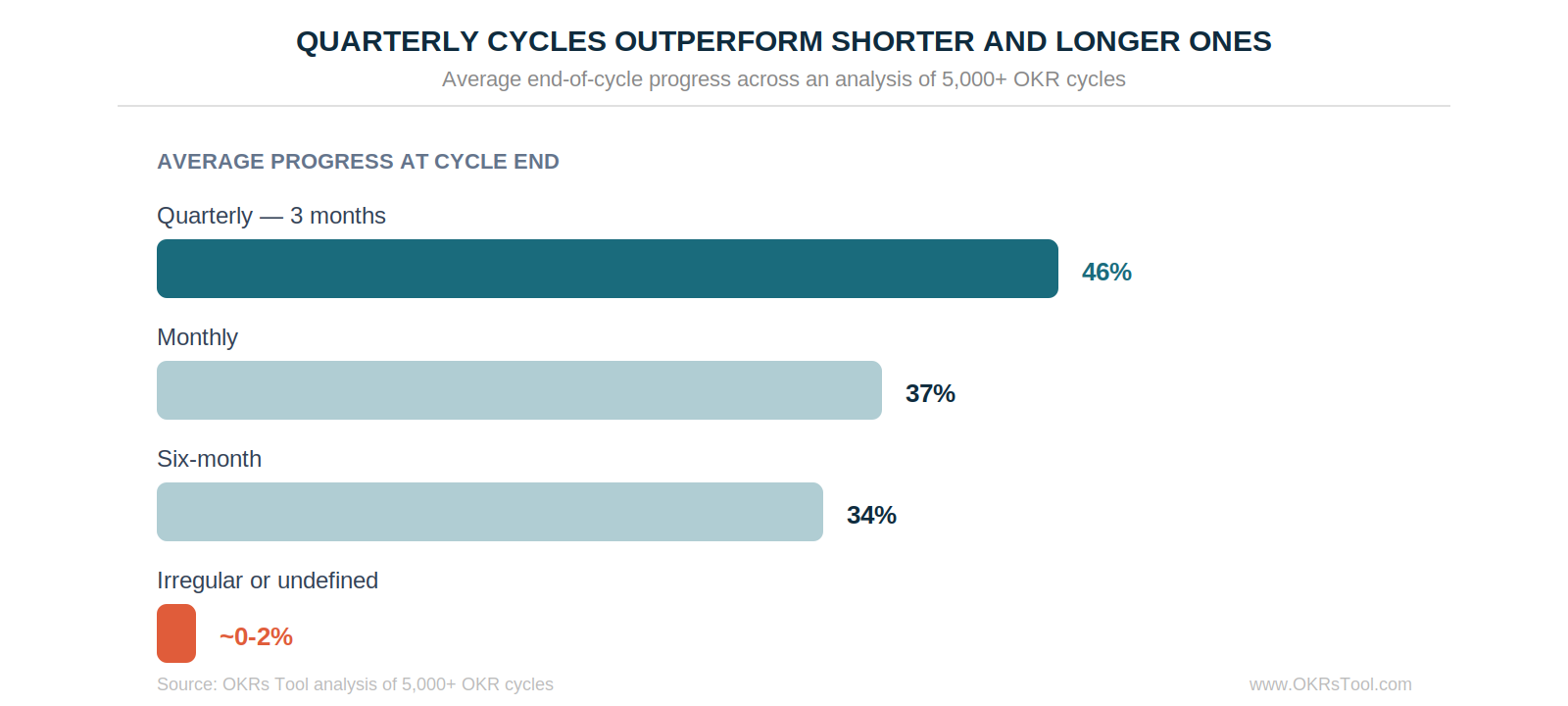
Quarterly cycles averaged 46% progress. Monthly managed 37%. Six-month cycles came in at 34%, and irregular or undefined cycles produced near-zero progress — goals set without a defined cadence barely move at all.
Quarterly is not only the best-performing cadence but also the most common in the dataset, which makes the signal statistically reliable rather than the product of a few outliers. And progress doesn't swing wildly from team to team within quarterly cycles — the cadence produces consistency, not occasional overperformance.
Why Quarterly Holds Up
The strength of quarterly OKRs isn't only higher average progress. It's that the outcomes are more predictable. Within quarterly cycles, median progress closely tracks the average, which means results are broadly distributed rather than carried by a handful of exceptional teams.
In practice, this is what makes quarterly plannable. A leader can plan the quarter, run check-ins, and course-correct with confidence, because performance is less volatile than it is at other cadences. The system works for most teams, not just the ones with exceptional execution discipline.
Quarterly strikes a balance the other cadences struggle to hold: enough time for meaningful outcomes to compound, paired with a feedback loop that surfaces problems while there's still time to act on them. Thirteen weeks is long enough to deliver real change and short enough that a weekly check-in can catch drift before the cycle is lost.
Where Six-Month Cycles Break Down
Six-month OKRs underperform, and the averages understate the problem. Nearly 14% of six-month cycles ended with zero progress — the highest abandonment rate of any cadence in the analysis.
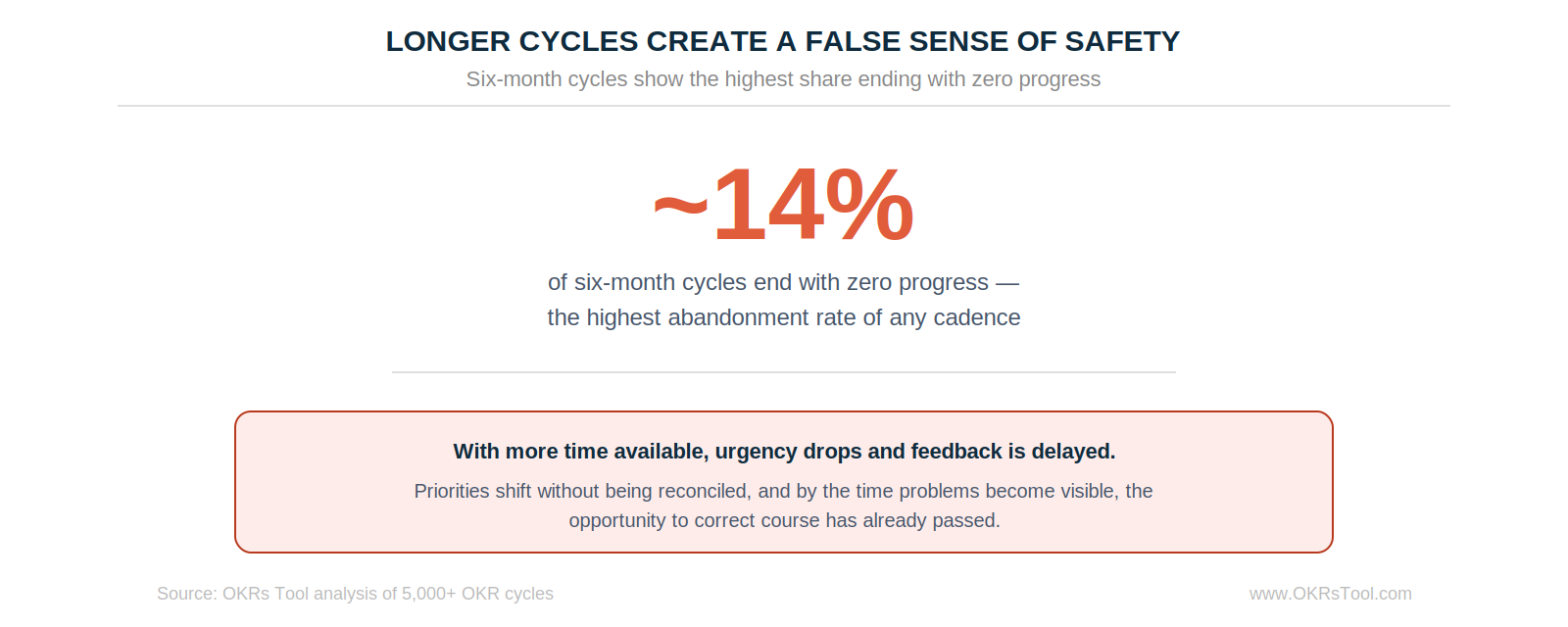
Median progress in six-month cycles runs lower than the average suggests, and variability is high — a few successes mask widespread drift. The extra runway creates a false sense of safety. Urgency drops, feedback is delayed, and priorities shift without being reconciled. By the time a problem becomes visible, the window to correct it has usually closed.
The cost isn't only lower execution. It's slower learning. A problem discovered in month five of a six-month cycle can't inform that cycle at all — the retrospective arrives after the fact rather than in time to change anything.
Why Monthly Falls Short Too
Monthly OKRs avoid the drift of long cycles but introduce a different constraint. Teams stay active, but outcomes struggle to materialize inside such a short window.
Setup and reset overhead consume a disproportionate share of each month, leaving little room for impact to compound. Median progress runs noticeably below quarterly — many teams complete a month of work without achieving meaningful change, because execution-heavy Key Results rarely have enough runway to land in four weeks.
The distinction worth drawing is between monthly check-ins and monthly OKRs. A monthly checkpoint can be useful. A full monthly OKR cycle rarely gives execution-heavy goals the time they need to turn into results.
What This Means in Practice
The analysis points to a clear operating recommendation for execution-heavy teams of 50 to 200 people.
Run quarterly OKRs as the core execution rhythm — the 13-week cycle is where average progress and consistency both peak. Support them with monthly checkpoints or milestones rather than full monthly OKRs, so shorter-horizon work has structure without the reset overhead. And reserve six-month horizons for high-level directional intent — a strategic anchor that quarterly OKRs execute against, not an execution cadence in its own right.
The quarterly rhythm reduces abandonment, surfaces problems earlier, and makes performance predictable enough to plan around. That combination is why it outperforms — not because thirteen weeks is a comfortable compromise, but because it matches how execution actually works.
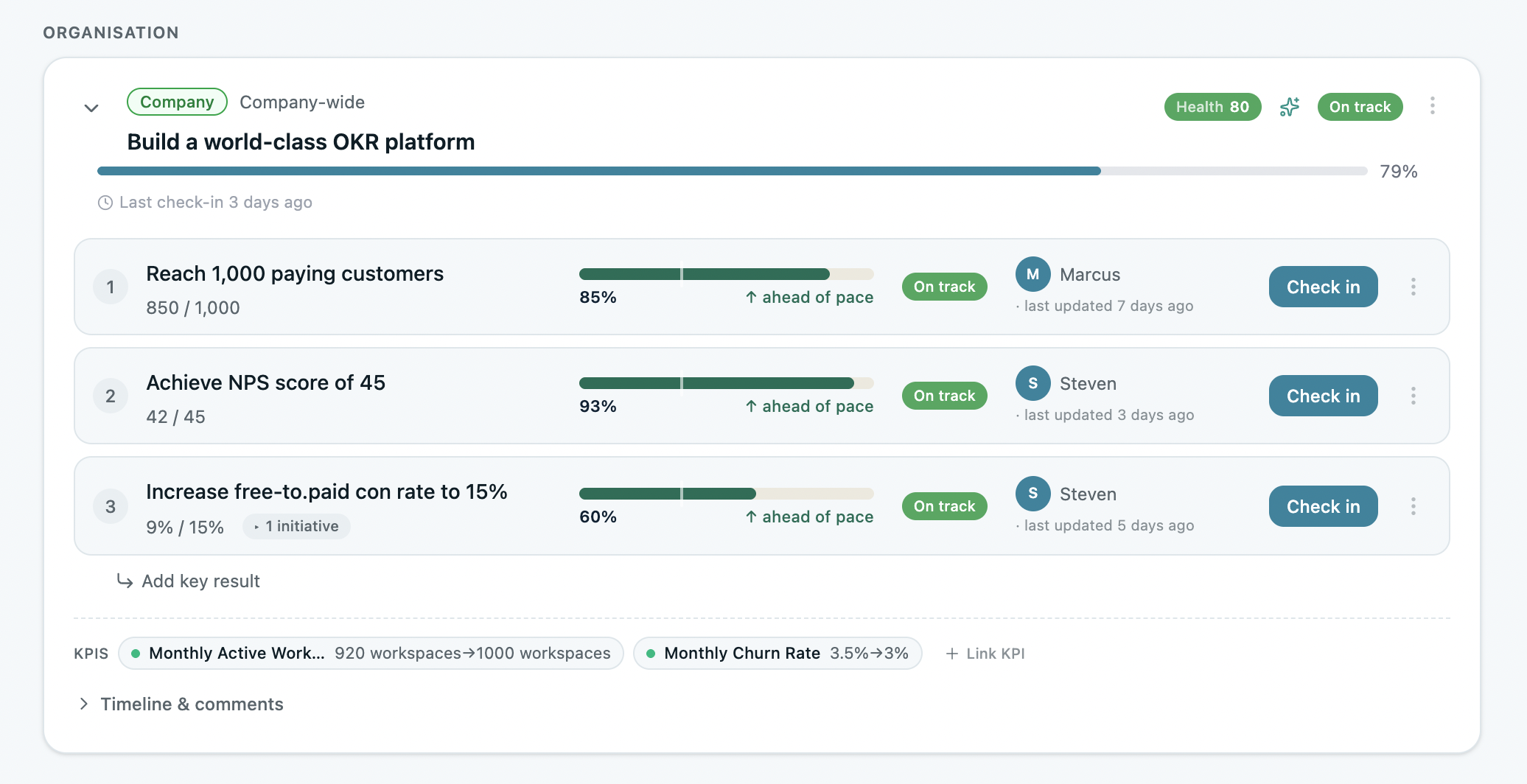
Cycle Length at a Glance
Cadence Is an Execution Decision
OKR cadence isn't a cosmetic choice. It directly shapes how teams prioritize, execute, and learn — and the analysis of roughly 5,000 cycles shows quarterly rhythms outperform the alternatives because they match how organizations actually operate. They balance urgency with realism, give outcomes room to compound, and surface feedback while it can still change a decision.
For teams that already take OKRs seriously, the question isn't whether cadence matters. It's whether the cadence in place is helping execution or quietly working against it. See how OKRs Tool runs the full quarterly cycle — free for up to 5 users.
Data: OKRs Tool analysis of 5,000+ OKR cycles. This cadence analysis is a distinct dataset from OKRs Tool's platform benchmarks (876 organizations) and the 2026 OKR Benchmark Report (330 organizations).