
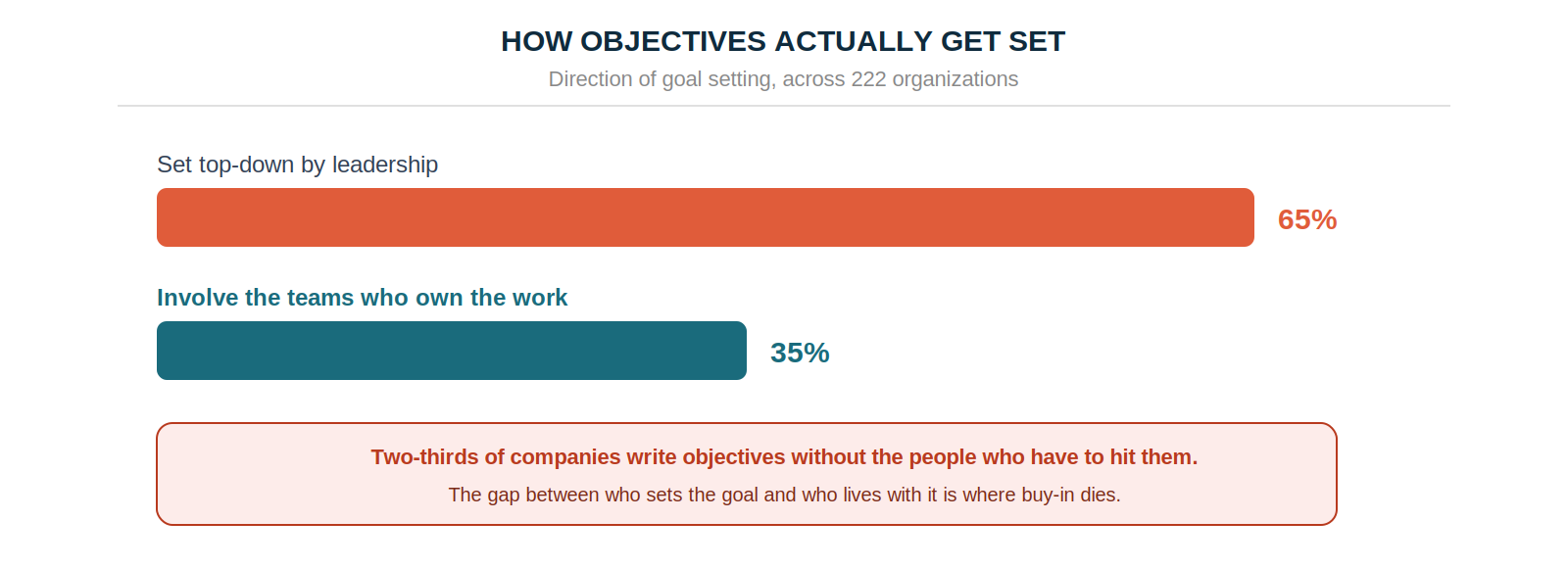
OKR goal setting fails before the quarter starts, and the cause is structural: 65% of companies write objectives top-down, without the people who have to hit them. The result is predictable — 92% of employees admit to gaming a goal they had no hand in setting. These seven steps build ownership into the objective itself.
Ask an employee whether deleting their goal tracker tomorrow would change anything about how they work, and a third say no. Not that they'd miss it, or work around it — that nothing would change at all. The goals are recorded somewhere and the work happens somewhere else, and the two have stopped touching.
That answer is set weeks earlier, in the room where the objectives get written. Whoever is in that room ends up owning the goal; whoever isn't ends up managing it. The distinction sounds subtle and produces two completely different quarters — one where people chase the number, and one where they handle it.
Why Isolation Is the Real Problem
There's a specific size where goal setting stops working on instinct. Below about fifty people, direction travels by proximity — someone says what matters in a meeting and everyone hears it. Above a couple of hundred, there's usually a planning function whose job is to move that information deliberately. In between, companies keep using the first method at a size that requires the second.
The OKR Intelligence Report 2026, covering 222 organizations, found 65% set objectives top-down. The asymmetry that creates is the whole problem: leadership writes the goals holding the reasoning behind them, and teams receive the output with the reasoning stripped out. Silence follows, and it gets misread as agreement. There was simply no moment in the process where disagreement was expected, so none was voiced.
What follows next looks like cynicism and is closer to arithmetic. Handed a number they didn't shape, people optimise for surviving it: 92% admit to gaming a goal at least once, 89% have padded a target so it lands safely, and 70% have shown green on something that wasn't. Each of those is a sensible move if the number was never yours to argue with.
Softer goals don't fix this, and neither does a longer offsite. What changes the outcome is a process where the people who carry the goal help write it — seven steps, applied before the quarter opens.
Step 1. Start With Company Context, Not Company Objectives
The session opens with the picture, not the plan: revenue against target, where growth is constrained, which bets are working, which are behind. Teams need this as raw material for their own thinking rather than as a preamble to be sat through.
The reason to be deliberate about it is that this context is usually missing. In 86% of companies, most employees can't state the strategy at all — so a team asked to write an objective is guessing at what the business needs. Give them the picture and two things improve at once: the objectives get sharper, and the questions get harder.
Step 2. Let Teams Draft Their Own Objectives First
Before the leadership set is locked, every team lead writes their own objectives: what does their team need to accomplish this quarter, and what would real progress look like?
Expect the drafts to be wrong in places. Accuracy was never the point of them — reconciling those drafts against company priorities forces an actual negotiation, and negotiation is what produces ownership. A team that argued for its objective and adjusted it will defend that objective in week eight. That's the top-down and bottom-up balance doing its work: priorities from leadership, interpretation from the people who'll deliver it.
Step 3. Write Key Results With the People Measuring Them
Three conditions have to hold for a key result to work: the person accountable believes the number is reachable, knows exactly how it'll be measured, and helped choose it. Miss any one and you've set a target rather than made a commitment.
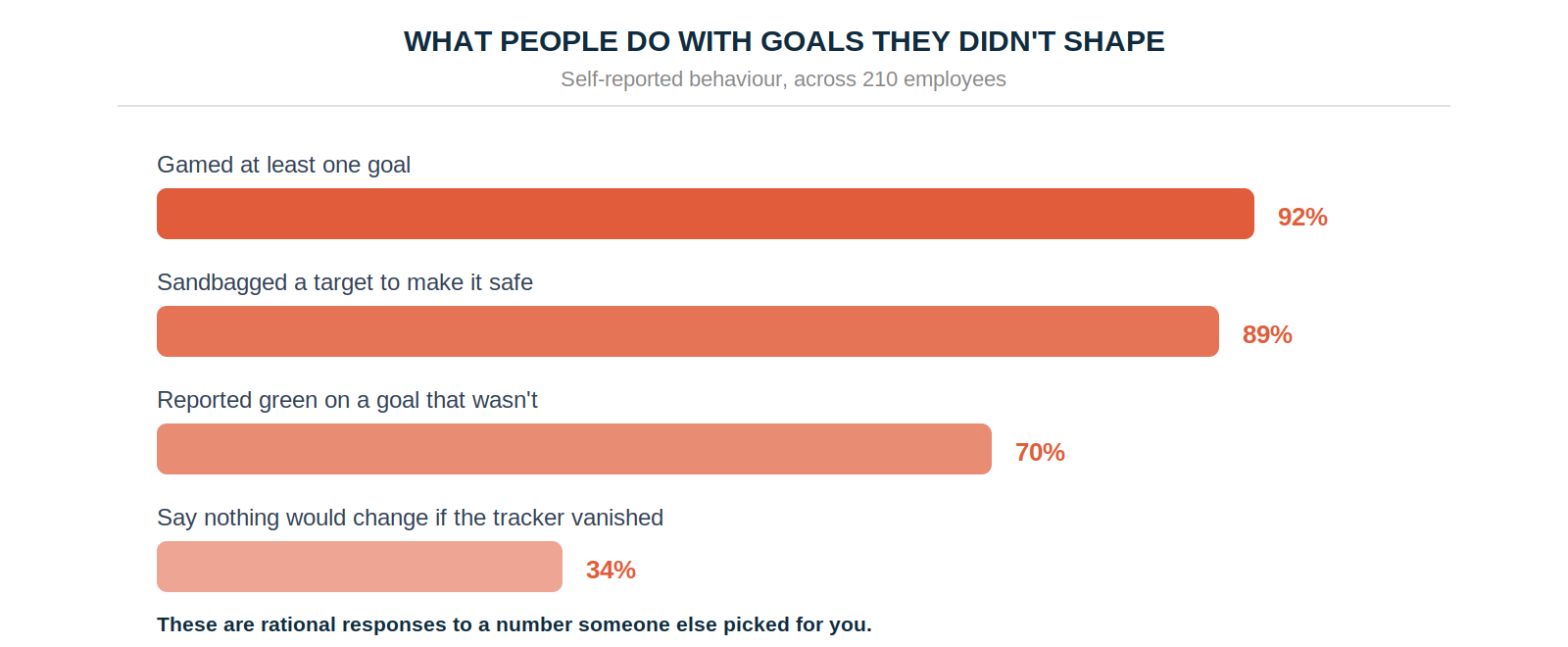
The 89% sandbagging figure is what happens when that third condition fails. Padding isn't dishonesty — it's insurance against a number you had no say in, taken out by someone who'll be judged on it either way. Remove the need for insurance and the padding goes with it.
Step 4. Stress-Test for Conflicts Before You Publish
Any set of team objectives contains contradictions. Product wants to slow down and clear technical debt while Sales is planning to accelerate; Marketing has a campaign that assumes engineering capacity nobody allocated. These are visible on paper if anyone looks.
A cross-team review before publication is where they get looked at. Name each conflict, decide it, and write down what was decided. Left alone, a contradiction that costs one honest conversation in week one costs a quarter and a political fight by week eight.
Step 5. Limit Objectives Ruthlessly
Every team will make a case for its priority being official, and honouring all of them is the default failure. Cap it: three to four company objectives, two to three per team, and ruthless prioritization to get there.
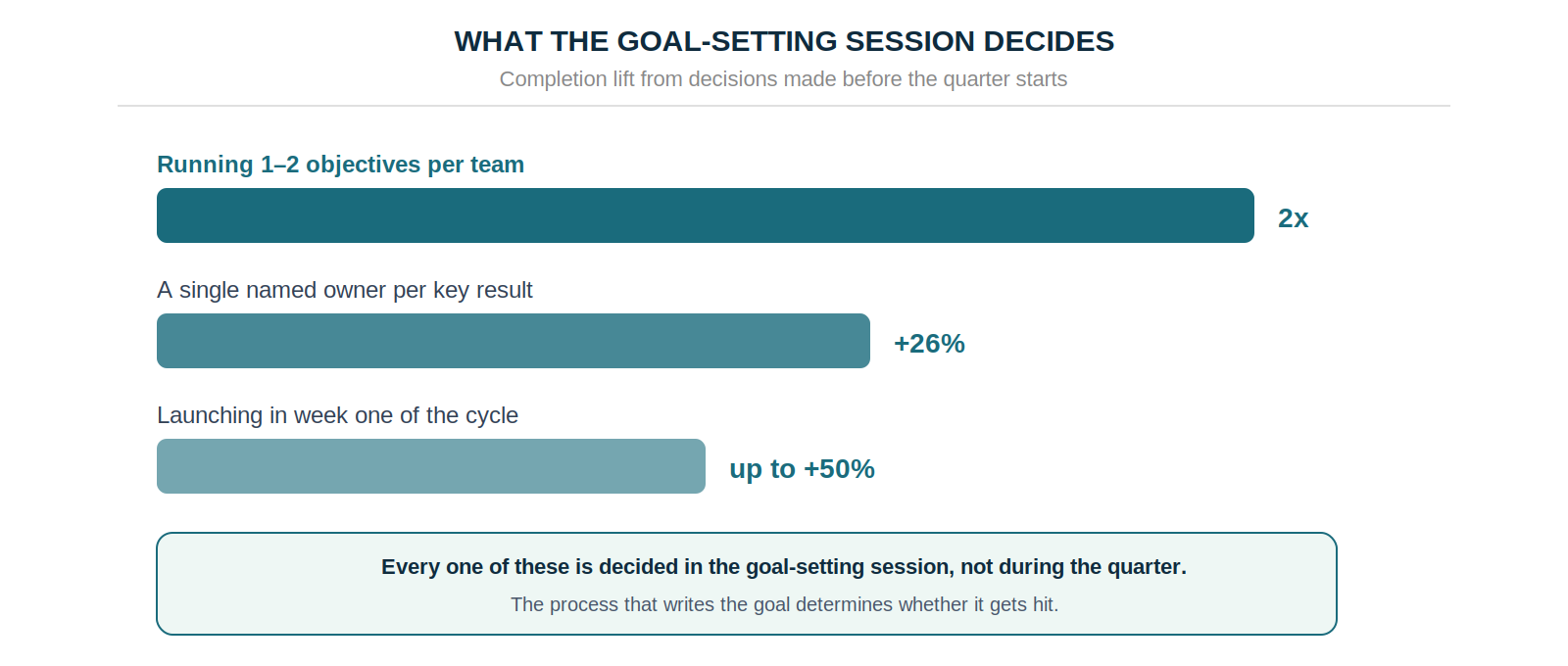
The number is load-bearing. Teams running 1–2 objectives a quarter are twice as likely to achieve them as teams running three or more — the same effort, spread thinner, produces less. And a useful test for anything that didn't make the cut: if it matters, it'll appear inside a key result. If it appears nowhere, it was a standing responsibility rather than a quarterly priority, and it never needed an objective.
Step 6. Assign One Owner Per Key Result
Not a team. Not a function. One person.
Half of all key results carry no owner at all, and the ones that name a single person are completed 26% more often than those with shared accountability. The mechanism is visible at any mid-quarter review: a key result that belongs to everyone produces a conversation where the miss belongs to no one.
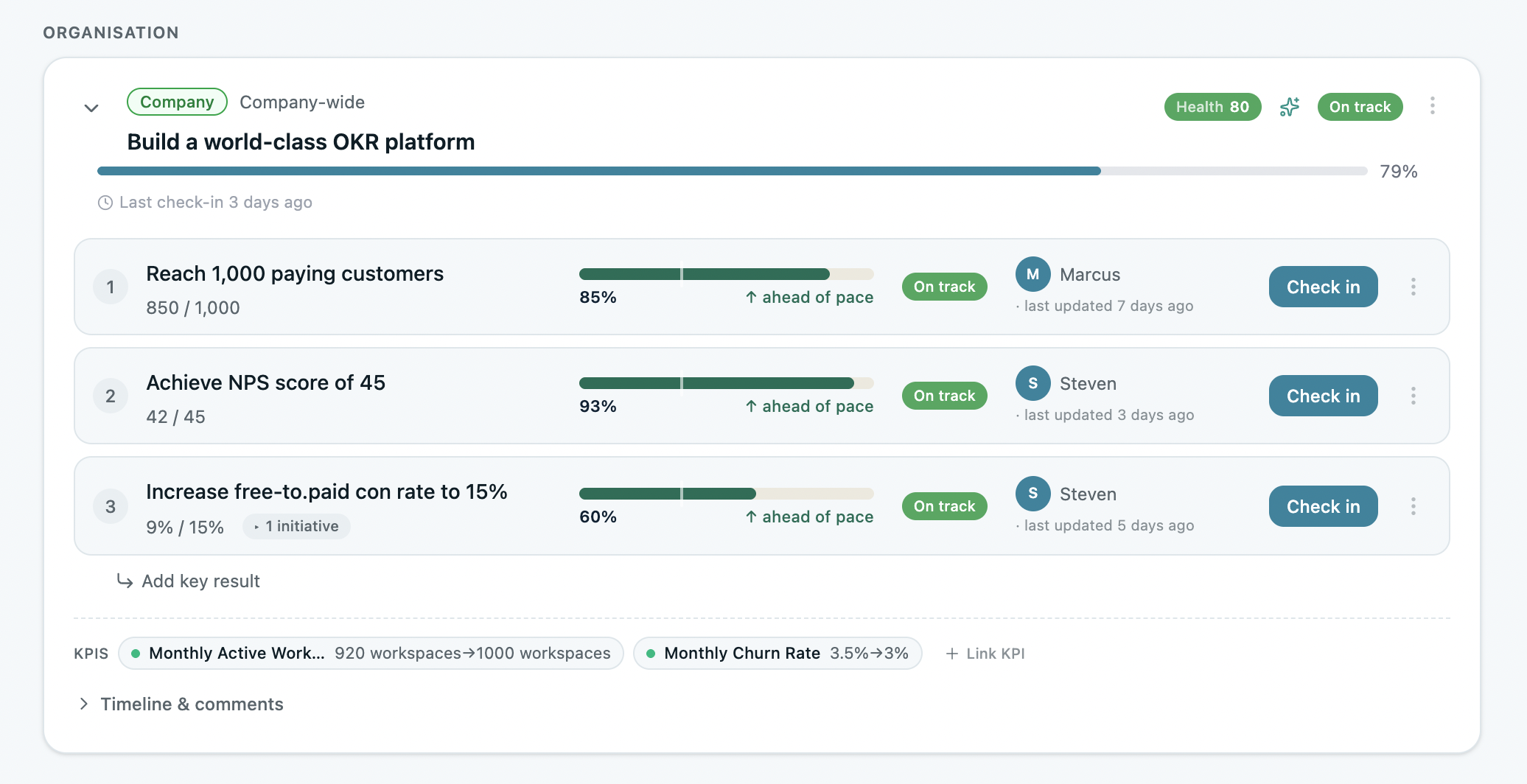
Naming happens in the session, not afterwards. And the requirement doubles as a quality filter — a key result where no single person can plausibly be accountable is usually a key result that was written badly.
Step 7. Build the First Check-in Into the Session
The last five minutes of the planning session are the highest-leverage minutes in it. Book the first check-in, name who runs it, and agree what "on track" should look like by week three — while everyone is still in the room.
Check-ins collapse when they're left to be organised later, because later means after everyone has returned to the work that was already waiting. The cost of that drift is measurable: teams that launch in week one see up to 50% higher completion, and teams holding a consistent weekly check-in complete 43% more goals than those reviewing monthly or ad hoc. Five minutes of calendar admin is what stands between an objective and the document it dies in.
Goal Setting Is a Conversation, Not a Cascade
Sophistication of framework has almost nothing to do with which teams hit their objectives. What separates them is direction of travel: context moving down, input moving back up, and a set of goals that survived contact with the people who have to deliver them.
Goals set in isolation get worked around, and the 92% gaming figure is the measurement of exactly that. Goals set together get worked toward. Nothing about the shift requires a new methodology or a two-day offsite — it requires the people closest to the work having a real say before the objectives are final. Once they've shaped the goal, they stop waiting to be told how it's tracking and start caring whether it lands.
The test of whether you got it right arrives in week eight, when something is behind. In a room that wrote its own goals, someone says so. In a room that received them, the number stays green and the work quietly moves elsewhere.
Data: OKR Intelligence Report 2026 (222 organizations), The State of Goal Management (210 employees), The 2026 OKR Benchmark Report (200 organizations), Strategy Execution Benchmark 2026 (180 strategy and operations leaders).