Start Planning Your Q1 2026 Goals Now
Sign Up Free

How to Make OKRs Work (Real Data from 2,000 Companies)

If OKRs “don’t work,” this data explains why. After analyzing how 2,000 organizations set and ran OKRs, we uncovered the execution habits that truly matter.

Steven Macdonald
7 ins read
December 31, 2025
How to Make OKRs Work (Real Data from 2,000 Companies)

More than 2,000 organizations have set and tracked OKRs using our software (OKRs Tool).

These organizations span startups, scale-ups, and established companies across industries and geographies.

What makes this dataset valuable isn’t theory - it’s behavior. We can see how teams write OKRs, how often they update them, where they struggle, and what correlates with success or failure.

After analyzing this data across thousands of OKR cycles, a few patterns show up again and again. Some are intuitive. Others are surprising. Together, they form nine practical lessons for any organization using - or considering - OKRs.

🧭 Before you start your next OKR cycle

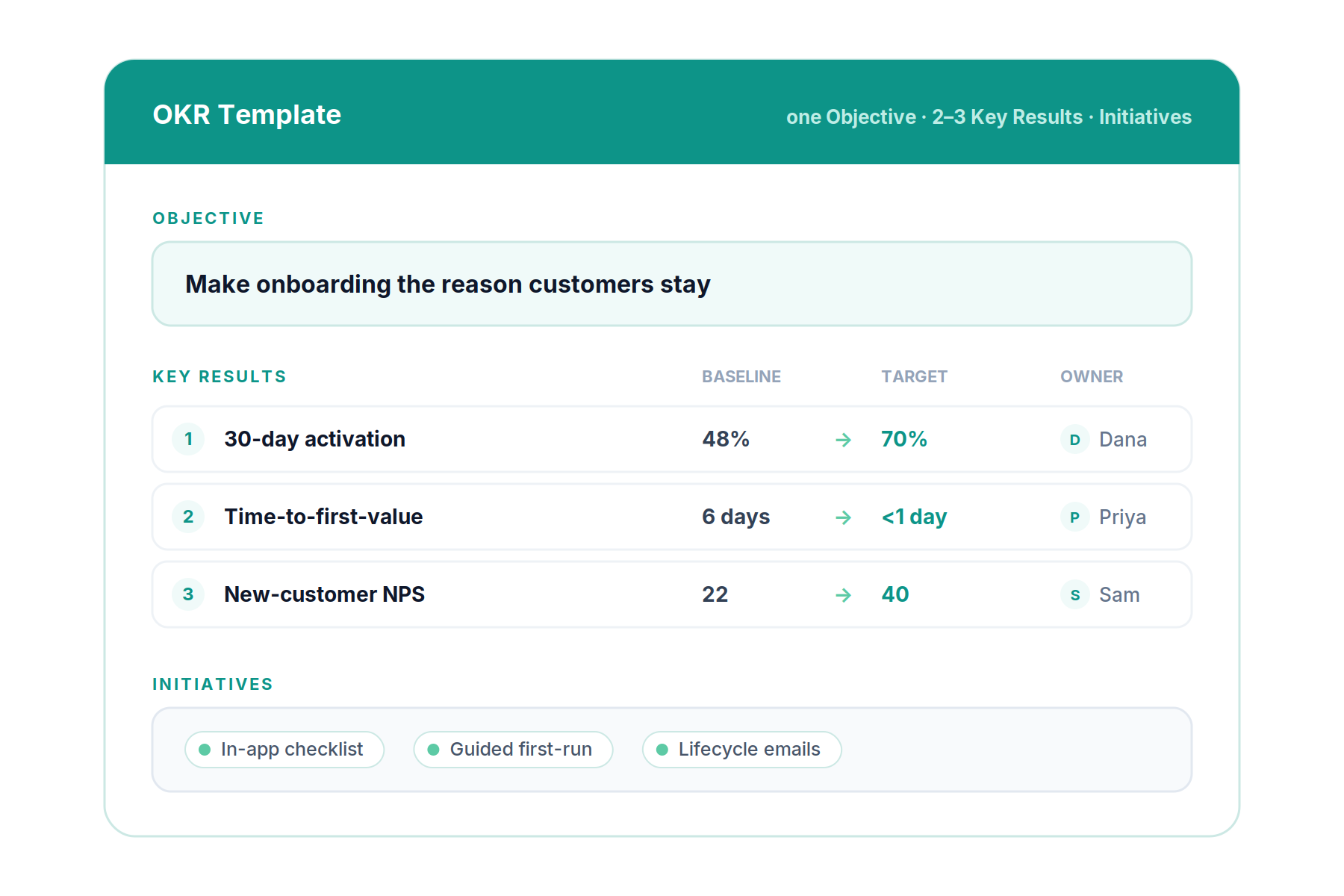
Download the 90-Day OKR Kickoff Template — a lightweight guide to structure your next quarter before you write OKRs, set cadence, or assign ownership.

Lesson 1: OKR Success Is About Rhythm, Not Inspiration

The strongest predictor of OKR success is not how ambitious the objectives are - it’s how often teams engage with them.

Organizations that update their OKRs weekly or every 7–10 days consistently outperform those that update them monthly or only at the end of the quarter. Regular updates create a feedback loop: teams notice slippage earlier, adjust initiatives faster, and keep goals top of mind.

Teams that don’t establish a rhythm tend to treat OKRs as a planning artifact rather than a management tool. By the time they review progress, it’s already too late to course-correct.

Takeaway: OKRs should operate on a weekly cadence. If they’re not part of your regular operating rhythm, they won’t drive execution.

Lesson 2: Over Half of “Key Results” Are Just KPIs in Disguise

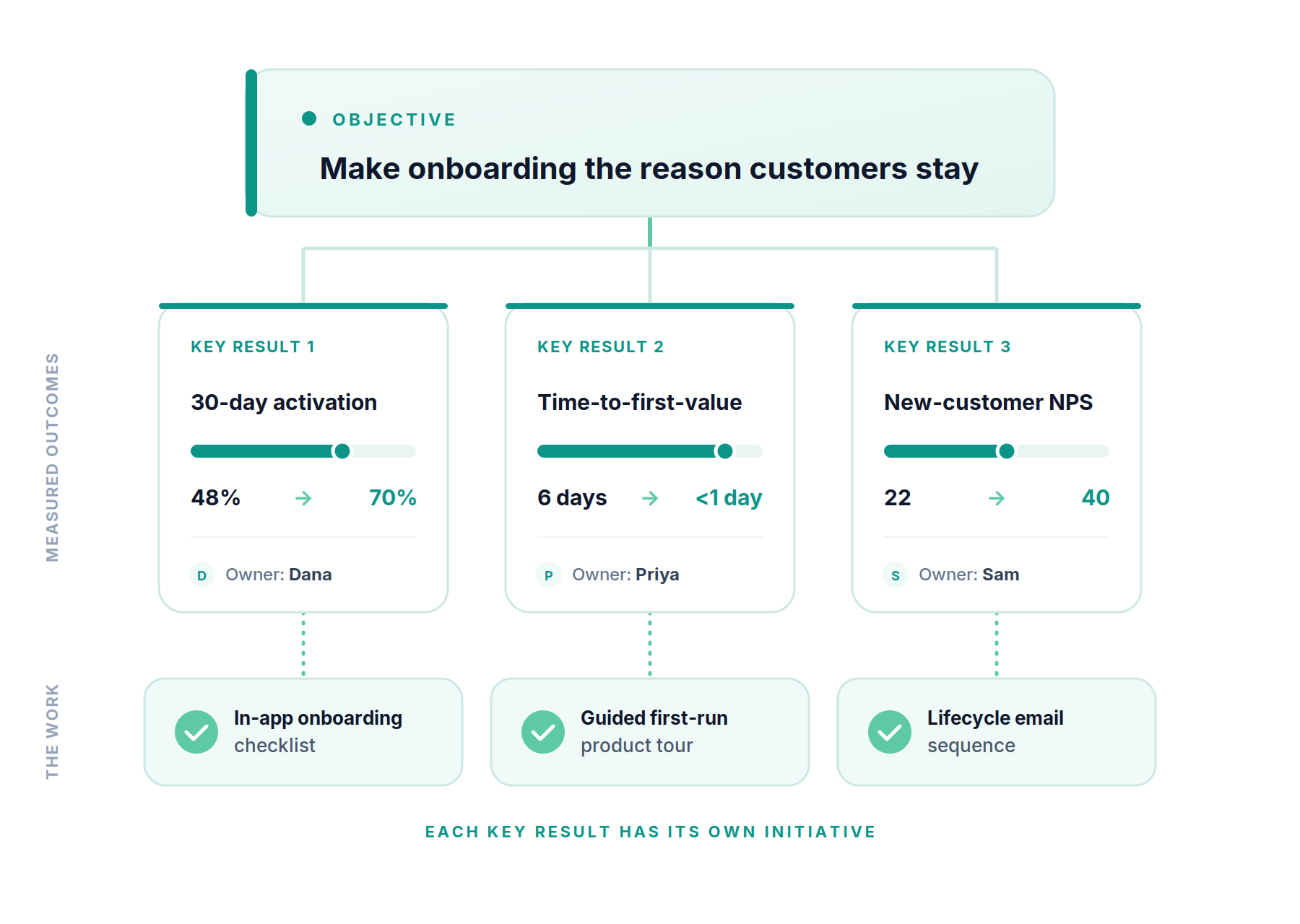
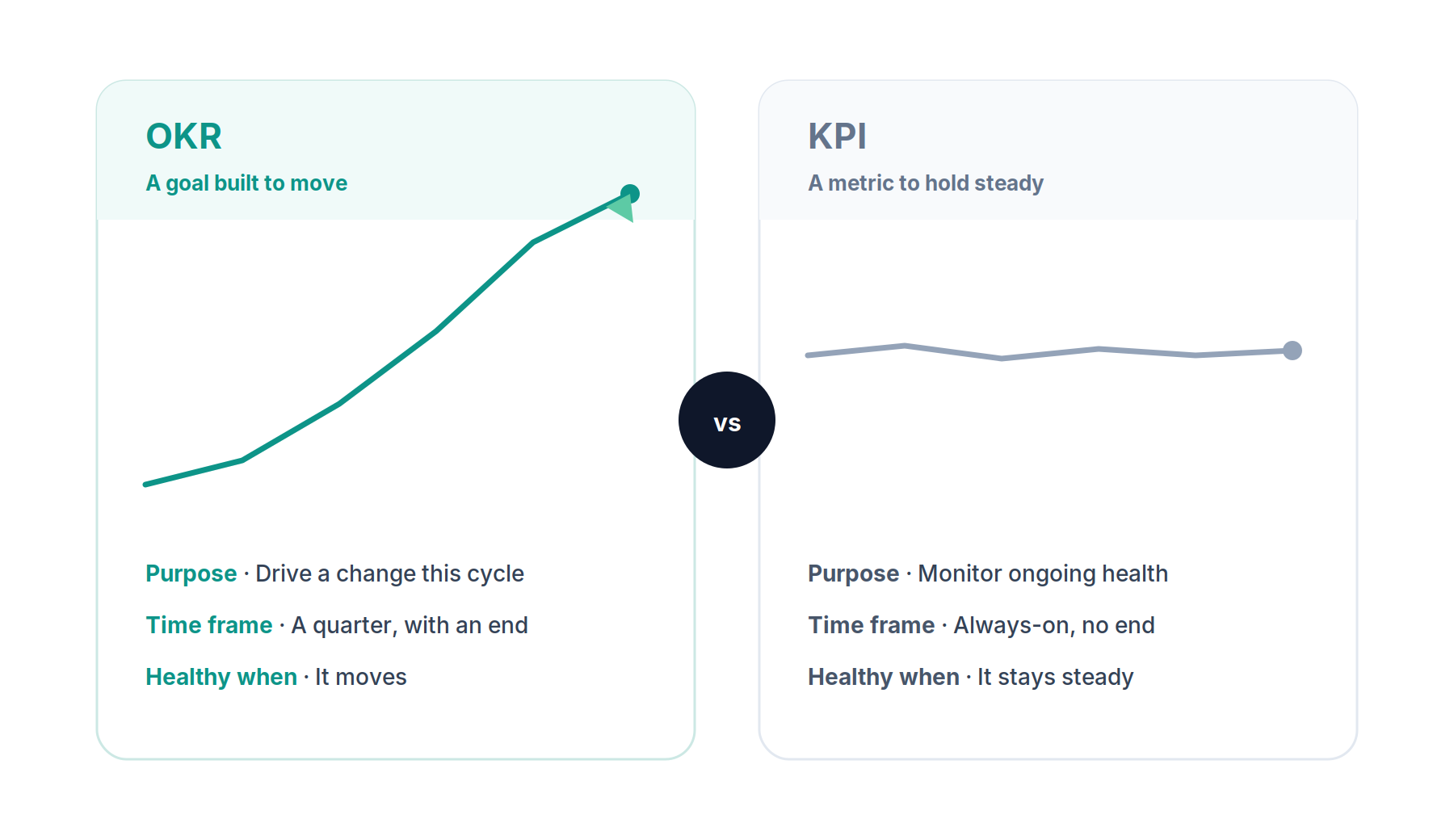
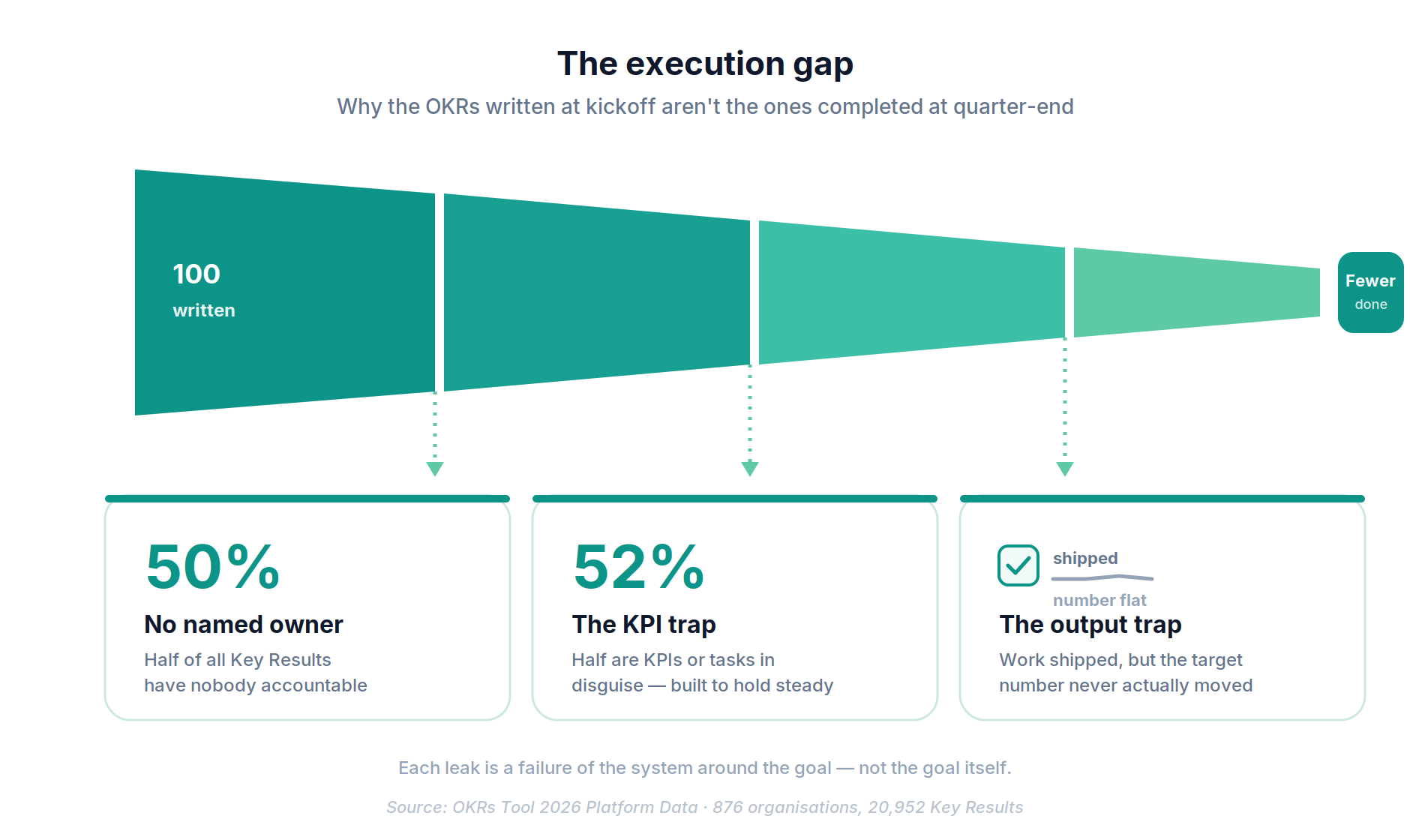
Across thousands of OKRs, we found that roughly half of all Key Results were written as KPIs - metrics that track the health of the business rather than measure meaningful change.

Examples include:

  • “Maintain churn below 5%”

  • “Keep uptime at 99.9%”

  • “Revenue per customer”

These metrics are important, but they don’t belong as Key Results unless they represent deliberate change from a baseline. When teams confuse KPIs with Key Results, OKRs stop being a tool for transformation and become a reporting mechanism.

Takeaway: KPIs sustain the business. OKRs are meant to change it. Teams need explicit training on the difference.

Lesson 3: More Key Results Usually Mean Worse Outcomes

Objectives with two to three Key Results consistently outperform those with four, five, or more. As the number of Key Results increases, completion rates drop and engagement declines.

This isn’t because teams aren’t working hard - it’s because attention is finite. Too many Key Results dilute focus, slow decision-making, and make trade-offs harder.

Teams often add extra Key Results to feel “safe” or comprehensive, but the result is the opposite: less clarity and weaker execution.

Takeaway: Constraint drives focus. Fewer, sharper Key Results lead to better outcomes.

Lesson 4: Teams That Attach Initiatives Early Move Faster

High-performing teams don’t wait weeks to decide how they’ll achieve their OKRs. They define initial initiatives early, often in the first week of the cycle, and refine them as they learn.

Lower-performing teams delay initiatives, hoping clarity will emerge on its own. Instead, they lose momentum and struggle to translate goals into action.

Importantly, the best teams don’t treat initiatives as static. They adjust, replace, or stop them based on progress data.

Takeaway: Speed matters. Early action creates momentum, even if the plan isn’t perfect yet.

Lesson 5: The First 30 Days Set the Trajectory

The earliest part of an OKR cycle is disproportionately important.

Teams that start late, skip early updates, or delay initiative execution almost never recover fully - even if they “catch up” later. Momentum compounds, both positively and negatively.

Early engagement creates habits: regular updates, honest scoring, and problem-solving conversations. Without those habits, OKRs slowly fade into the background.

Takeaway: Protect the first month of the cycle. That’s when success or failure is decided.

Lesson 6: There Is a Real Disconnect Between Planning and Execution

Many organizations write decent OKRs - but still fail to achieve them.

The reason is rarely goal quality. It’s a disconnect between OKRs and day-to-day execution. When OKRs aren’t referenced in weekly meetings, sprint planning, or prioritization discussions, they lose influence.

Teams under pressure default to urgent work. Without intentional reinforcement, OKRs get crowded out by operational noise.

Takeaway: OKRs must be embedded into how work is planned and reviewed - not stored in a separate system.

Lesson 7: High Performers Win on Habits, Not Framework Mastery

Benchmarking across organizations reveals a clear pattern: high-performing teams are not doing radically different things. They’re doing basic things consistently.

They:

  • Update regularly

  • Keep OKRs simple

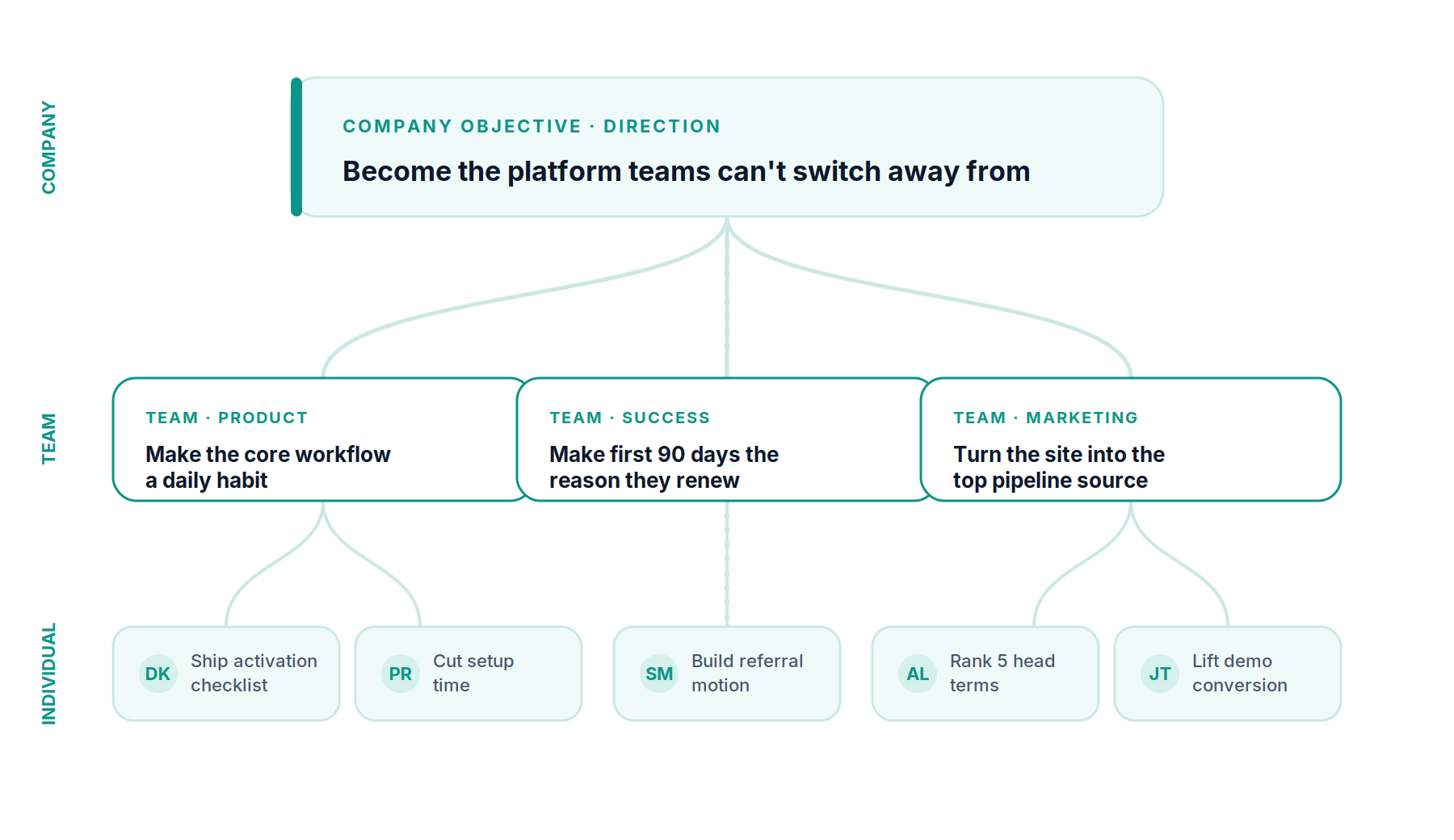
  • Assign ownership clearly

  • Review progress honestly

  • Run multiple consecutive OKR cycles

Lower-performing teams often search for advanced frameworks or perfect templates, when the real gap is execution discipline.

Takeaway: Maturity comes from repetition and consistency, not sophistication.

Lesson 8: OKRs Work Best When They’re Treated as a Long-Term System

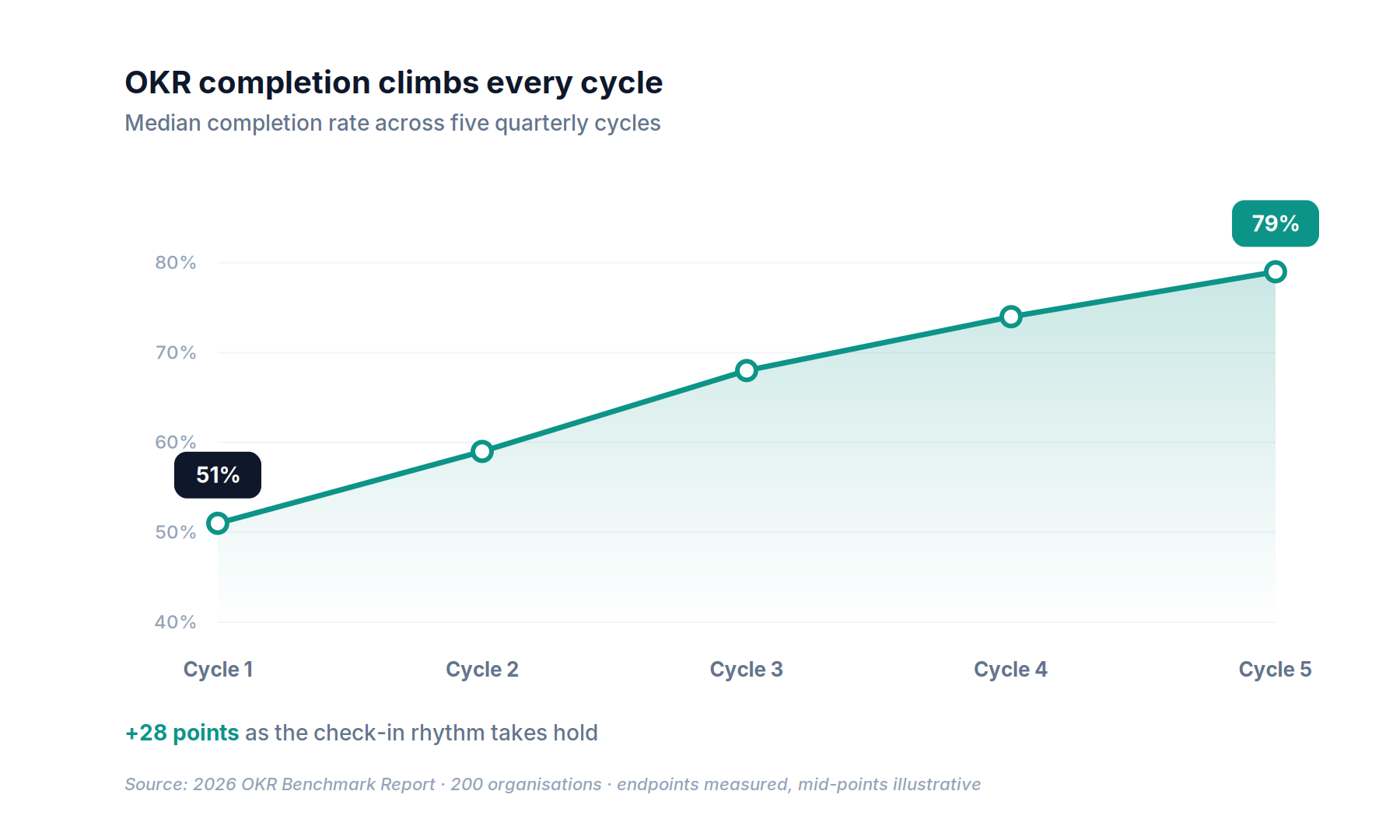
OKRs deliver the most value when organizations commit to them over multiple cycles. Teams that abandon OKRs after one or two quarters often do so just before benefits compound.

OKRs are a learning system. Each cycle improves goal quality, alignment, and execution skill. Organizations that stick with them long enough see stronger focus, faster decision-making, and more intentional growth.

Takeaway: OKRs are not a one-quarter experiment. They’re a long-term operating system.

What 2,000 Organizations Taught Us About OKRs

After analyzing thousands of OKRs across industries, team sizes, and maturity levels, the same execution patterns appear again and again - regardless of company type or ambition level.

# Lesson What We Observed Across 2,000 Orgs Practical Implication
1 Rhythm beats ambition Teams updating weekly consistently outperformed those updating monthly or quarterly Make OKRs part of the weekly operating cadence
2 Many KRs are just KPIs ~50% of Key Results tracked health, not change Train teams to write outcome-based Key Results
3 Fewer KRs perform better Objectives with 2–3 KRs had higher completion rates Limit KRs to force focus and trade-offs
4 Early initiatives matter High performers attached initiatives in the first week Move from goals to action immediately
5 Early engagement compounds The first 30 days strongly predicted final outcomes Protect momentum at the start of each cycle
6 Execution disconnect is common OKRs often faded from day-to-day decision-making Embed OKRs into weekly planning and reviews
7 Habits beat sophistication High performers followed simple practices consistently Focus on discipline, not advanced frameworks
8 OKRs reward commitment Multi-cycle teams saw stronger compounding benefits Treat OKRs as a long-term system

Taken together, these lessons show that OKR success is less about writing perfect goals and more about building repeatable execution habits.

OKRs Don’t Fail - Execution Habits Do

After observing 2,000 organizations, one conclusion stands out: OKRs are rarely the problem.

When teams struggle, it’s almost always due to inconsistent cadence, unclear ownership, lack of integration into daily work, or confusion between measurement and change.

The good news is that none of these issues require radical transformation. Small, disciplined improvements - weekly updates, fewer Key Results, clearer ownership - compound quickly.

If there’s one lesson above all others, it’s this:

OKRs work when they are treated as a management habit, not a planning exercise.

📥 Starting a 90-Day OKR Cycle? Use This First

After analyzing OKRs from 2,000 organizations, one pattern is clear: teams fail when they rush into writing goals. This kickoff template helps you set up the quarter so OKRs actually guide execution.

  • ✅ Define what actually matters this quarter
  • ✅ Establish ownership and cadence upfront
  • ✅ Avoid common OKR breakdowns before they happen
Download the 90-Day OKR Kickoff Template →
CEO Photo

Founder

Steven Macdonald│LinkedInX

Steven is the founder of OKRs Tool and has helped 1,000+ startup and scale-up teams start their OKR journey through the platform. With 4+ years of experience in OKR management, he built OKRs Tool to make setting objectives, tracking progress, and staying aligned simple for small teams.