What Is an OKR? Objectives & Key Results Explained
OKR stands for Objectives and Key Results. It's a goal-setting framework used by teams and companies to set an ambitious Objective and track it with two to three measurable Key Results.

We asked 280 company leaders where they stand on OKRs. 18% had never looked into them, and another 11% didn't know what they are. If that's where you're starting, this guide is for you.
The 60-second version, if you'd rather watch:
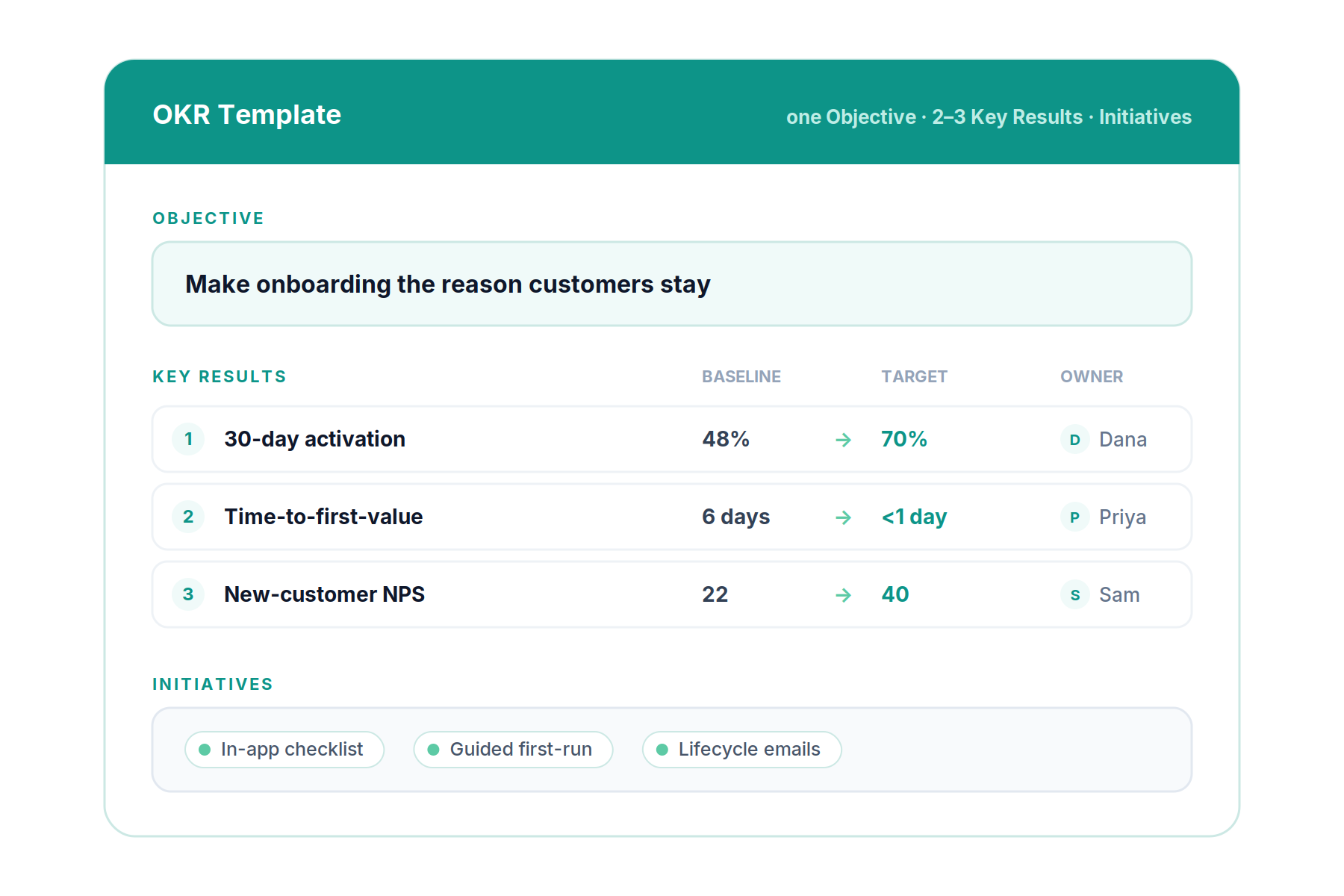
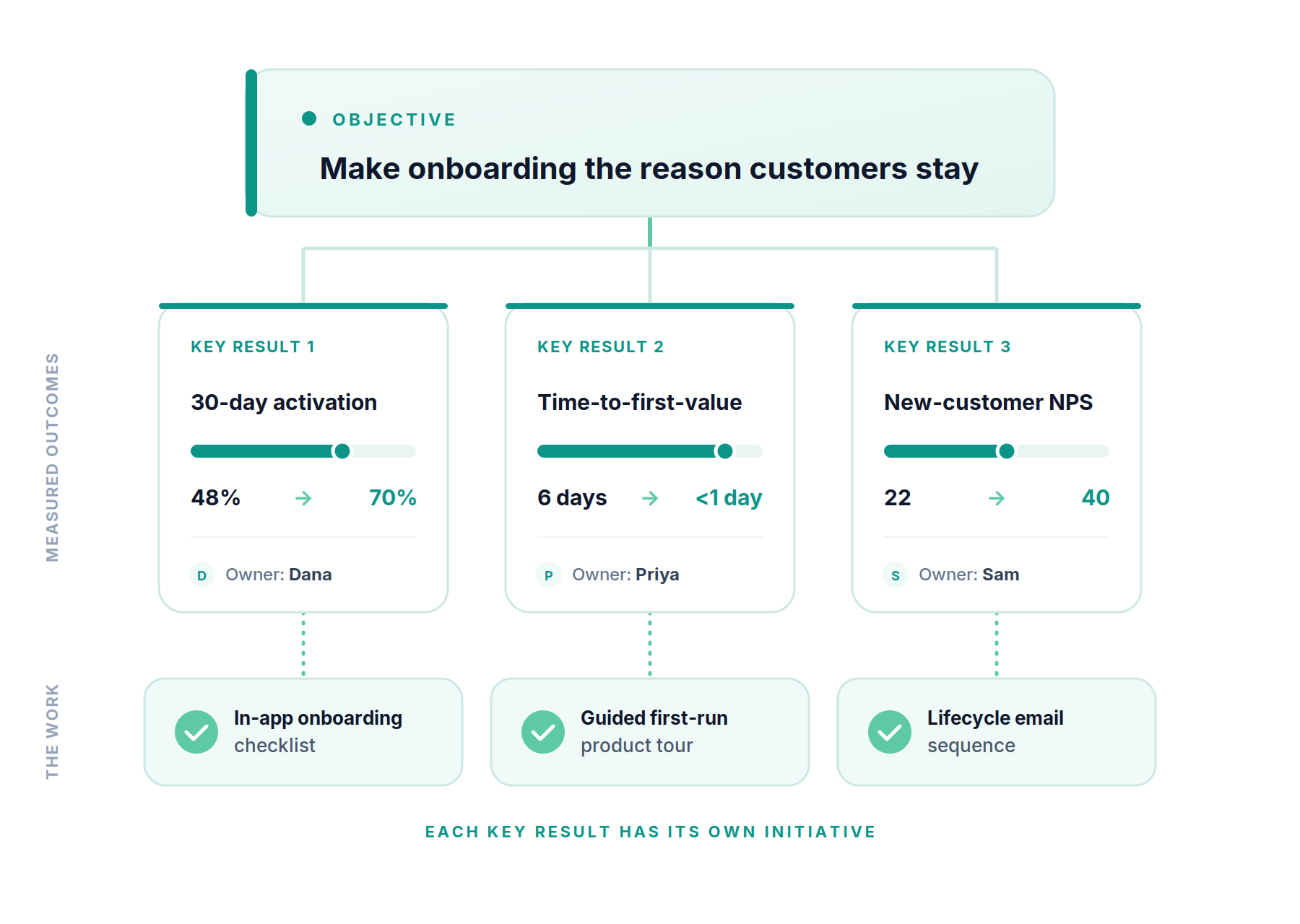
- Key Result 1: Raise 30-day activation from 48% to 70%.
- Key Result 2: Cut time-to-first-value from 6 days to under 1.
- Key Result 3: Lift new-customer NPS from 22 to 40.
Objectives, Key Results & Initiatives
Every OKR is built from three parts. Keeping them distinct is what separates a real OKR from a to-do list with ambitions.
Where you're going
A clear, inspiring, qualitative goal that tells you where to go and why it matters. No number in it — it's the direction, not the measure.
How you'll know
A measurable outcome that proves the Objective is being met. Each one moves from a baseline to a target. If you can't put a number on it, it isn't a Key Result.
What you'll do
The projects and tasks you believe will move the Key Results. Initiatives are the work, not the goal — you complete them, but you measure the Key Result.
OKR examples for every team
The framework looks a little different in each function. Here's one worked OKR for five teams — each an Objective plus outcome Key Results that move from a baseline to a target. For ready-made starting points, browse our OKR templates by role and function.
- Grow qualified pipeline coverage from 2.1x to 3.5x
- Lift win rate on sourced deals from 18% to 28%
- Cut average sales cycle from 74 to 50 days
- Raise weekly active use from 34% to 55%
- Increase feature adoption of the new flow from 0 to 40%
- Cut time-to-first-value from 6 days to <1
- Grow organic-sourced SQLs from 40 to 110/mo
- Lift demo-request conversion from 1.9% to 3.5%
- Rank top-3 for 5 priority head terms
- Cut lead-time-to-deploy from 9 days to 2
- Reduce change-failure rate from 18% to 8%
- Bring P1 incident recovery from 4 hrs to <1
- Ship self-serve onboarding for the top 10 use cases
- Lift 90-day activation from 52% to 75%
- Stand up expansion handoffs: 0 to 40 qualified
- A qualitative Objective with no number
- 2–3 Key Results, each baseline → target
- Outcomes that move, not metrics to hold
OKRs vs KPIs
A KPI measures the health of something you're already doing. An OKR is a deliberate push to change something. They work together, but they aren't the same — and confusing them is why so many “OKRs” never change anyone's behaviour.
| OKR | KPI | |
|---|---|---|
| Purpose | Drive a specific change this cycle | Monitor ongoing health |
| Time frame | A cycle — usually a quarter | Always-on, no end date |
| Ambition | A stretch you're not sure you'll hit | A level you aim to hold |
| Doing its job when | It moves | It stays steady |
| Example | Raise activation 48% → 70% | Keep uptime above 99.9% |
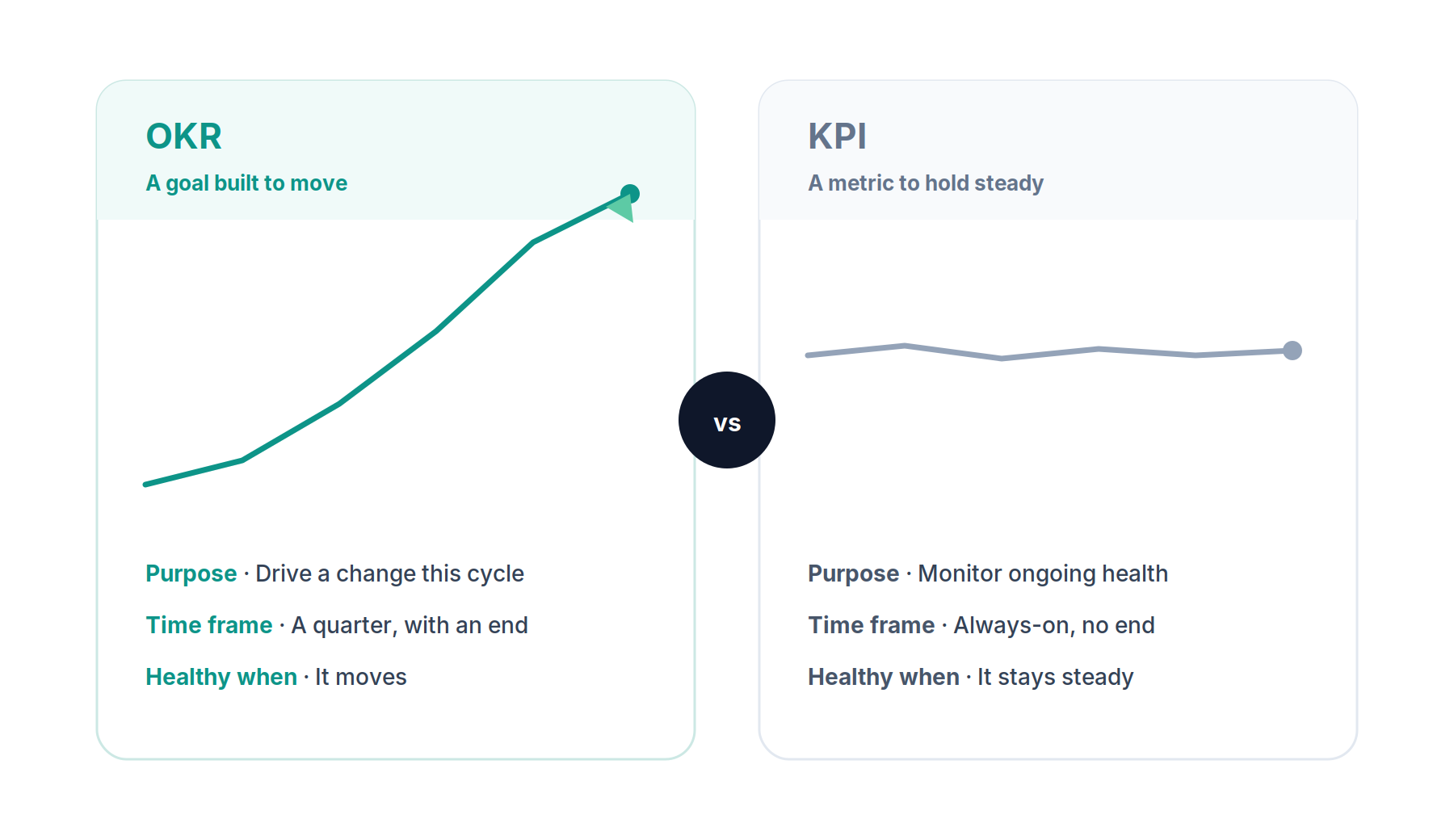
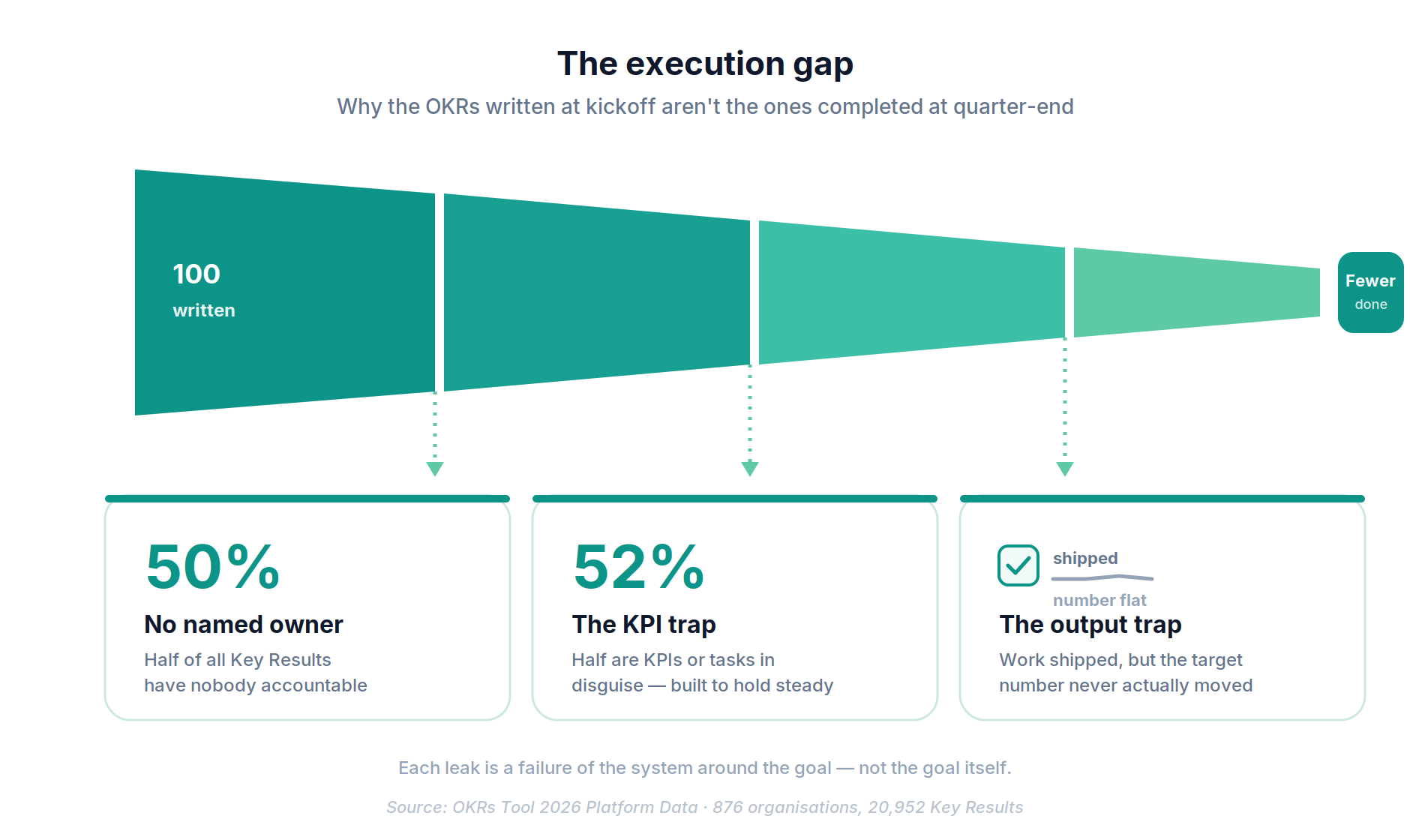
Across 20,952 Key Results, more than half were really KPIs or tasks in disguise — metrics to hold steady, or work to complete, dressed up as goals to move. When half your Key Results aren't built to move, the framework can't do the one thing it's for.
OKRs by level: company, team & individual
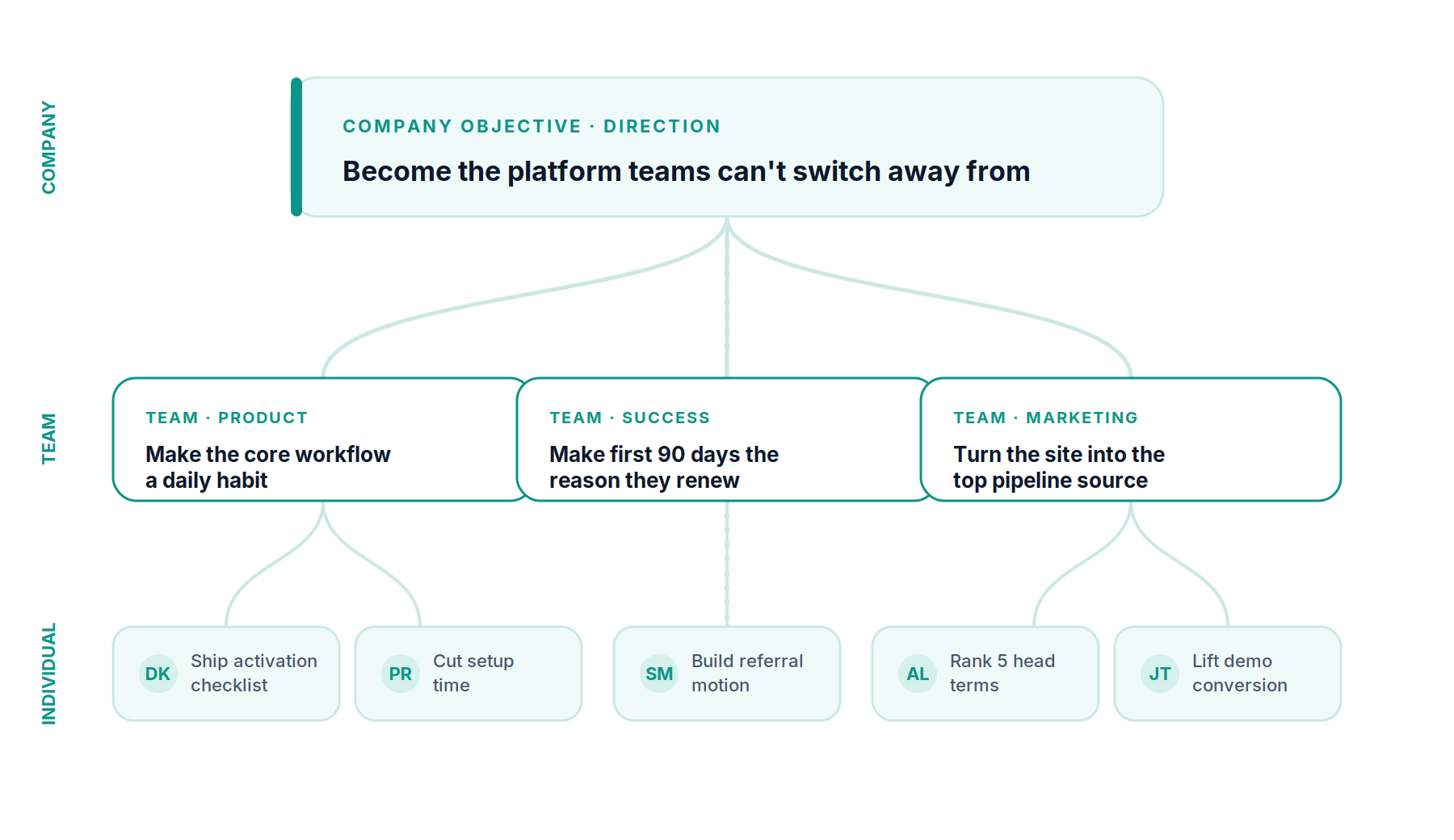
OKRs work as a stack. Company objectives set direction; team OKRs turn that direction into outcomes they own; individual OKRs — where used — connect a person's work to both. Alignment is the thread that runs top to bottom.
A small number of company Objectives set the priorities for the whole cycle. They're broad, ambitious, and owned by leadership. Everything below should ladder up to one of them — if it doesn't, it's a sign the work isn't connected to strategy.
Each team writes OKRs that advance a company Objective in their own area. This is where most of the real work lives. Team OKRs cascade from company goals — not copied down, but chosen so that hitting them moves the level above.
Individual OKRs are the most contested level — useful for connecting a person's work to the team's outcomes, risky when they turn into a performance-review checklist. Use them to create clarity, not to grade people.