When you read one OKR, you learn about a team.
When you read 15,000, you start to see the shape of a year.
OKRs Tool recently analyzed more than 15,000 Key Results across companies, looking not for buzzwords or surface-level trends, but for intent. Instead of counting how often words appeared, we grouped similar objectives and KRs together to understand what companies were actually trying to change.
When you step back from the noise, three priorities show up again and again. Not as slogans - but as patterns in how teams define success.
Together, they paint a clear picture of how companies are thinking about 2026.
Where Company Focus Is Concentrated in 2026
Before looking at the individual goals in detail, it’s worth zooming out.
When we grouped 15,000+ OKRs by intent and clustered them at a company-wide level, a clear concentration emerged. The chart below shows how organizations are allocating their focus across major goal areas in 2026.
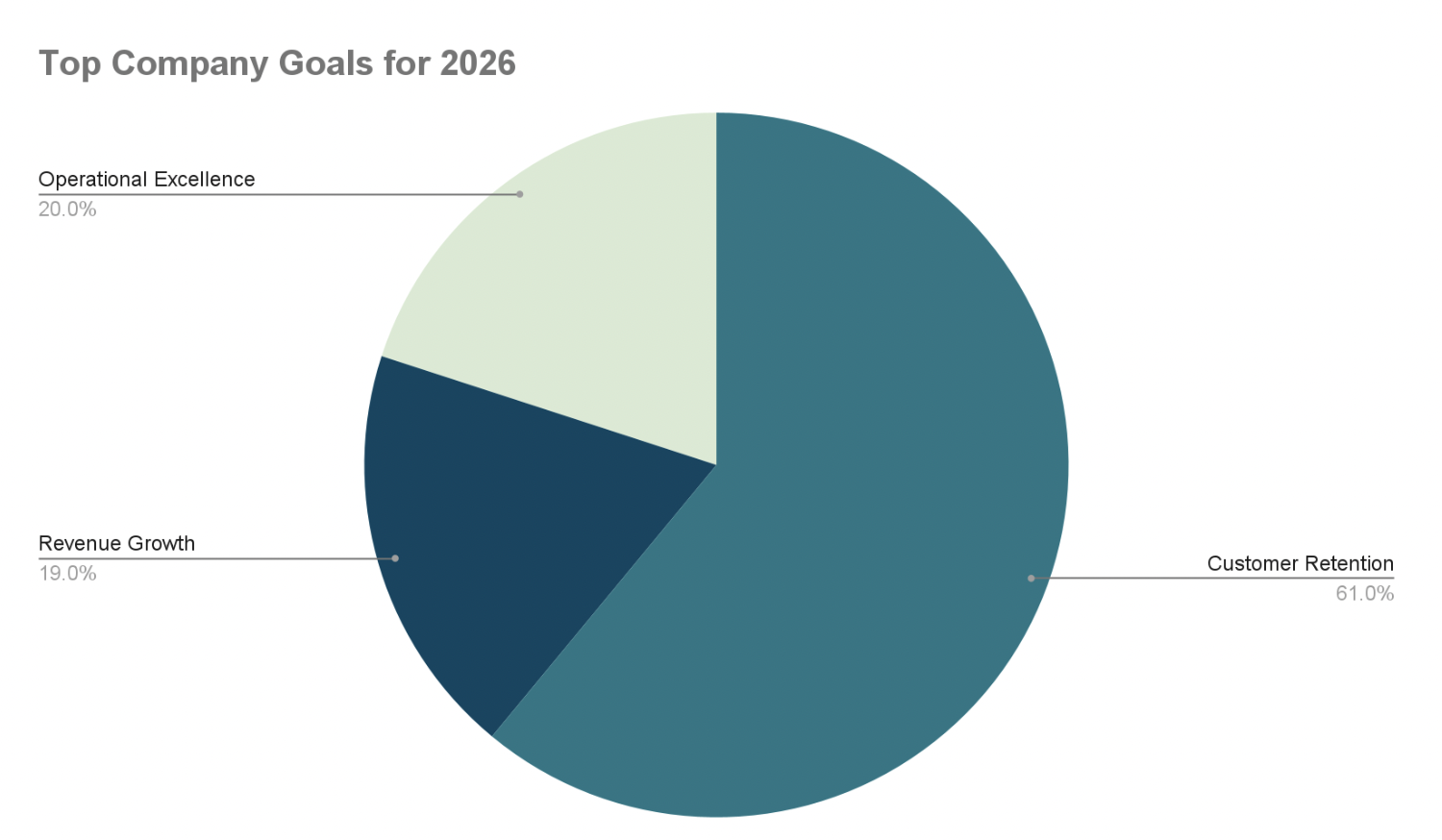
Customer-related goals dominate by a wide margin, accounting for well over half of all company-level priorities. Revenue and operational goals follow closely behind each other, each representing roughly one-fifth of overall focus.
This distribution doesn’t suggest that companies are deprioritizing revenue or operations. Instead, it shows where leadership attention is being anchored - and which outcomes teams believe will most directly influence everything else.
What follows breaks down these three goal areas in more detail, based on how they show up consistently across thousands of OKRs.
1. Customer Growth Is Still the Goal - But Retention Is the Strategy
The most dominant theme in the data is customer-related work.
Across companies, Key Results consistently focus on:
- Increasing active customers and users
- Improving satisfaction metrics like CSAT and NPS
- Reducing churn and improving renewals
- Strengthening onboarding and long-term engagement
This isn’t surprising on the surface - “customers” have always mattered. But what’s notable is how they show up in the data.
Rather than one-time acquisition targets, many KRs are tied to ongoing, monthly signals: active usage, repeat engagement, sustained satisfaction. The language is less about winning customers and more about keeping them.
That shift matters.
In earlier years, growth was often measured by how fast the top of the funnel expanded. In 2026, companies are optimizing for customer quality - relationships that last, compound, and create stability.
The implicit bet is clear:
If customers stay, growth follows.
Here's an example of a customer-led OKR focused on durable growth, not short-term activity.
2. Revenue Is About Reliability, Not Just Scale
Revenue remains a core priority - but the way companies frame it has changed.
Key Results frequently reference:
- Monthly or quarterly revenue targets
- Conversion rates and deal velocity
- Predictable pipelines and repeatable motions
- Clear timelines tied to execution
What stands out isn’t ambition, but discipline. The data is full of words like increase, rate, monthly, and quarterly. Revenue is being broken down into manageable, repeatable units rather than celebrated as occasional big wins.
This reflects a broader recalibration.
After years of volatility, companies are less interested in headline numbers and more interested in consistency. One strong quarter is good. Being able to do it again - and again - is better.
The underlying question many KRs seem to be answering isn’t “How big can we get?”
It’s “Can we make this predictable?”
Here's an example of an OKR designed to improve revenue quality and predictability, not just growth volume.
3. Scaling Safely Is Now a First-Class Goal
The third major theme is internal - and it’s one that often gets less attention.
A significant portion of Key Results focus on:
- Improving internal processes and execution plans
- Closing compliance gaps and reducing risk
- Training teams and enabling consistent performance
- Establishing ownership, cadence, and accountability
The language here is telling. Words like ensure, implement, conduct, plan, and training appear repeatedly. These are not growth hacks. They’re signs of organizations preparing for scale.
Earlier-stage companies can tolerate messiness. Larger, more mature ones can’t.
The 2026 data shows companies investing deliberately in foundations: governance, people systems, and operational rigor. Not because they’re slowing down - but because they want to grow without breaking.
Here is an example of a stabilizing OKR that protects execution capacity as the company scales.
Reading Between the Lines: What Changed From Prior Years
Taken together, these priorities signal a clear shift from the past few years.
Earlier cycles emphasized speed, expansion, and ambition - sometimes at the expense of durability. In contrast, 2026 OKRs show companies optimizing for long-term health.
You can see this shift clearly when you compare mindsets:
- From acquiring more customers → to keeping the right ones
- From chasing revenue → to building reliable revenue engines
- From moving fast → to building organizations that can hold together
This isn’t a retreat from growth. It’s a refinement of it.
A Maturity Shift in Company Priorities
When you compare 2026 OKRs to the dominant patterns from the previous few years, the shift in priorities becomes very clear.
Together, these shifts point to a clear maturity moment: companies aren’t pulling back on growth - they’re learning how to make it last.
The Big Picture
If I had to summarize what 15,000 Key Results say about 2026, it would be this:
- Keep customers happy and loyal
- Grow revenue in a controlled, repeatable way
- Strengthen operations and teams to support scale
Together, these point to a broader maturity moment.
Companies aren’t abandoning ambition. They’re grounding it.
This year looks less like “grow at all costs” and more like “grow in a way that lasts.”
And when you look closely at what teams are committing to - not what they say in decks, but what they write into their OKRs - that shift is already well underway.