OKRs and agile work at different altitudes — the sprint is what you build this fortnight, the key result is what you're trying to change this quarter. The friction is linguistic: sprint culture rewards "ship it," so product teams reach for delivery verbs and write output-based key results. Across 20,952 key results, 52% turned out to be tasks in disguise, and sprint-heavy functions skew higher.
The tension between OKRs and agile is real, but it isn't philosophical. Sprint culture trains one kind of thinking with real discipline: define the work, break it into tickets, ship it in two weeks, repeat. That rhythm is excellent for execution and actively unhelpful for writing key results, because it teaches a team to measure completion when a key result is supposed to measure change.
That single mismatch is what makes OKRs and agile feel like they're fighting, when the real issue is vocabulary rather than any deep incompatibility between OKRs and agile. The benchmark data shows the cost directly: teams that tie goals to outcomes rather than outputs are 30% more likely to hit them. This guide covers why sprint teams systematically reach for the wrong kind of key result, how the two systems actually nest together, and what the high-performing agile teams do differently.
Why Sprint Cadence Trains Output Thinking
Agile is built around delivery. Every fortnight the team commits to a set of work and ships it, and the success metric is completion: did the sprint deliver what was planned? That's the correct metric for running a sprint. It's the wrong one for a quarterly key result.
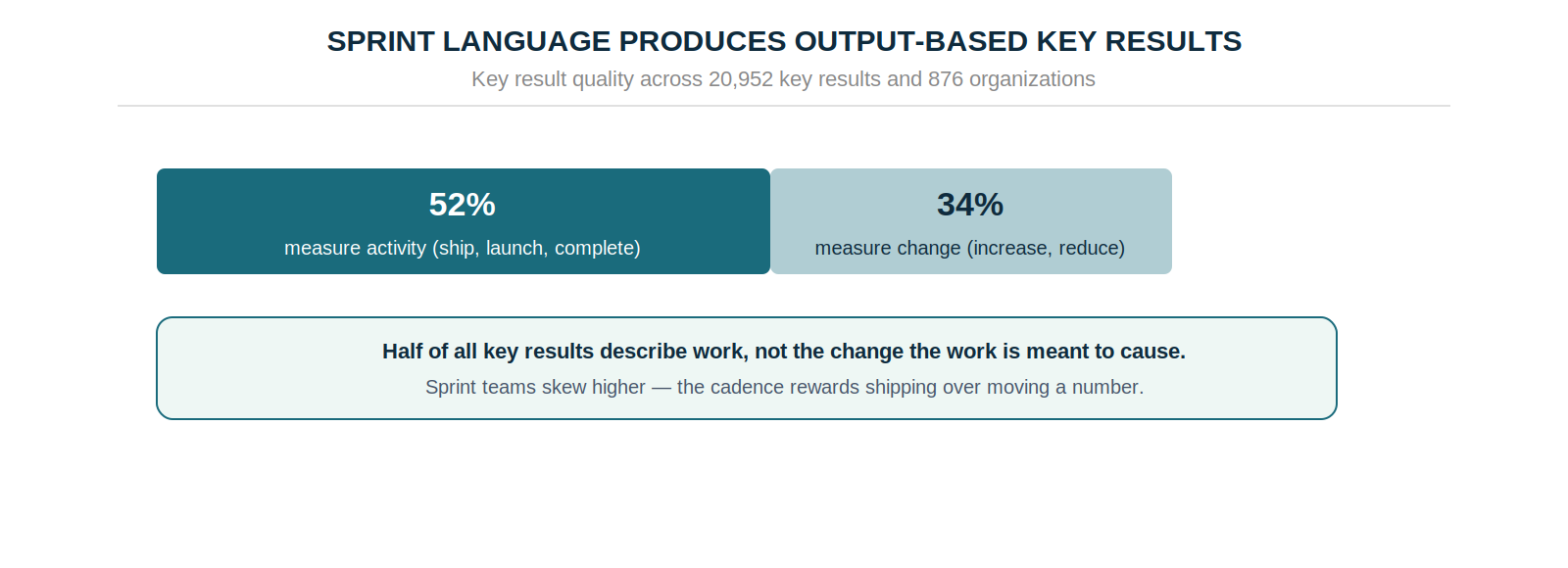
When sprint teams write OKRs, they reach for the vocabulary they use every day — ship, complete, launch, build, test. Those words describe work, not what changes because of the work. Across 20,952 key results in the platform data, 52% were tasks or KPIs in disguise, and product and engineering functions skew higher than average precisely because the sprint framework reinforces the habit of measuring completion.
There's a one-line test: can you track this every week, forever? If yes, it's a KPI or a task, not a key result. "Ship the onboarding redesign" is done the moment it ships. "Increase Day-7 activation from 34% to 52%" is a commitment that persists until the quarter closes. The fix is a single habit change — write the key result to describe the customer or business impact the sprint work is chasing, not the sprint work itself. The sprint is the initiative; the key result is what the initiative is trying to move.
OKRs and Agile Are Nested, Not Competing
The most common objection to running OKRs and agile together is "we already have sprints, why add OKRs on top?" The answer is that they operate at different altitudes and answer different questions. Sprints answer what we're building this fortnight; OKRs answer what we're trying to change this quarter, and whether it's working.
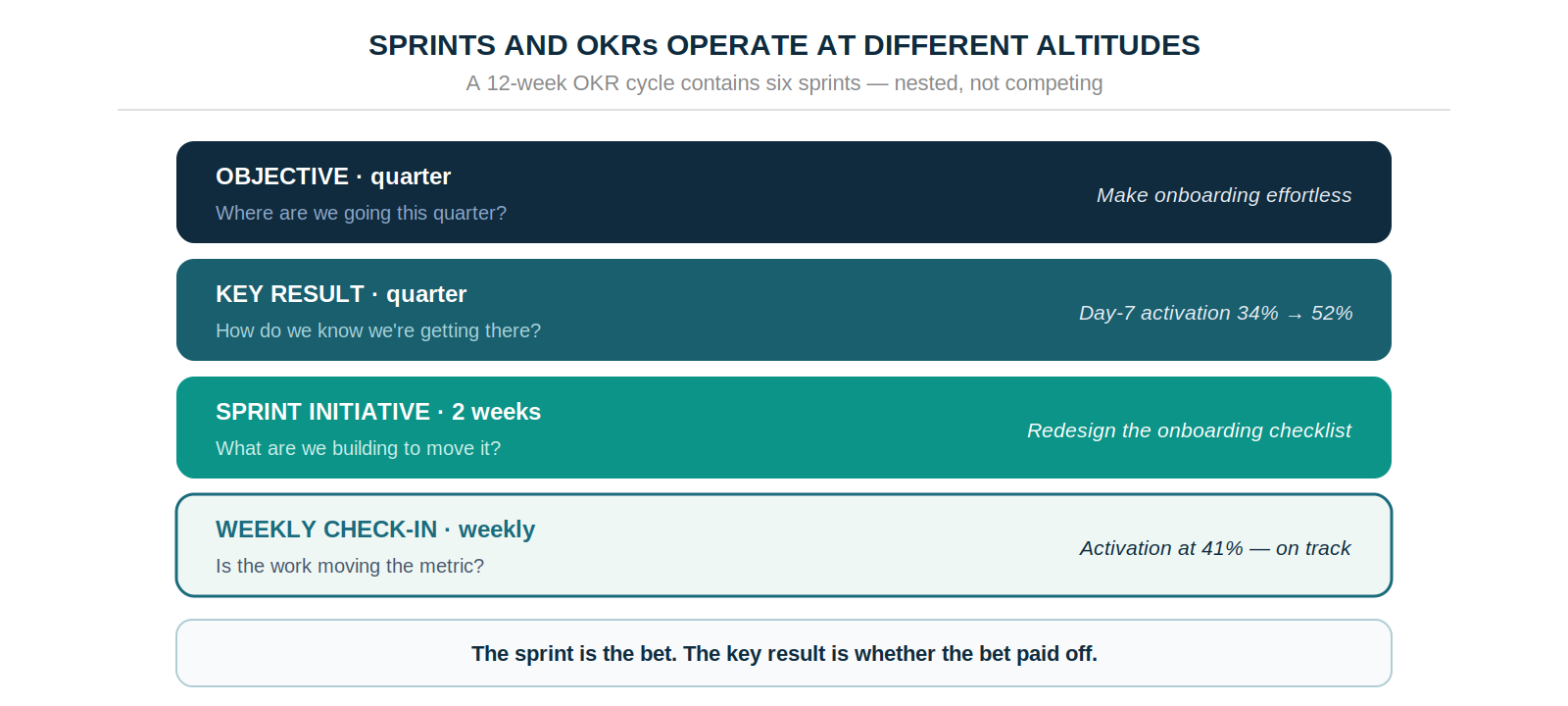
They're not competing systems but nested ones. A twelve-week OKR cycle contains six two-week sprints, and each sprint is an initiative — a bet on what will move the key result. The key result is the outcome metric that tells you whether the sprint work is actually having the intended effect. When sprint planning connects to OKRs, the question shifts from "did we ship what we planned?" to "did what we shipped move the number?" — which is the whole distinction between output accountability and outcome accountability.
How Sprints Move a Key Result
The relationship works when each layer stays in its lane. The key result is the outcome the quarter is trying to move: it has a baseline, a target, and a named owner, and it doesn't change when sprint priorities do. The sprint initiatives are the bets on how to move it — hypotheses, not guarantees, so if sprint one's bet doesn't shift the metric, sprint two tries something else.
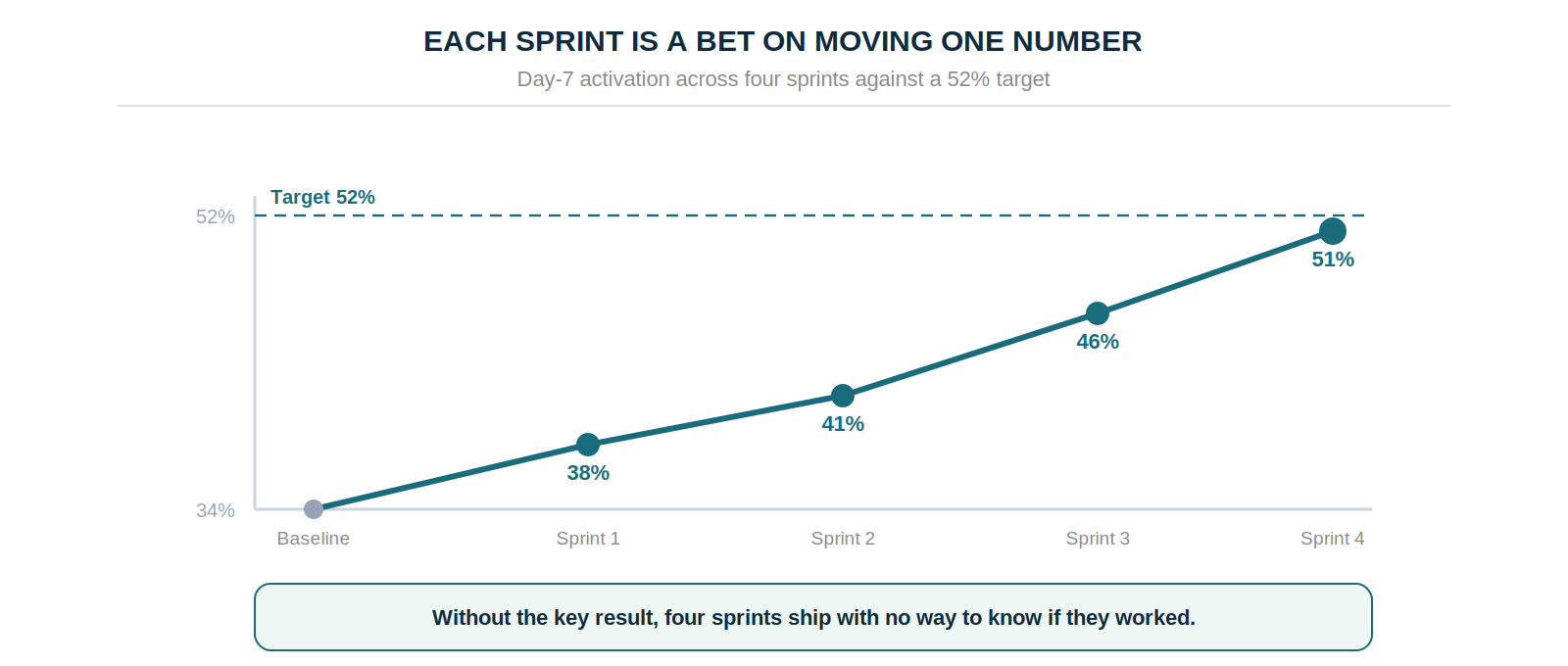
Take a key result of increasing Day-7 activation from 34% to 52%. Sprint one redesigns the onboarding checklist and activation moves to 38%; sprint two adds a walkthrough and it reaches 41%; sprint three personalizes the first session to 46%; sprint four cuts setup friction to 51%. Each sprint is a learning loop, and the key result is the signal telling you whether the loop is working.
The connective tissue is the weekly check-in, which complements the sprint review rather than replacing it — the sprint review asks whether you delivered the planned work, the OKR check-in asks whether the work moved the outcome. Teams with a weekly review habit complete 43% more of their goals, which is why the second question can't be optional.
How to Write Agile-Compatible Key Results
The principle is one sentence: a key result measures the outcome of sprint work, not the sprint work itself. The template that enforces it — change [metric] from [baseline] to [target] by [end of quarter].
If the team ships everything and the metric doesn't move, the key result wasn't hit — and that's the most valuable data point in the quarter, not a failure of ambition. It tells you the initiative was wrong, so next quarter's sprint planning starts with better information.
Where Agile Teams Get the Structure Wrong
Beyond key result quality, two structural mistakes undermine the whole system. The first is setting OKRs at the sprint level: writing a fresh OKR every two weeks defeats the point, because the sprint is already the planning unit at that cadence. OKRs need to run quarterly — long enough to see genuine outcome movement, short enough to stay relevant. Two-week OKRs are just sprints with extra paperwork.
The second is making the roadmap the OKR. A roadmap describes what will be built; an OKR describes what will change as a result. Paste a roadmap into an OKR tool and you haven't adopted OKRs, you've added a reporting layer to your existing plan. The roadmap is the list of sprint initiatives; the OKR is the outcome that list is designed to produce.
What High-Performing Agile Teams Do Differently
The benchmark data marks out four behaviours that separate strong agile OKR programmes from the rest.
They separate the what from the how — the key result defines the outcome, the sprint backlog defines the work, and the two live in different places on different timelines. They run outcome retrospectives, not just sprint ones: the sprint retro asks whether the planned work shipped, the OKR retrospective asks whether it moved the outcome, and the second is what compounds — teams past cycle five complete 79% of their goals against 51% in the first two cycles.
They protect the key result from scope creep: sprint work is allowed to change, the key result stays fixed, because the anchor is the outcome and not the initiative. And they assign one owner per key result rather than letting it default to "the team" — single ownership is worth 26% higher completion than shared or vague accountability.
The OKR–Agile Stack
For teams running both, this is the structure that holds. Each layer serves a different purpose, and removing any one breaks the system: OKRs without sprint initiatives are goals with no execution path, sprint initiatives without OKRs are work with no outcome accountability, and weekly check-ins without both are just status updates.
OKRs and Agile: Fix the Key Result, Keep the Sprints
OKRs and agile were never competing frameworks. They operate at different altitudes and answer different questions, and the conflict most teams feel is linguistic rather than philosophical: sprint culture teaches "ship it" as the unit of success, OKR culture teaches "change it." Getting a sprint team to write outcome-based key results doesn't mean changing how they work — only what they measure at the end of twelve weeks.
The finding underneath all of it: 52% of key results written by real teams are tasks or KPIs in disguise, and in product and engineering the share runs higher, a common reason OKRs fail. Every one of those is a quarter where a team worked hard, shipped consistently, and had no reliable way to know whether any of it moved the business. Fix the key result and keep the sprints — the rest follows from there.
Data: OKRs Tool platform data (876 organizations, 20,952 key results), The 2026 OKR Benchmark Report (200 organizations).