Measure What Matters made OKRs click. Spreadsheets made them feel like 1980.
Ryan had been aware of OKRs for years before deciding to roll them out across Tuff Shed's infrastructure team. The moment it clicked was reading John Doerr's Measure What Matters — the book that documents how Andy Grove pioneered OKRs at Intel in the 1970s and 80s before John brought the framework to Google.
But there was a problem. Most OKR examples Ryan came across involved running the whole framework in spreadsheets. What worked at Intel in the 1980s — because it was the 1980s — felt deeply wrong as the foundation for a modern infrastructure team.
Adoption was the hard part. The tool needed to disappear.
Ryan's team didn't need another platform that demanded weeks of configuration and training before anyone saw value. They needed a system that got out of the way — somewhere objectives, key results, and progress could live without the team having to fight the UI to update them.
The criteria were simple: a real SaaS product (no spreadsheets, no homebrew tooling), no heavy setup, and a structure simple enough that adoption could happen quickly across the team. If the tool needed a champion to chase updates, it would fail. If the tool nudged the team forward on its own, it would stick.
The infrastructure team adopted OKRs Tool rapidly.
Ryan rolled OKRs Tool out across the infrastructure support and security team. Adoption was fast — no extended training, no implementation project. The team was setting objectives, defining key results, and updating progress within the first cycle.
What surprised Ryan was how quickly the framework started doing the work he'd hoped OKRs would do. The team's focus sharpened almost immediately. Conversations shifted from "what should we work on?" to "does this work serve our cycle objectives?" Work that didn't ladder up to a key result got deprioritized — sometimes cut entirely.
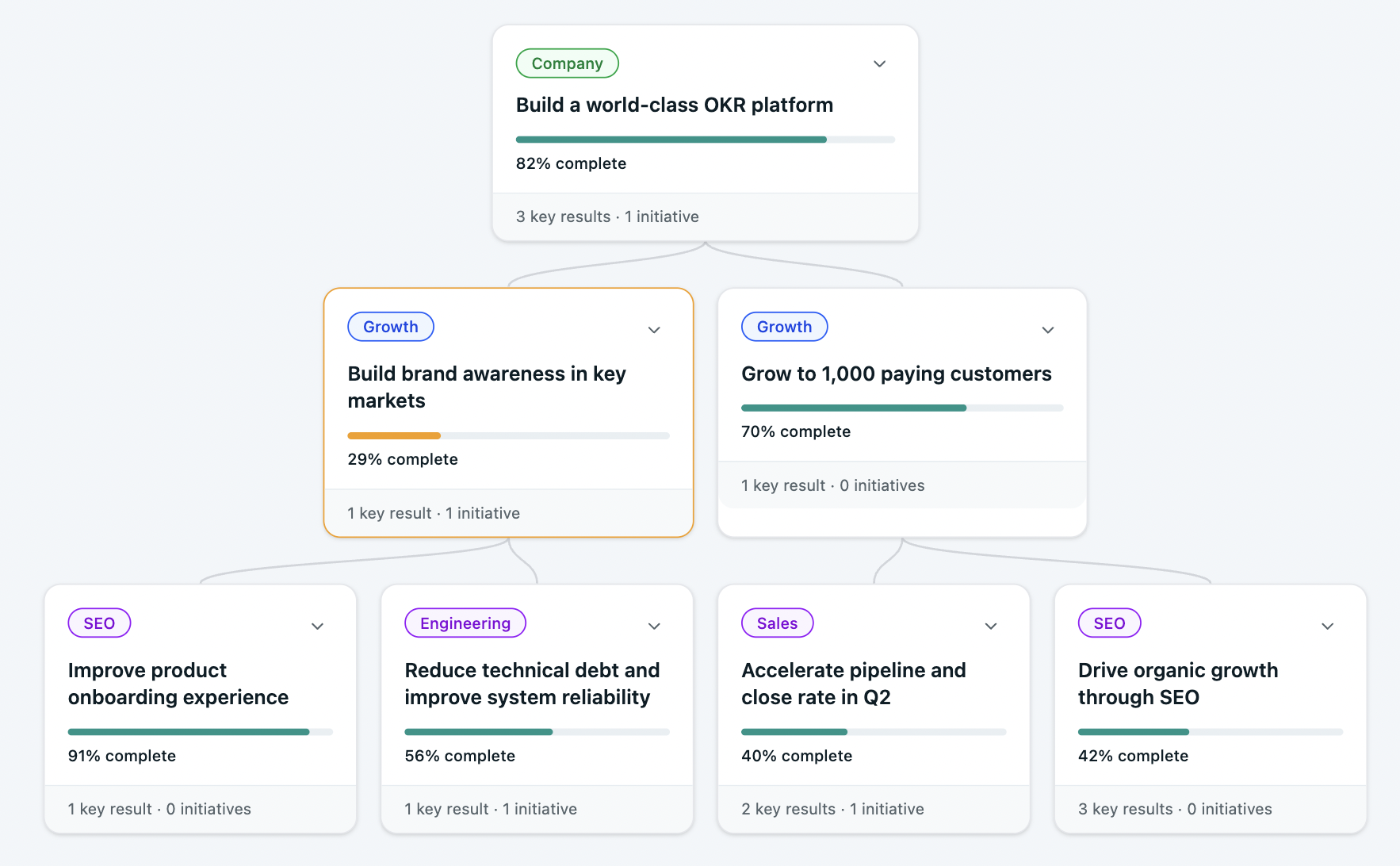
Faster time to value. Measurable progress for leadership.
The Alignment Map became the central tool Ryan's team used to evaluate work. If a task or project didn't ladder up to a cycle objective, it was either deprioritized or removed entirely — accelerating time to value on the work that did matter.
For leadership, the change was just as material. Instead of subjective status updates, leadership now sees real, measurable progress along the path to objective completion. That visibility translates directly into business value for the wider organization.