They were scaling fast. The way they tracked goals wasn't built for it.
Trillium, a global cybersecurity company, was growing steadily — adding people month after month. Mahir, the founder, read Measure What Matters and decided OKRs were how the company should run. He set up the first cycle on spreadsheets across 105 people.
It worked. Sort of.
People updated their OKRs, but only when Mahir followed up individually. Every week. Every person. He'd become the single point of failure for the entire organisation's goals — and every new hire made that worse. The system wasn't just strained; it was getting more strained with every month of growth.
Enterprise software was off the table. Spreadsheets had already shown their ceiling.
Trillium was still scaling, which ruled out the enterprise route — procurement cycles, implementation projects, and per-user fees that get worse precisely as you grow. And spreadsheets had already proven they couldn't hold a 100-person organisation without someone manually driving every update.
Mahir needed something with no learning curve, no implementation project, and no founder bottleneck — simple enough that everyone could use it without training, structured enough to hold the whole organisation's goals, and priced so that adding people didn't punish them for growing.
250 OKRs migrated. Whole org live. Same day.
Mahir found OKRs Tool and reached out. The team imported all 250 OKRs from his spreadsheets and set up the full user list as part of concierge onboarding. Trillium subscribed to the Scale plan on day one.
Nobody needed training. The system was already structured and ready when the team logged in for the first time. Goals, key results, owners, cycles — all already in place. People just started updating.
As they kept growing past 130 users, they moved to Expand for unlimited cycles, the alignment map, and performance reviews. The price didn't climb with every new hire.
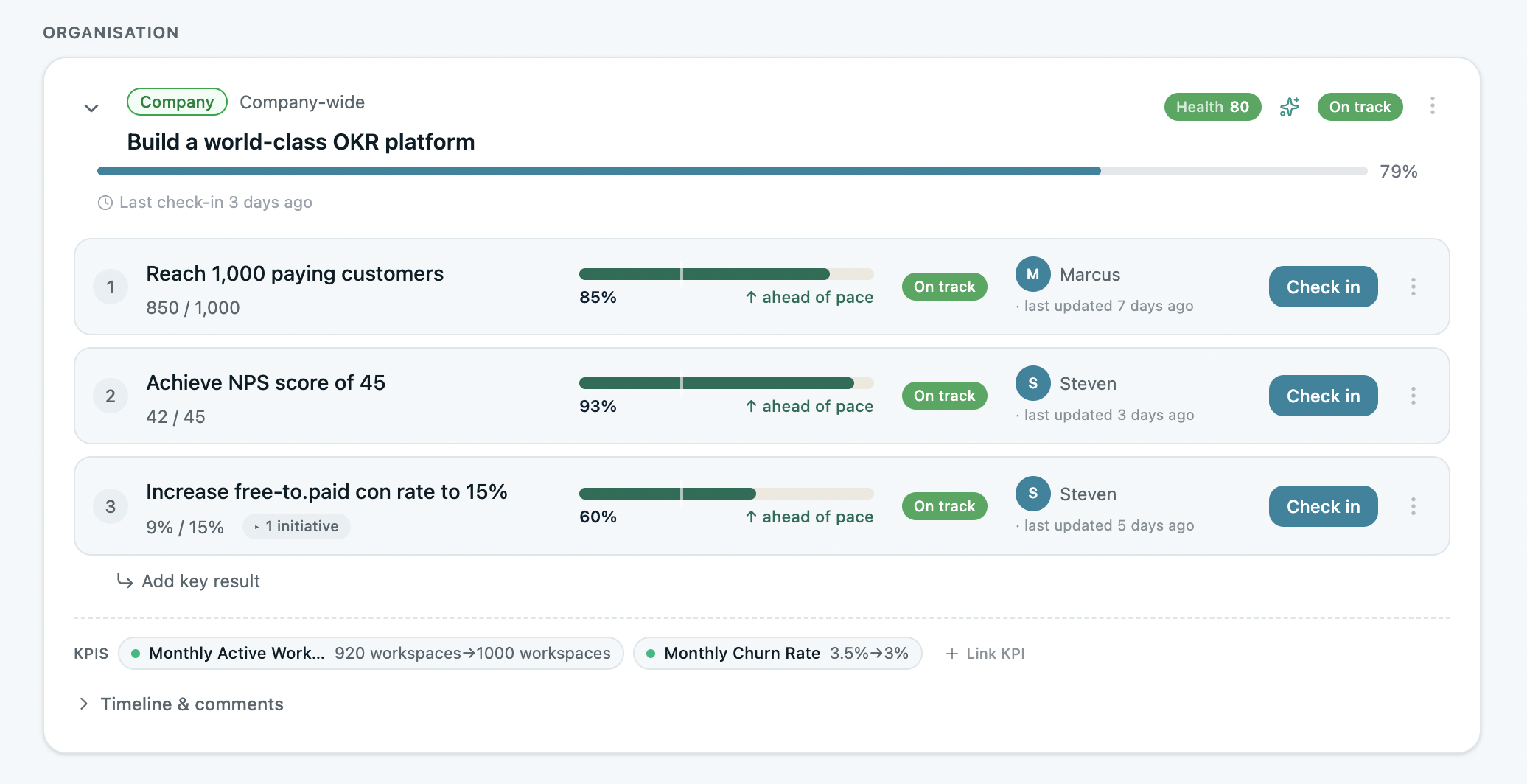
They kept growing. The OKRs kept working.
This is the part that matters. Trillium didn’t stop scaling after they switched — they’ve added people every month since, and they now run 600+ OKRs every quarter, roughly four per person. The system has held the whole way.
More OKRs. More people. More cycles. The founder still isn’t the one chasing.
Mahir is no longer the bottleneck. The tool prompts people, the structure persists across cycles, and OKRs are simply part of how Trillium works now — not something the founder maintains through manual effort. Every new hire joins a system that already runs.