He'd tried the expensive enterprise platforms. He'd built his own template in Confluence. Neither was right.
Rudy, VP Engineering at Sensys Gatso, has been running OKRs for years across multiple companies. He's seen the landscape. Most enterprise OKR platforms were too complicated for his team — and frankly, too expensive.
So he did what experienced operators do when the tools don't fit: he built a workaround. He created a Confluence template for OKRs and ran the process there. It worked. But it was clunky — and visually limited. Goals didn't look like progress. Status was a paragraph, not a glance.
Not every customer can articulate their OKR philosophy. Rudy can.
One reason Rudy's endorsement carries weight: he's not new to OKRs. He's used them for years, refined his approach across companies, and has clear views on what works. When asked why he runs OKRs the way he does, he explains:
I'm a strong believer in target setting — agree on the objective, then let the team figure out how to get there. We agree on the key results so we can measure if we achieved where we wanted to be.
I also strongly believe that 100% is almost always the wrong target — except for pacemakers. As an enthusiast of agile development, producing software is just not as predictable as producing the same car over and over again.
That mental model — set the target, let the team find the path, accept that 100% isn't always the goal — is exactly the mindset OKRs Tool is built around. Rudy didn't have to bend his thinking to fit the tool. The tool already matched it.
Simpler. More visual. And it kept getting better.
Sensys Gatso moved from the Confluence template to OKRs Tool. The transition was straightforward — Rudy didn't need a consultant or an implementation project. The team of 29 was running OKRs in their first session.
What Rudy noticed first was the visual difference. Confluence gave him a structured page; OKRs Tool gave him progress bars, health scores, alignment maps, and at-a-glance status. The same OKRs, but you could actually see them.
What he noticed over time was the pace of improvement. New features kept landing. The tool kept evolving. Not the static enterprise platform he'd tried elsewhere — something that responded to how teams were actually using it.
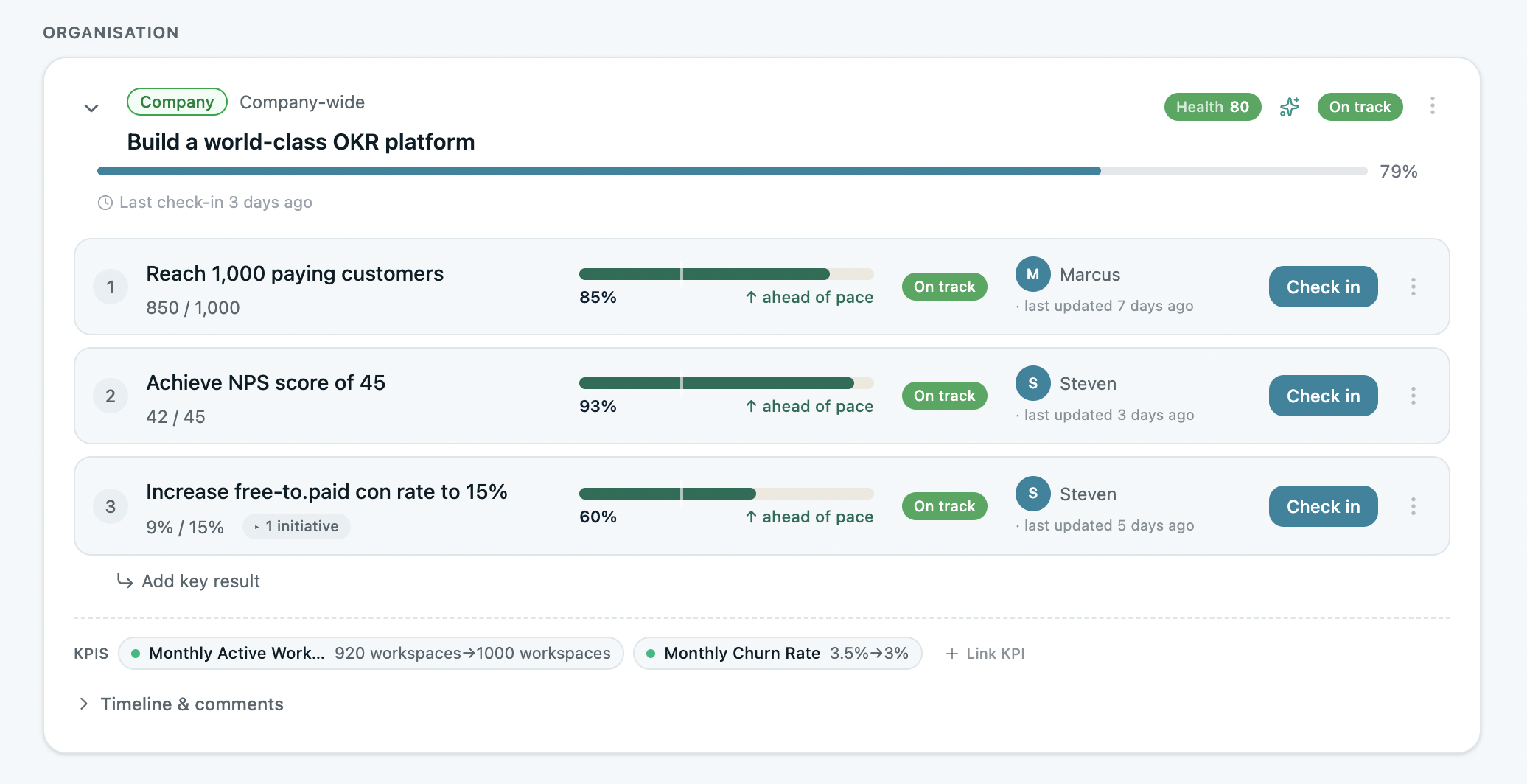
Q1 targets hit. Tool used heavily. No regrets on the annual commitment.
Sensys Gatso replaced their Confluence workaround with a system that matches how Rudy thinks about OKRs — set the target, let the team find the path, measure what matters. The team is using it heavily, the targets are getting hit, and Rudy's no longer maintaining a template that was never quite right.