Trying OKRs for the first time. Without committing to a heavy platform.
Most case studies you read are about teams escaping spreadsheets or migrating from another OKR tool. Josiah's was different. He hadn't run OKRs before — and he wanted to test the framework before committing to it.
That created a chicken-and-egg problem. To know whether OKRs would work for his team at Chick-fil-A Rivergate Cordova, he needed a tool. But every enterprise OKR platform he looked at assumed you'd already decided OKRs were right for you — they were sold for full rollout, not for experimentation.
Pick the tool that lets you try the framework. Worry about scale later.
Josiah's criteria were the opposite of what enterprise OKR platforms optimize for. He didn't need SSO. He didn't need a six-figure contract. He didn't need an implementation consultant. He needed a tool that wouldn't punish him for being new to OKRs.
OKRs Tool fit because it removed every barrier between "I want to test this" and "we're actually using it." No procurement. No training session. No multi-month rollout. The free plan let his team get started, and the framework either worked or it didn't — without OKRs Tool standing in the way of finding out.
The framework stuck. So did the tool.
Josiah's team adopted OKRs Tool and the framework together. Within the first cycle, they'd settled into a monthly review cadence — the team reviews progress together, the platform keeps everything visible between meetings.
The big difference from his team's previous goal-setting attempts wasn't ambition or planning. It was staying on track between conversations. Goals that used to drift between quarterly check-ins now had weekly visibility — and a monthly forum where the team could course-correct.
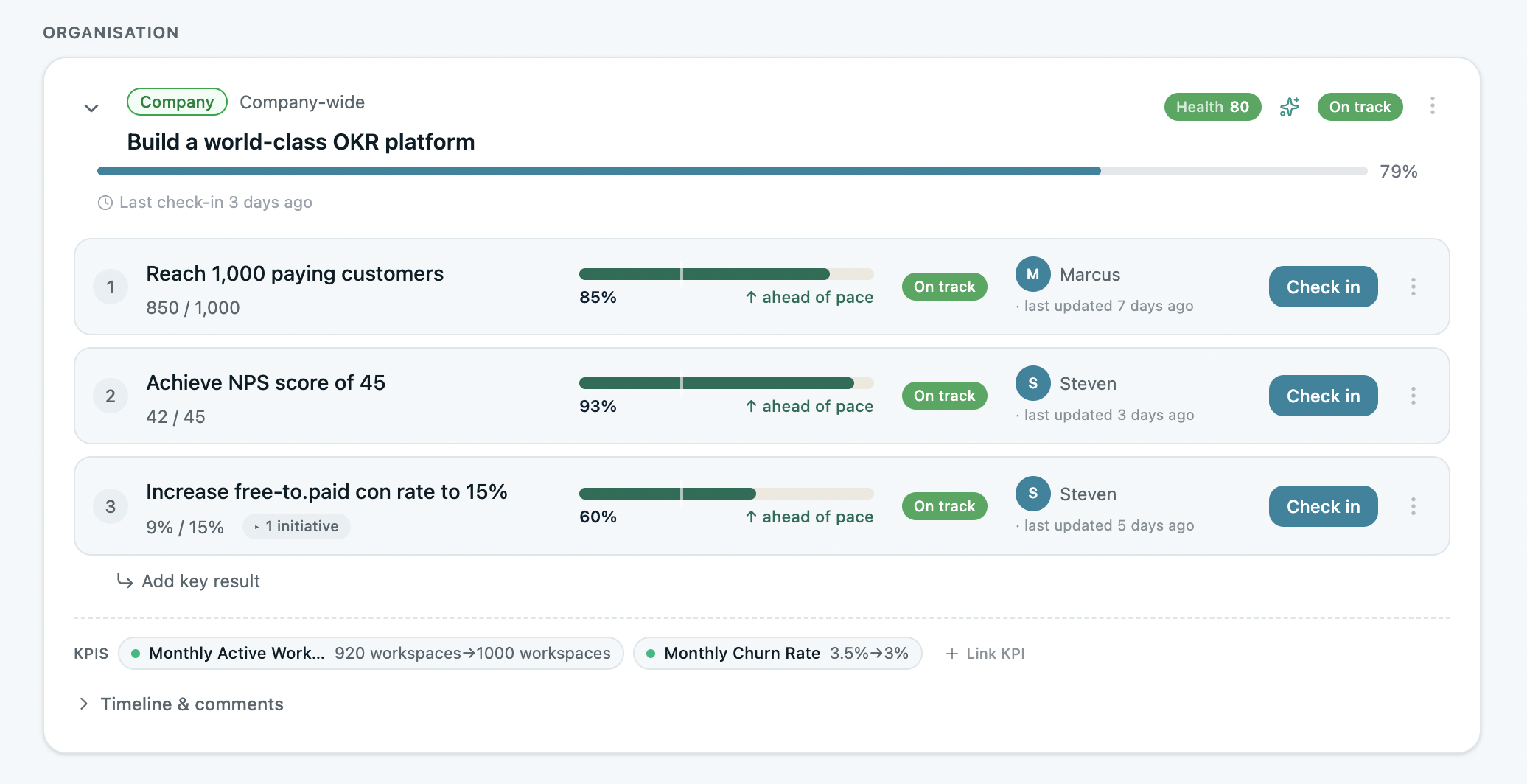
Staying on track. That's the headline.
When asked what's changed since adopting OKRs Tool, Josiah's team highlighted the same thing: it helps them stay on track. Goals don't disappear into the gap between monthly meetings. Progress is visible without anyone having to chase it.
For a team trying OKRs for the first time, that's the outcome that matters most. The framework only works if it survives past the first cycle — and the tool only works if it removes friction instead of adding it. Both have stuck.