Close every cycle with a retro.
Close every cycle with a retro. The reflection is where next quarter's targets get set against what actually happened — not against a guess made before the last cycle taught you anything.
Skip it and you don't just lose this quarter's lessons — you start the next one blind, likely to repeat the same misses. Reflection is what turns a single good quarter into a system that gets sharper each time.
Skipping the retro costs you the next cycle, not just this one
A quarter you don't review is a quarter whose lessons evaporate. The targets that were wildly off, the goals that stalled at week two, the bets that didn't pay — all of it is signal for how to plan better next time. Without the retro, next quarter's targets get set the same way the last ones were, so the same misses repeat. The retro is cheap; repeating a bad quarter isn't.
The habits compound — and so does dropping one
None of these seven habits is magic alone. Stacked together, they multiply. Run none of them and about 1 in 10 teams hit their goals consistently. Run all of them — outcomes, owners, alignment, scoring, weekly check-ins, the mid-cycle rescue, and the retro — and it's 8 in 10. That's roughly an 8× swing, and it works in reverse too: drop any one habit and you give up around half the result.
Run every core habit and roughly 8 in 10 teams hit their goals — against about 1 in 10 running none. Each cycle you close sharpens the next. OKR Platform Data →
Close the cycle, carry the lessons forward
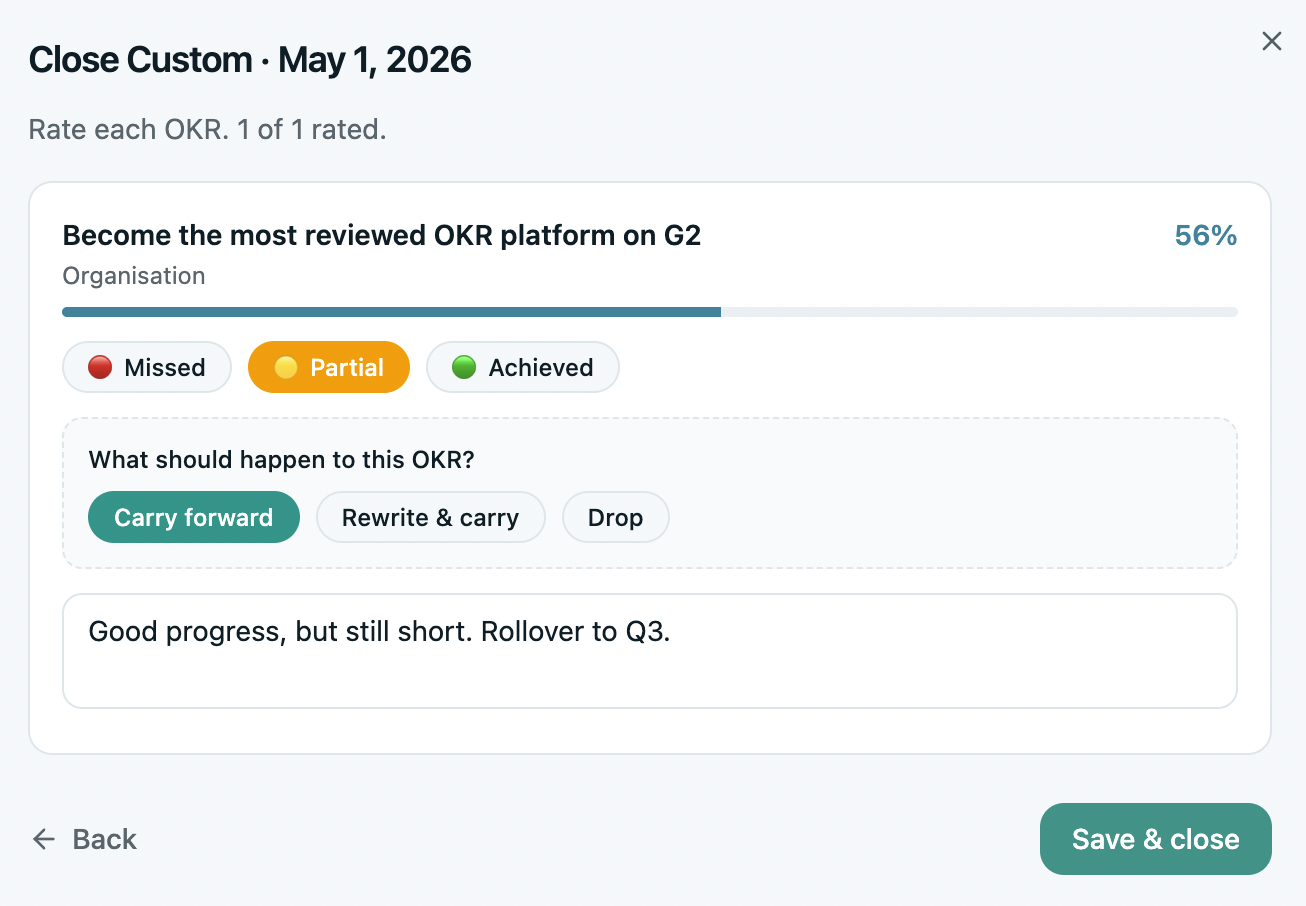
OKRs Tool scores the finished cycle, prompts the retro, and rolls what you learned into the next one — so each quarter starts from the last, not from scratch.
Score the cycle as you close it
You close the cycle and set the final score on every objective and key result — what landed, what missed, and by how much. A deliberate call on each one, so the retro starts from facts, not memory.
Roll goals into the next cycle
Carry forward what's still live, close out what's done, and reset the rest. Last quarter's results sit right there as you set new targets — so they're grounded in what actually happened.
Each cycle sharpens the next
History stays attached, so patterns show up across quarters: which teams over-commit, which targets were always soft. The program compounds instead of resetting.