A flat key result is a deadline, not a status.
A key result still at zero at its first check-in isn't just "not started yet." It's an early warning — and the first check-in is where you read it, not a formality to skip past.
The good news: the window to act stays open longer than teams expect. A flat goal that starts moving before the mid-cycle review usually recovers. Past that point, the odds roughly halve. This is the moment that saves a quarter, and almost no team plans for it.
The first check-in already tells you which goals are at risk
A key result already moving at its first check-in reaches its target far more often than one still at zero — not because early movers are easier, but because motion means someone has started and found the real obstacles. A flat goal is one where the work hasn't begun, and every week it stays flat, the target gets harder to reach in the time left.
So the first check-in isn't a status update — it's the earliest read on which goals need attention. The ones sitting at zero are the list to act on, while there's still most of a quarter to do it.
The mid-cycle review is the last exit
A flat goal still being worked on can recover — but the odds depend on when it starts moving. Begin before the mid-cycle review and recovery is the norm. Let that review pass with the goal still at zero and the chance roughly halves. The review exists for exactly this: a scheduled moment to find the stalled goals and decide to rescue, re-scope, or drop them before it's too late to matter.
First-party behavioral data across thousands of Key Results. OKR Platform Data →
OKRs Tool surfaces the flat ones early
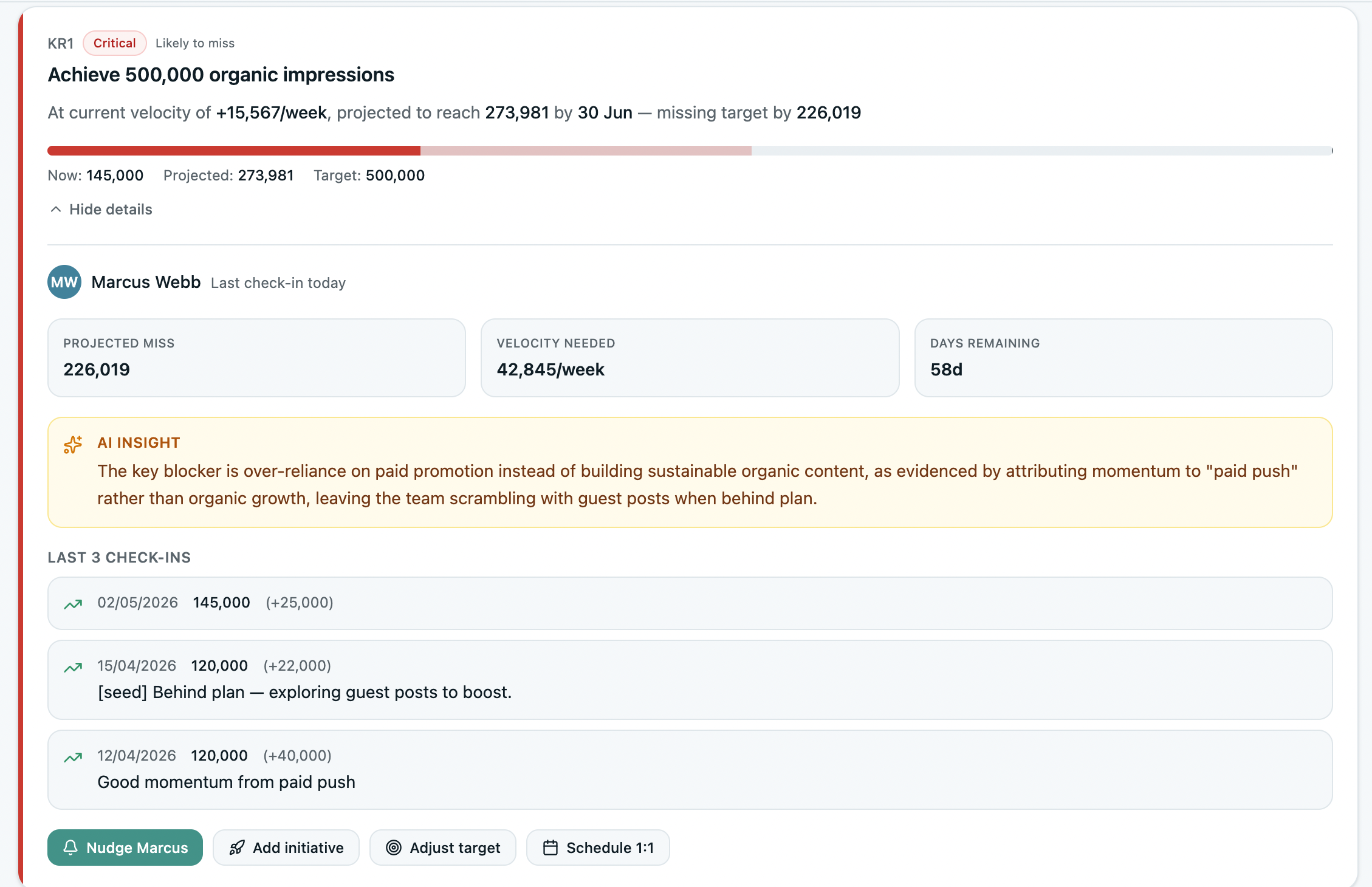
You don't have to scan every goal to find the stalls. OKRs Tool flags the key results sitting flat or losing confidence — so you catch them while the mid-cycle window is still open.
At-risk goals rise to the top
One filtered view shows the key results that are flat, slipping, or low-confidence — the ones that need attention. No digging through every team to find the trouble.
Flagged from the first check-in
A key result still at zero shows up as at-risk right away — not at cycle end. You get the early warning the data says matters, with the quarter still in front of you.
Act before the mid-cycle review
Rescue it, re-scope it, or nudge the owner — straight from the view. The mid-cycle review becomes a decision point, not the moment you discover what's stalled.