Score every key result.
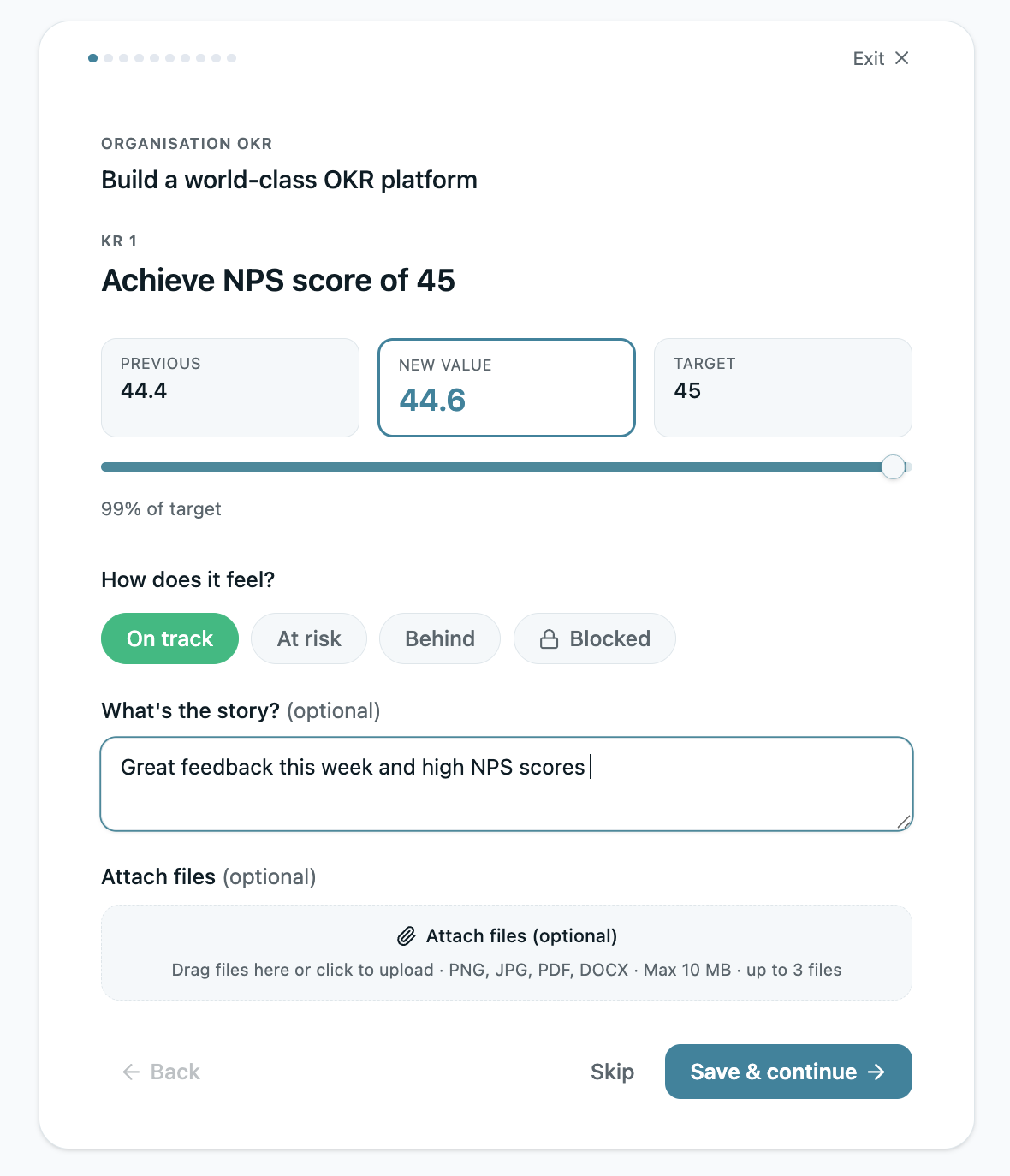
At every check-in, the owner puts a confidence score on each key result, on one shared scale. Not the progress bar — a read on whether this still lands by cycle end.
Skip it and nothing visibly breaks: the key result stays on the board, the dashboard still shows a percentage. That's exactly the problem — the goal underneath goes red while every surface stays green.
A progress bar isn't a read from the owner
Progress is backward-looking: it tells you how far the number has moved, not whether it'll arrive. A key result can sit at 60% and be dead in the water — the easy 60 came first, the hard 40 isn't coming. A confidence score is the owner saying, out loud, "I still think this lands" or "I don't." The dashboard can't tell you that; only the person doing the work can.
That's why the score and the percentage have to live side by side. Progress at 60% with low confidence is a goal to act on now. Progress at 40% with high confidence is fine — the owner knows the back half is loaded. The two numbers together are the signal; either one alone misleads.
Unscored key results are usually the ones in trouble
When an owner skips scoring, it's rarely because the goal is sailing. It's because the honest score is bad and nobody wants to type it. Scoring every KR — not just the ones in motion — is what drags those into the open, while there's still a cycle left to act. Agree one scale before the quarter starts, so a "3" means the same thing on every team.
A confidence score on every check-in
When an owner checks in, OKRs Tool asks for the number and the confidence read — on one shared scale, next to the progress that's been made.
Score is part of the check-in
Updating a key result isn't just entering the new number. The owner sets a confidence score in the same step — so every KR gets read, not just the ones obviously moving.
One shared scale across every team
Confidence uses the same scale everywhere, so a score means the same thing on every team. No reinterpreting what one group's "on track" is worth against another's.
Progress and confidence, side by side
Each key result shows how far it's moved and how confident the owner is. A goal at 60% with low confidence surfaces as at-risk — before the quarter runs out.