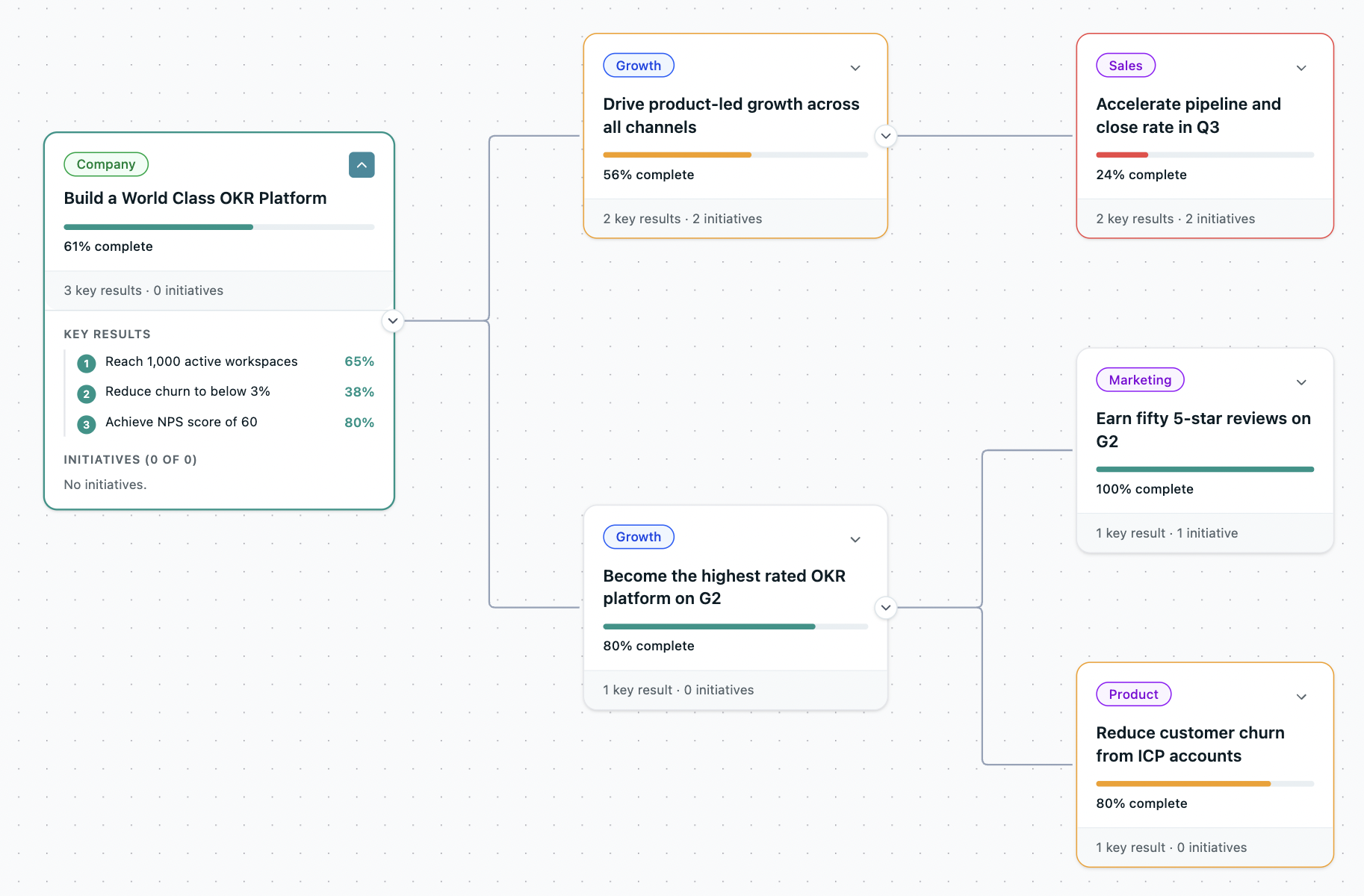
Ladder goals up to the company's.
Every team objective should name the company objective it serves. A goal that can't name its parent has no reason to survive a trade-off — and it's the first one quietly dropped when priorities shift.
Alignment isn't a diagram you draw once in planning. It's the link that gives every team goal a reason to exist, and gives leadership a view of the whole company without asking anyone to build it.
Unlinked goals are the first to get dropped
When priorities get traded off mid-quarter — and they always do — the goals that survive are the ones that can defend themselves. A team objective linked to a company priority has an answer to "why are we still doing this?" An unlinked one doesn't, so it's the first to quietly disappear when attention moves elsewhere.
That's also why a goal measuring activity can't ladder: if it doesn't name the change it drives, there's nothing to connect it to a parent. Laddering forces the question early — what company outcome does this move? — and a goal that can't answer gets fixed or cut before the cycle starts.
Leadership gets the view without asking for it
When every goal links upward, the alignment picture builds itself. Leadership can see how each team's work ladders to the company's priorities — top-down or bottom-up — without anyone compiling a slide. That visibility is what keeps a program alive past the first cycle, instead of fading into a set of disconnected team lists.
See every goal ladder up on the Alignment Map
One live view of how company, team and individual goals connect. Link goals as you create them, straight on the map, or any time after the cycle starts.
Link a goal to its parent as you create it
When you write an objective, pick the company or team goal it serves. Alignment is set at creation — so a goal starts its life already connected, not floating on its own.
Or draw the links on the map itself
The Alignment Map shows the whole tree. Connect goals right there, or spot the ones with no parent at a glance — the orphaned goals that would otherwise be first to drop.
Leadership reads it without asking
The map is the alignment view — top-down or bottom-up — always current. Leadership sees how every team's work ladders to company priorities without anyone building a slide.