Write OKRs, not KPIs.
"Grow MRR to $2M" reads like an objective — but it's a target you track, not an outcome you're working toward. Name the outcome first, and let the number sit underneath it as a key result.
Get the order wrong and everything built on top inherits the mistake: the goals become a list of metrics, and the quarter becomes a dashboard no one feels responsible for. This is the distinction the rest of the course depends on.
The difference, in one sentence
An objective is the change you're working toward — qualitative, directional, the reason the number matters. A KPI is a number you already track — a health reading, not a goal. "Grow MRR to $2M" is a KPI standing in for a goal; the objective is what that growth is supposed to prove, like becoming the default choice for mid-market buyers.
Your existing KPIs don't get thrown away. They become the key results that sit underneath the objective and prove it's happening — MRR, activation, NPS, each moved from a baseline to a target. "Increase X to Y" belongs there, under the outcome, never as the goal on its own.
The same intent, written both ways
Watch one line flip from activity to result. The work is the same; only the definition of "done" changes.
Let OKR Analysis catch the outputs for you
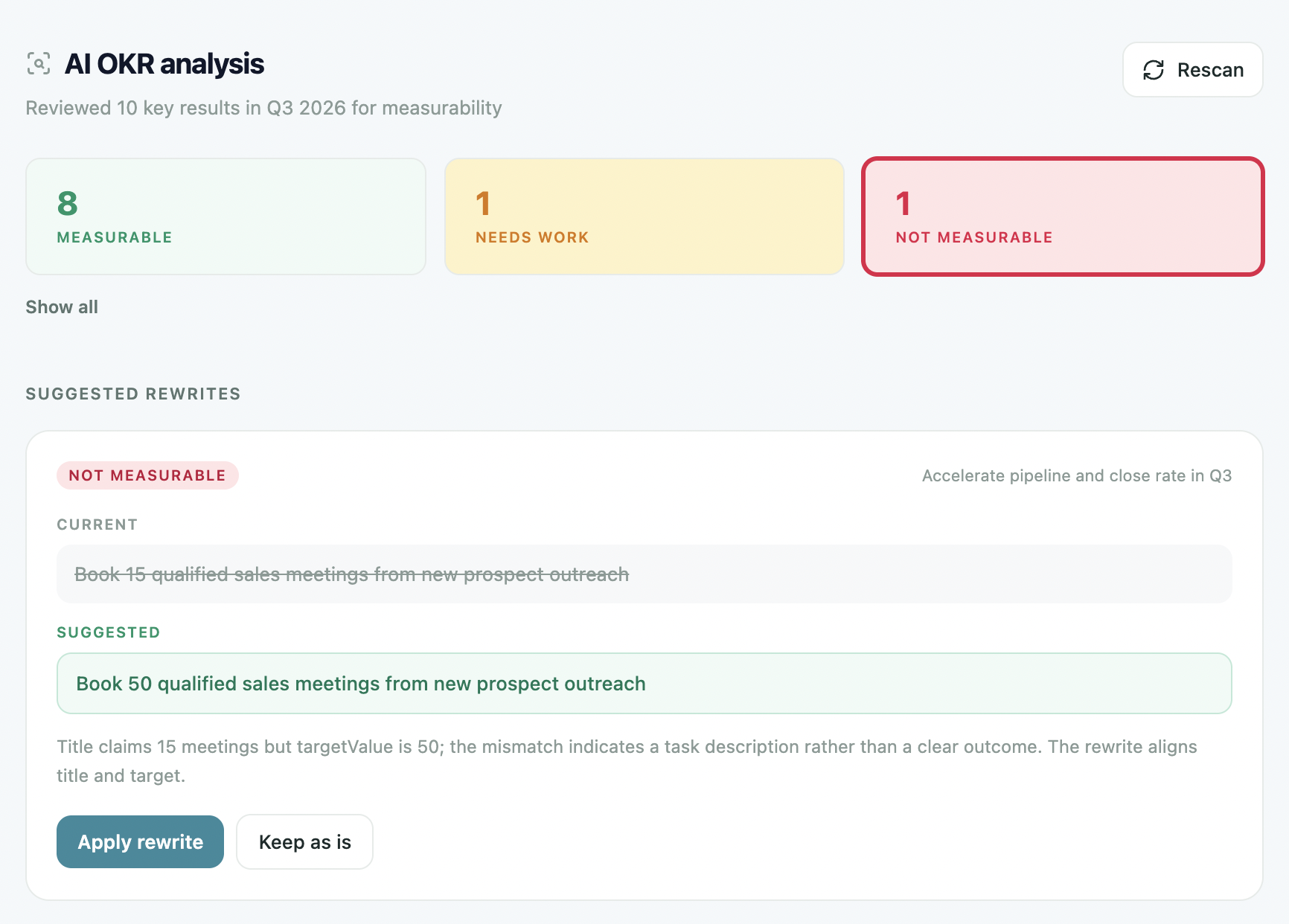
You don't have to eyeball every goal. OKRs Tool scans your Key Results, flags the ones measuring activity, and suggests an outcome rewrite you can apply in one click.
Scan every Key Result for measurability
OKR Analysis reviews all your KRs and sorts them into Measurable, Needs work, and Not measurable — so you see at a glance how many goals measure motion instead of change.
Get an outcome rewrite for each one
For every flagged KR it shows the current line, a suggested rewrite in baseline-to-target shape, and why the original was an output — "shipping a count of improvements is activity, not outcome."
Apply the fix in one click
Hit Apply rewrite and the outcome replaces the output, or keep your own. The quarter starts with goals that can actually move a number.